
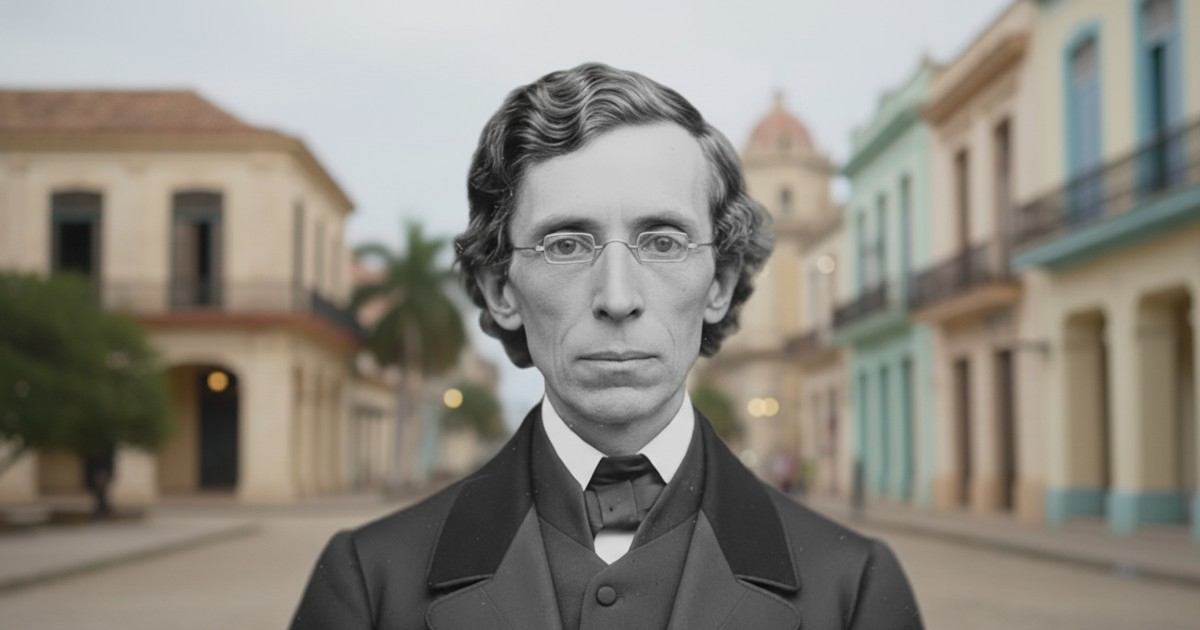
No one can doubt it: Cuban philosophical and emancipatory thought has a consistent thread that runs through our history to this day, and in Félix Varela y Morales—priest, educator, journalist, physicist, chemist, violinist, and genuine patriot—lies its clearest origin.
A Varela, "the one who first taught us to think," was defined this way by one of his great biographers: Doctor in Historical Sciences Eduardo Torres-Cuevas, National Prize for Social Sciences and current director of the National Library. The Havana priest died on February 25, 1853, in San Agustín, Florida. Just 28 days later, José Martí was born.
Confluences that define a nation
Torres-Cuevas insists on that coincidence that few notice, but which resonates in the history of Cuba:
"The initiator of Cuban liberation thought, Varela, has died, and the one who will carry that independence to its fullest expression in the 19th century, Martí, is being born."
And it also highlights a very human thought from Padre Varela himself, as he observed the society around him, marked by scholasticism, indolence, slavery, and colonialism:
"As is my custom, I will express myself frankly: in the field that I cleared, a lot of brush has been allowed to grow; and since I don't have a machete nor the habit of using one, I would like those who have both to take up the work again."
Unbeknownst to them, a month earlier, the man who would wield that symbolic machete was born: Martí, the one of ideas, who would turn that spiritual gesture into a weapon of liberation.
Why "the one who first taught us to think"?
The phrase is from José de la Luz y Caballero, written in 1838, amidst a heated philosophical debate. The youth of Havana were captivated by eclectic European currents that questioned the possibility of Cuba creating its own culture and society.
Luz then defended the essence of the Varelian legacy:
to think first, to act later; to walk on one's own feet; to think with one's own mind.
Varela was not an improviser: he created a method to think about Cuba and America, and taught that thought must have roots, preparation, and ethics.
A teacher who trained teachers
All the great Cuban thinkers of the 19th century were schoolteachers, and they were almost always trained by another Cuban before them:
Varela taught Luz; Luz taught Mendive; Mendive taught Martí.
Varela, with his Letters to Elpidio and his Social and Moral Instructions, understood that childhood is where the habits, customs, and moral compass of a country are cultivated. Martí continues that tradition with The Golden Age. Luz had already stated it:
“Give us the teaching, and Cuba will be ours”;
“Either we win the child, or we lose Cuba.”
The idea is the same: there can be no possible homeland without first shaping the patriot.
The "political masks": Varela also spoke about opportunism
In his newspaper El Habanero, Varela published a series of texts that dismantle a phenomenon that, if one looks closely, still exists among us: patriotism.
There he distinguishes between true patriots —those who dedicate their lives to a cause— and the "merchants of patriotism," political opportunists who use national fervor as a means for profit or disguise.
Varela made it clear:
the Homeland owes nothing to anyone; it is us who owe everything to her.
The human Varela
In his exile in New York, it is said that he gave away his own clothes to those in need and fed them. He devoted everything he could to build a church for his followers. He was an extraordinary musician; many envision him playing the violin as a form of meditation.
There are figures that allow a nation to see itself in its best version.
For Cuba, one of them is Félix Varela: the Founding Father, the one who taught to think before teaching to fight.
Filed under: