
Related videos:
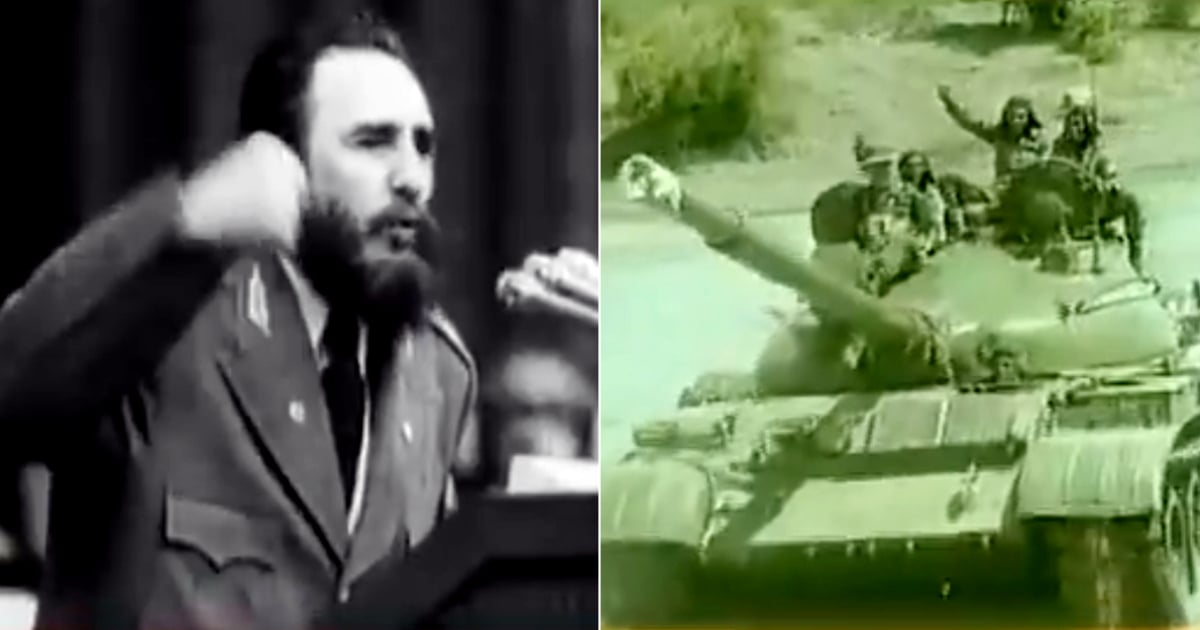
The Ministry of the Revolutionary Armed Forces of Cuba (MINFAR) published a message on the social media platform X (formerly Twitter) on November 5th to commemorate the 50th anniversary of Operation Carlota, the Cuban military intervention in Angola.
“November 5 marks the 50th anniversary of Operation Carlota. We secured Angola's independence, aided Namibia's, defeated Apartheid and brought only our dead home,” wrote the military institution.
The final phrase —“we only brought our dead”— sparked a wave of indignation among Cubans both on and off the island. An internet user responded with harshness and truth:
"They were not 'your' dead. They were the children of Cuban families, thousands of whom mourned them in silence, never receiving any compensation, and today they live in extreme poverty. And yes, they brought more things: natural wealth and influence that consolidated the power of the dictatorship."
The expression from MINFAR, far from paying homage, resonates as an act of appropriating pain.
To say "our dead" —as if they belonged to the state and not to their families— encapsulates how the Cuban regime has manipulated for half a century the sacrifice of thousands of young people sent to foreign wars under the banner of so-called "proletarian internationalism."
A distant war, thousands of Cuban lives
The Carlota Operation, launched in November 1975, was the code name for the Cuban military intervention in the civil war in Angola, where Fidel Castro's regime supported the People's Movement for the Liberation of Angola (MPLA), backed by the Soviet Union.
The official pretext was "internationalist solidarity" and the "moral duty" to assist an African country in its independence. But the reality was different: a prolonged, ideological, and costly war, part of the Soviet strategy in Africa during the Cold War.
According to Cuban sources and historical documents:
- More than 300,000 Cubans participated in military or civilian missions in Africa, especially in Angola, Ethiopia, and Mozambique.
- Between 2,000 and 10,000 Cubans died, according to various estimates; the regime officially recognizes only 2,085 military deaths and 204 civilian deaths.
- In 1989, the so-called Operation Tribute repatriated the remains of some of them, but thousands of families never received information or compensation.
- Tens of thousands of injured, mutilated, and veterans returned to Cuba without recognition or real assistance.
Those "dead" referred to by MINFAR were not theirs: they were children, siblings, and parents of humble families. Many of them were recruited without full awareness of the conflict, trained in an ideological discourse that turned them into pieces on a geopolitical chessboard.
The myth of altruism and the returns of power
For decades, the Castro regime presented its interventions in Africa as the supreme example of "internationalist solidarity."
But the facts, the documents, and the consequences reveal that it was not just altruism, but a carefully designed political, economic, and propaganda operation.
1. Geopolitical instrument of the Soviet bloc
Cuba acted as the military arm of the USSR in Africa, providing logistical support, weaponry, and aerial and maritime transportation from the Soviets.
In return, Moscow financially compensated the Havana regime through subsidized oil, soft loans, and annual aid that, between 1986 and 1990, amounted to more than 4.3 billion dollars a year, equivalent to 20% of Cuba's GDP at the time.
In other words, Cuba provided the dead; the USSR provided the money and weapons.
2. Political and Diplomatic Gain
The military involvement in Africa granted Havana a significant role within the Non-Aligned Movement and the UN, securing African votes in favor of the Cuban regime on resolutions against the U.S. embargo and other international issues.
Fidel Castro capitalized on that symbolic capital to present himself as the leader of the "socialist Third World."
3. Extended economic benefit
After the military withdrawal, Angola and other African countries hired thousands of Cuban doctors, engineers, and technicians under state agreements.
Companies like Antex managed those services and retained up to 80% of the payments, reporting revenues between 4.8 billion and 9.6 billion dollars for the Cuban state.
Meanwhile, the collaborators received minimum wages and were subject to political surveillance.
Thus, what began as "proletarian internationalism" ended up transforming into a state business and a diplomatic tool.
The human cost of silence
The phrase "we only brought our dead" erases the tragedy behind each urn. Thousands of Cuban families wept in silence because they could never publicly speak about the pain or the absurdity of that war.
Some mothers died without knowing where their son fell. Others received medals, diplomas, and slogans, but never a dignified pension or sincere recognition.
The Cuban state never allowed a public debate on the human and moral consequences of Operation Carlota. It also did not acknowledge the exploitation of those young people or their use as cannon fodder in a foreign ideological conflict.
Today, half a century later, many of those families continue to live in poverty, while the high-ranking officials who sent them continue to hold positions or receive honors, keeping that rhetoric and those practices alive.
Propaganda using the dead of others
The tweet from MINFAR reveals a constant in Cuban politics: the appropriation of collective sacrifice to sustain a heroic narrative of the regime.
“Bringing our dead back” is not a phrase of tribute; it is a confession of power. A power that considers even the life and death of its citizens to be the property of the State.
The official narrative portrays Operation Carlota as a victory. However, for thousands of Cuban families, it was an irreparable loss and a historical falsehood: a distant war, without any just cause, that solidified the regime's hold on power and filled the most humble neighborhoods of the island with mourning.
Fifty years later
Fifty years later, the regime continues to celebrate an achievement that does not belong to it.
The true protagonists —the soldiers, the teachers, the doctors, those who never returned— are not part of the power that invokes them, but rather victims of it.
And while the MINFAR proclaims that "we only brought back our dead," the Cuban people continue to carry theirs: nameless dead, without known graves, without justice, and without a voice.
The MINFAR tweet is not just a communication blunder: it is a reflection of the contempt with which the Cuban regime has always treated its own people.
Turning a national tragedy into a propaganda slogan is perhaps the greatest offense that a state can commit against its people.
Filed under: