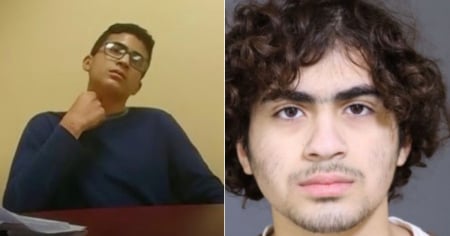
The defense of Derek Rosa, the teenager accused of murdering his mother in October 2023, has made a radical shift in its legal strategy.
Instead of focusing solely on the minor's initial confession, the lawyers have now introduced an alternate theory of the crime that points to Frank Ramos, the minor's stepfather and the victim's partner, as a possible suspect.
This new approach is based on the existence of messages and audio recordings in which Ramos described details of the homicide that, according to the defense, could only be known by someone who was present at the crime scene or directly involved in the events.
The defense, led by the renowned lawyer José Báez, presented its new legal strategy during a hearing this Monday, questioning how Ramos could have known such specific details about the events if he was not present during the murder.
The Unexpected Turn: A New Theory of Crime
The defense argues that “audio recordings and messages exchanged on social media by Frank Ramos... could give rise to a second theory in which Rosa would not be the culprit and there would be another suspect,” as revealed by the network Univision based on the defense's document.
In those Facebook messages, Ramos accurately describes elements of the crime that he supposedly never witnessed: “the victim's precise reaction, the movements she made when getting out of bed, her cry for help, the struggle against the assailant, and the place where the victim ultimately collapsed.”
The defense argues that these details could not have been deduced through later observation.
"The stepfather does not claim to have received the details from Derek Rosa... Instead, he now asserts that he fabricated them based on his observations of the crime scene. However, the stepfather is neither an expert in blood spatter analysis nor does he have experience in observing, processing, or handling crime scenes," explains the cited document.
"The existence of these messages raises the possibility of an alternative theory, according to which the true perpetrator of the crime would not be Derek Rosa... The level of detail in Ramos's descriptions, despite his claim of not being present, raises reasonable doubts and suggests that he may have been at the crime scene or witnessed it in some way."
Therefore, the lawyers argue that Ramos' messages are "exculpatory and dismissive. The messages are exculpatory because they present the possibility of an alternative theory, which, of course, includes that the guilty party is not Derek Rosa."
What did the messages contain and why are they relevant?
The lawyers have requested that all text messages, audio recordings, and social media posts from Frank Ramos be included as judicial evidence. Furthermore, they assert that if the prosecution opposes the admission of this evidence, it would "severely harm" their client.
In the words of the defense, reported by Univision: “The messages and the audio from Facebook are exculpatory... because they suggest the possibility of an alternative theory... The stepfather does not claim to have received the details from Derek Rosa.”
Questions about Frank Ramos' alibi
The defense has also begun to dismantle Ramos's alibi.
Although the prosecution claims that the stepfather was working in Georgia on the night of the crime, Rosa's attorneys requested to examine Ramos' work records, which the prosecution has strongly opposed.
The court documents state that Ramos is a truck driver and “had claimed to be working out of state... the prosecution had supported his statement by presenting work records indicating his presence there.”
However, the defense has requested a second statement from Guillermo Sevilla Velázquez, a coworker of Ramos, who "had been reluctant to identify a crucial photo showing an alleged exchange of trailers between him and Ramos."
On the other hand, a trip that Ramos took shortly after the murder is questioned: “he purchased three plane tickets from Cuba to the United States on November 18, 2023, thirty-seven days after the crime.”
Although Ramos confirmed purchasing the tickets, he did not provide "the exact date of the purchase or the names of the passengers."
The defense considers this data crucial to connect it "temporally... with the events."
The response from the prosecutor's office
The prosecution has firmly responded to this defense strategy. In their legal arguments, they assert that "there is currently no evidence to suggest that the witness was present at the crime, and all available documentary and video evidence shows that he was in Georgia at the time of the incident."
Regarding the Facebook messages and their viral content on social media, the prosecution states that "the witness has indicated that any message about the event itself is based on what he has learned through the media and/or through conversations with law enforcement, and not on his personal knowledge or through a third party."
They also refuse to release Ramos's employment records, claiming that doing so would violate his privacy.
Frank Ramos, for his part, also reacted to the accusations with this strong statement: “I don’t have to give explanations. The prosecutor’s office is the one handling all of this.” For him, this situation also makes him a victim.
It is worth noting that Frank Ramos was married in Cuba and that Irina García, Derek Rosa's mother, was an extramarital relationship. However, the deceased woman and Ramos had just had a daughter together at the time of the tragedy.
Confessions and evidence that still weigh on Derek Rosa
Despite the defense's efforts to introduce an alternate theory, the prosecution insists that Rosa confessed to the crime at two different times: during the 911 call and later in front of the detectives.
Additionally, it was leaked that the teenager "would have taken a selfie after the crime, with a bloodied hand, sticking out his tongue and waving," which he sent to a friend along with "two images of his mother's body."
These evidences are still considered compelling by the prosecutors.
However, the defense has questioned her context and pointed out that Rosa may be suffering from a mental disorder.
In March, the defense reported that it was assessing the young man's mental health as a possible legal argument.
"The incident itself is classified as a traumatic event, regardless of the theories presented by each party, especially when it involves the adolescent brain. This necessitates a longer and more thorough evaluation than usual. A comprehensive assessment must address prior trauma, which requires time and repeated visits," they argued.
What’s next in the process?
So far, Judge Richard Hersch has not issued a final ruling on whether the request to formally investigate the stepfather will be accepted, nor whether the trial will be postponed.
The defense attorneys have requested an extension, warning that if it is not granted, "the adolescent's right to an attorney could be violated."
Meanwhile, the next hearing is scheduled for April 26, although the date of the trial, initially set for June, is still not confirmed.
The inclusion of Frank Ramos as a possible alternative suspect opens an unexpected chapter in a case that was already deeply complex.
The doubts raised by the defense, based on the precise details that Ramos shared without having witnessed the crime, the purchase of plane tickets after the homicide, and a alibi that is beginning to show cracks, could reshape the legal process.
Frequently Asked Questions about the Derek Rosa Case and the New Defense Theory
Why does Derek Rosa's defense want to investigate stepfather Frank Ramos?
Derek Rosa's defense has introduced an alternative theory pointing to Frank Ramos, the child's stepfather, as a possible suspect in the crime. The lawyers argue that Ramos possesses specific details about the homicide that only someone who was present or involved in the events could know. These details include precise descriptions of the incident that do not align with his claim of not having been at the crime scene.
What evidence has the defense presented to support its theory about Frank Ramos?
The defense has presented text messages and audio recordings in which Frank Ramos details aspects of the crime that, according to the lawyers, could only be known by someone who was present. Additionally, they have requested to examine Ramos's employment records and other documents that could challenge his alibi of being out of state on the night of the crime.
What does the prosecution say about the new defense theory involving Frank Ramos?
The prosecution has rejected the defense's theory, arguing that all documentary and video evidence shows that Ramos was in Georgia at the time of the crime. Furthermore, they assert that Ramos's messages are based on information obtained from the media and not from personal knowledge. The prosecution has also denied the release of employment records, citing that it would violate the stepfather's privacy.
What has been Frank Ramos' response to the defense's accusations?
Frank Ramos has denied the accusations and has declared himself as yet another victim in the case. He has stated that he does not have to provide explanations and has emphasized that it is the prosecution that manages the entire legal process. Ramos maintains that the details he shared about the crime were fabricated or inferred from public information.
What comes next in Derek Rosa's legal process?
The judge Richard Hersch has not yet decided whether he will accept the request to formally investigate the stepfather. The next hearing is scheduled for April 26, and the trial, initially set for June, does not yet have a confirmed date. The defense has requested an extension, arguing the need for more time to review evidence and conduct a psychological evaluation of the minor.
Filed under: