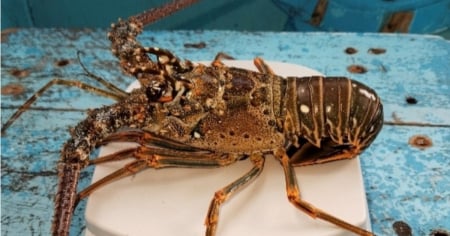
A young Cuban has captured attention on TikTok after answering a common question among foreign users: why, living on an island, do Cubans not consume seafood like lobster? On her account @anita.cubanita64, the content creator stated, “In Cuba, it is prohibited to eat lobster.”
The tiktokera explained that many people ask her why fish or seafood is not consumed more on the island, and she replied that “we can fish, but we need a permit.” She added that “we are also prohibited from buying and selling lobster and shrimp.”
In the video, he pointed out that "you will never go to a market and see them selling lobster" and insisted that this seafood "can only be found in private establishments that clearly have to have permission to sell it, whether it be restaurants, bars, and so on." He also mentioned that it is served in hotels for tourists.
He also mentioned that fishing for lobster is not an option for citizens because, in his words, "they clearly export it to other countries to earn dollars." Additionally, he warned that "if you are caught selling lobster, you will face a hefty fine."
The young woman concluded the video with the phrase: “We live in Cuba, on an island surrounded by water, but no, we can't eat lobster, we can't eat shrimp.”
The video has sparked significant interest on TikTok, accumulating thousands of views in a short time and dozens of comments. Some expressed sadness: “It’s truly sad to know so many things that Cubans experience,” commented one user. Others criticized the restrictions: “A prison island, it’s a shame for the people living there,” wrote another internet user. “The dictatorship is strong,” added someone else.
The creator of the content herself responded to several comments with sad emojis and phrases like “I hope this changes one day.”
Between export and scarcity
The claims of the tiktokera resonate with recent reports concerning the seafood situation in Cuba. One of the most striking is the commercial lobster farming project in Villa Clara, promoted by the regime alongside Vietnam, which aims to generate foreign currency and, in theory, contribute to food security.
In addition to this, there is a decline in catches, which official sources attribute to climate change, although exports have not ceased. Meanwhile, domestic markets continue to lack regular access to these products.
In Camagüey, the Fishing Company of Santa Cruz del Sur celebrated the fulfillment of its annual catch plan, becoming one of the few that achieved this goal. However, all production was allocated to the international market.
This disconnection between the abundance for export and internal scarcity was also reflected in the video of a Cuban grandmother in Spain, who reacted with surprise upon seeing a shrimp for the first time. Her experience, shared by her grandson, generated empathy and reflection on the food shortages faced by many families on the island.
Filed under: