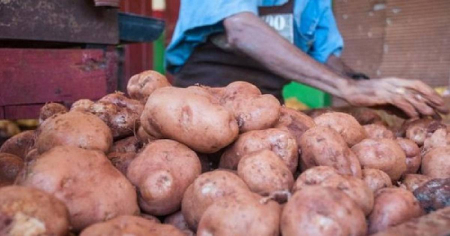
The latest potato harvest in Isla de la Juventud was not only a production setback but, above all, a direct consequence of improvisation. A new variety was chosen without verifying its suitability for local conditions, while a seed that had already shown stable and successful yields was dismissed for no apparent reason.
Osmar Enrique Garcés González, an experienced farmer in the area, experienced this firsthand. At his farm La Reina, north of La Fe, he went from producing 24.5 tons per hectare with the Naima variety in the previous harvest, to just seven tons this year with the new seed. This figure, far from being an isolated case, was echoed among other producers, reported the official newspaper Victoria.
“Ocurrence that nobody imagined. The results were far from what was expected and this greatly affected the supply to the population, a supply that could not be fully completed. To many areas, we could not even reach them with an initial round of potatoes,” Garcés acknowledged.
Even more, he added, the complete technological package was available: fertilizers, chemical and biological products, "plus an ideal time for potato cultivation, which happens rarely; however, we didn’t even reach half of what was expected. All the eggs were put in one basket, everything was risked on an unknown variety, and we ended up with the disappointment you can see.”
However, neither Garcés nor the other producers received an official explanation. "Explanations… none," he summarized. The only clear thing is that the change of seed was a top-down decision, imposed from outside, without dialogue with those on the ground.
The results are evident: the variety failed, and the people paid the consequences. In this regard, Garcés recommended that when selecting seed, previous yields should be considered, particularly with a variety that adapted well.
"We gain nothing by constantly changing seeds; we should stick to one variety and let it dominate. The other options can remain as experiments, I'm not opposed to that, but only in limited areas, not across the entire Island," he emphasized.
The lesson from this situation is clear: agricultural production cannot be planned from a bureau, nor can it depend on the whim of introducing new varieties without prior validation. Putting "all your eggs in one basket," especially when it's unknown, is not innovation; it's irresponsible when the experiment costs the food of the people.
Despite having a favorable climate for cultivation, the potato harvest for 2024-2025 in the province of Villa Clara was a complete failure, further evidence of the ongoing mismanagement of economic and agricultural resources in Cuba, despite the government's supposed intent to achieve food sovereignty.
The potato, traditionally regarded as "the queen" among roots and tubers on the island, has lost its crown amidst a disorganized agricultural system, with diluted responsibilities, chronic inefficiency, and an ineffective distribution and control system. The difference between the official price of 11 pesos per pound and the 150 or 200 pesos (or more) that it sells for in the informal market illustrates this.
In Cuba, the tuber has become a symbol, and its arrival each year represents the hope for a more complete dish, an economic alternative, a respite from rice and grains. However, what should be a food guarantee has transformed into a symptom of poverty and institutional neglect.
The most recent attempt to plant potatoes in Guantánamo ended in a failed harvest, with minimal yields and some of the food lost, while the planting in Ciego de Ávila began with a situation similar to previous campaigns, characterized by delays, lack of resources, and adverse weather conditions.
In Sancti Spíritus, the so-called "national balance potato," aimed at ensuring equitable distribution, suffered from production issues, institutional disorganization, and politically motivated decisions lacking technical support, which led to a new wave of uncertainty and discontent among the population.
The sale in Santiago de Cuba generated tensions by being limited to three pounds per person, evidence of the severe food crisis, where basic products like this are reaching the population in a rationed manner and in minimal quantities, unable to meet the demand.
Frequently Asked Questions about the Potato Production Crisis in Cuba
Why did the last potato harvest fail in Isla de la Juventud?
The potato harvest in Isla de la Juventud failed due to the imposition of a new seed variety that was not suited to local conditions. This decision, made without consulting the producers, resulted in a drastic decrease in yields, impacting the supply to the population. This is yet another example of how improvisation and politically-driven decisions without technical support affect agricultural production in Cuba.
¿Cómo ha impactado la mala gestión agrícola en la escasez de papa en Cuba?
Poor agricultural management in Cuba has led to a critical shortage of potatoes, raising their price in the informal market from 150 to 200 pesos per pound. This situation is the result of a series of misguided decisions, such as the introduction of untested seeds, lack of control in distribution, and chronic inefficiency in the agricultural system. All of this has turned potatoes, a staple food, into a symbol of poverty and institutional neglect in the country.
What are the consequences of the potato crisis for the Cuban population?
The potato crisis in Cuba has led to a rationed and limited distribution, with insufficient quantities to meet demand. This has resulted in discontent among the population, which faces shortages of basic products and exorbitant prices in the informal market. The situation highlights the system's inability to ensure food security for the population, turning the potato into a reflection of the structural failure of the Cuban agricultural system.
What lessons should be learned from the recent failures in potato production in Cuba?
The main lesson is that agricultural planning should not be done from an office without considering local conditions or the experience of producers. The introduction of unvalidated seeds, the lack of dialogue with farmers, and centralized management have proven to be ineffective. It is essential to implement planning based on adaptation to the environment and the efficient use of resources to avoid repeating the failures of the past.
Filed under: