The Cuban regime has once again placed the responsibility of feeding themselves in the hands of the people, acknowledging that, in light of the severe crisis the country is facing, "the most reliable thing we will have in each territory is what we can produce with our own efforts."
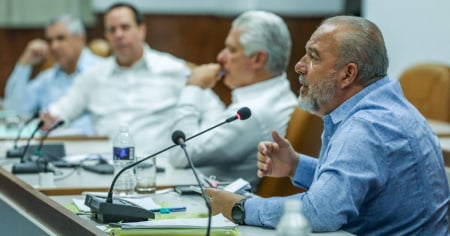
This was affirmed by Prime Minister Manuel Marrero Cruz during an assessment of the implementation of the Food Sovereignty and Food and Nutritional Security Law, in a report broadcast by the Cuban News Channel.
The statement, made during a critical moment for millions of Cuban families facing shortages, inflation, and a lack of basic products, is an official admission of the failure of the centralized agricultural model and the collapse of the state's ability to ensure minimal access to food.
During the meeting of the National Commission responsible for the issue, Marrero acknowledged that "what we have done is not enough" and that the goal of food sovereignty will only be reflected "on the table of the Cuban family."
He insisted that it is a matter of "national security," although he avoided taking responsibility for the structural inefficiencies that have plagued the agricultural sector for decades.
The television report also quoted Vice President Salvador Valdés Mesa, who emphasized from Matanzas that "the challenges for this year are greater" and urged for a better leverage of the territories' potential.
However, amid the bureaucratic discourse on agroecology, agricultural extension, and "self-sufficiency movements," the central message became clear: each municipality will have to fend for itself.
The official narrative once again emphasized the "complexity of the situation" and the "intensified blockade," while acknowledging the assistance from international organizations such as the United Nations System.
Meanwhile, on the streets, Cubans are facing a harsh reality where access to a meal increasingly relies on individual ingenuity, bartering, and daily hustling.
Far from structural solutions or coherent policies that promote production with real incentives, the government seems to cling to slogans and promises, leaving the people with the certainty that the little that reaches their tables will be only "whatever can be produced."
In October 2023, during a public address, the Minister of Food Industry stated that “thanks to Fidel, we have the installed capacity to produce many food items”, in a speech that stood in stark contrast to the reality of widespread shortages on the island.
The statement, filled with official rhetoric, omitted the inefficiency of that capability and the impossibility of maintaining it due to a lack of supplies and resources.
Nearly two years later, in March 2025, the government attempted to attract foreign investments at the International Food Fair in Cuba, a desperate measure in search of foreign currency and external support to reactivate a collapsed sector.
During the event, Cuban authorities acknowledged that the national agroindustry was paralyzed due to a lack of funding, technology, and management autonomy, factors that hinder any genuine attempt at recovery.
At the beginning of April, the regime claimed that it had achieved an increase in agricultural production, but at the same time acknowledged a decline in the marketing of those products.
The announcement turned out to be contradictory and highlighted the lack of coordination within the production apparatus, as well as the State's inability to deliver food from the field to the Cuban table.
A few days later, the government once again blamed the “intermediaries” for inflation and high prices, without addressing the structural failures of the centralized model.
These statements reinforced the official narrative of blaming third parties for the economic collapse, while maintaining strict control over the markets and obstructing decentralized solutions or genuine private participation.
Frequently Asked Questions about the Food Crisis in Cuba
What does the Cuban government say about food production in the current crisis?
The Cuban government acknowledges that food production relies on what each municipality can produce through its own efforts. Prime Minister Manuel Marrero Cruz has admitted the failure of the centralized agricultural model and has shifted production responsibility to local authorities. However, this strategy has been criticized by the public, who feel that the central government is trying to evade responsibility for the issue.
How does the food crisis affect the Cuban population?
The food crisis in Cuba has forced millions of families to confront shortages and rely on individual ingenuity to access food. The scarcity of basic products, inflation, and the collapse of the agricultural system have made access to a meal increasingly dependent on bartering and self-management. The population faces a reality where government promises do not translate into tangible improvements.
What measures has the Cuban government taken to address the food crisis?
The government has implemented the Law on Food Sovereignty and Food and Nutritional Security, but its application has been ineffective. Despite acknowledging the crisis, no effective structural measures have been taken to resolve the issue. The regime has chosen to shift responsibility to the municipalities and has insisted on protecting international aid such as that from the United Nations System.
Why has the proposal for "municipal autonomy" been criticized?
The proposal for "municipal autonomy" has been criticized as it is seen as an attempt by the government to evade its responsibility in the food crisis. Citizens and critics believe that the idea of each municipality achieving its own food sovereignty is unrealistic given the centralization of state control and the lack of resources. This strategy does not address the structural deficiencies of the agricultural system in Cuba.
Filed under: