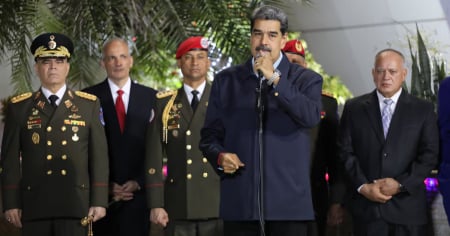
The government of Venezuela has ordered the deployment of warships in its territorial waters in the Caribbean as part of an expanded security operation that, although officially aimed at combating drug trafficking, falls within a growing escalation of tensions with the United States.
The decision, announced by the Minister of Defense Vladimir Padrino López, comes at a delicate time for the region, following the recent deployment of destroyers, nuclear submarines, and U.S. Marines to the Caribbean, which Caracas views as a provocative and intimidating maneuver.
A military operation that covers land, sea, and air
According to Padrino López's details in a video posted on social media, the plan includes naval patrols with larger vessels in the northern part of the country, within the Caribbean Sea, as well as river patrols by the Marine Infantry along the main rivers of western Venezuela, particularly in border areas with Colombia.
The deployment is part of the reinforcement of the so-called “Catatumbo Lightning Operation”, a military strategy initiated at the beginning of the year and now intensified by the government of Nicolás Maduro.
Additionally, the minister reported on the widespread use of technological and human resources: drones with multiple missions, helicopters, surveillance and intelligence systems, and citizen service points as part of a comprehensive deployment.
"We are also going to have a significant deployment with drones, exploration and surveillance points, river patrols […] naval patrols on Lake Maracaibo, in the Gulf of Venezuela, and larger vessels further north in our territorial waters," he explained.
The operation involves the participation of around 15,000 military personnel deployed along approximately 851 kilometers of the border shared with Colombia, an area of high geopolitical complexity that Caracas has identified as an entry point for armed groups, paramilitaries, and drug trafficking networks.
“We know the territory, we know the geographic conditions and the characteristics of the terrorist groups and drug traffickers operating at the border who intend to cross into Venezuelan territory,” Padrino concluded.
Military movements of the United States: the trigger
The Venezuelan announcement occurs alongside an intensification of the U.S. military presence in the Caribbean.
According to reports from agencies such as Reuters and AFP, the administration of Donald Trump has deployed additional naval units to waters near Venezuela.
Among them are the guided missile cruiser USS Lake Erie and the fast attack nuclear submarine USS Newport News, which will join three previously deployed destroyers (USS Gravely, USS Jason Dunham, and USS Sampson), along with P-8 spy planes and approximately 4,500 Marines.
These movements are part of a broader strategy that the White House presents as an offensive against drug trafficking, although it carries strong political connotations.
"President Trump is prepared to use all the resources of U.S. power to stop the entry of drugs into our country and bring those responsible to justice," said an official spokesperson, adding that the Maduro government is "not legitimate" and operates as "a drug cartel."
The U.S. administration also recently raised the reward to 50 million dollars for information that leads to the capture of Nicolás Maduro, whom he accuses of leading the so-called “Cartel of the Suns”, a drug trafficking network allegedly linked to high-ranking officials in the Venezuelan armed forces.
Caracas denounces to the UN and warns about nuclear presence
Venezuela's response has gone beyond the military sphere.
Chancellor Yván Gil denounced the hostile nature of the U.S. military deployment at the United Nations headquarters, describing it as a "serious threat to regional peace and security."
Caracas demanded an "immediate cessation" of Washington's naval operations in the Caribbean and requested UN Secretary General António Guterres to intervene to "restore sanity" in the face of what they describe as an unjustified escalation.
One of the most sensitive points highlighted by the Venezuelan government is the arrival of the nuclear-powered submarine USS Newport News, whose presence—according to diplomatic representation—violates the principles of the 1967 Treaty of Tlatelolco, which designates Latin America and the Caribbean as a nuclear-weapon-free zone.
"The entry of a nuclear submarine, without transparency regarding its payload or rules of engagement, undermines the object and purpose of the regional denuclearization regime," denounced Venezuela, which also called for urgent consultations with the Organization for the Prohibition of Nuclear Weapons in Latin America and the Caribbean (OPANAL).
Activation of the Bolivarian Militia and ideological defense
Internally, Maduro has ordered the full activation of the Bolivarian National Militia, a force composed of civilians with ideological military training, affiliated with the Bolivarian National Armed Forces.
In a televised speech, Maduro asserted that his country is ready to face any threat. "No one touches Venezuela [...] we have all our forces and national power activated to defend ourselves against the illegal, immoral, and criminal threats of the empire of the United States."
The government claims that around 4.5 million militia members have been enlisted as part of an extended and popular defense system, although analysts question both the operability and the accuracy of these figures.
During a recent ceremony at the 4F Military Museum in Caracas, weaponry was displayed and military demonstrations were conducted as part of the readiness event, a direct message to Washington and the national public opinion.
Drug war or strategic conflict?
Although both nations frame their actions within the narrative of the fight against drug trafficking, the confrontation appears to be driven by broader geostrategic factors.
Venezuela claims that its territory is free from illicit crops, a statement supported by the United Nations Office on Drugs and Crime (UNODC), which strengthens its position that U.S. maneuvers have political rather than operational objectives.
"The U.S. deployment has no technical justification; it is aimed at politically destabilizing the country and provoking a reaction that would justify greater intervention," stated analyst Phil Gunson from the International Crisis Group.
In his opinion, the presence of submarines, cruisers, and troops so close to the Venezuelan coast "represents a tactical pressure to force negotiations or concessions from the Maduro government."
The Caribbean as a new focal point of hemispheric tension
With both governments reaffirming their commitment to continue and expand their respective military deployments, the Caribbean region becomes the epicenter of a dangerous struggle that threatens the principles of regional security and cooperation.
Although no direct incident has occurred so far between the naval forces of both countries, the risk of escalation cannot be ruled out.
The western region of Venezuela—particularly the state of Zulia and the Catatumbo region—continues to be identified as a strategic corridor for drug trafficking and a hub for operations of illegal armed groups.
The Venezuelan deployment, in that context, also reinforces the control of key oil facilities, as seen in operational maps presented by Minister Padrino, which reference the Crab Task Force, a unit of the Coast Guard that patrols Lake Maracaibo.
Frequently Asked Questions about Military Tensions between Venezuela and the United States
Why has Venezuela deployed warships in the Caribbean?
Venezuela has deployed warships in the Caribbean as part of an expanded security operation in response to the increased military presence of the United States in the region. Although the deployment is officially aimed at combatting drug trafficking, it is part of a rising escalation of tensions with the United States, which Caracas views as provocations and intimidation.
What is the reason for the U.S. military deployment near Venezuela?
The United States argues that its military deployment near Venezuela is part of an offensive against regional drug trafficking. However, analysts and the Venezuelan government believe it also has political implications, seeking to pressure the regime of Nicolás Maduro, which Washington accuses of leading a drug trafficking cartel known as the "Cartel de los Soles."
What actions has Venezuela taken in response to the measures from the United States?
Venezuela has intensified its military strategy through the "Catatumbo Lightning Operation," which includes the deployment of warships, drones, helicopters, and troops along the border with Colombia. Additionally, it has activated the Bolivarian National Militia, made up of civilians with military training, to bolster its defense against U.S. actions.
How has the international community reacted to the conflict between Venezuela and the United States?
The international community has had mixed reactions to the conflict. Venezuela has denounced the U.S. military deployment before the UN, describing it as a serious threat to regional peace. Some ALBA countries have condemned Washington's actions. However, the U.S. maintains its stance that it is acting against drug trafficking and has offered 50 million dollars for information leading to the capture of Nicolás Maduro.
Filed under: