
Related videos:
The comparison between the U.S. invasion of Panama in 1989 and the ongoing military deployment against Venezuela has sparked heated debate on the social media of CiberCuba.
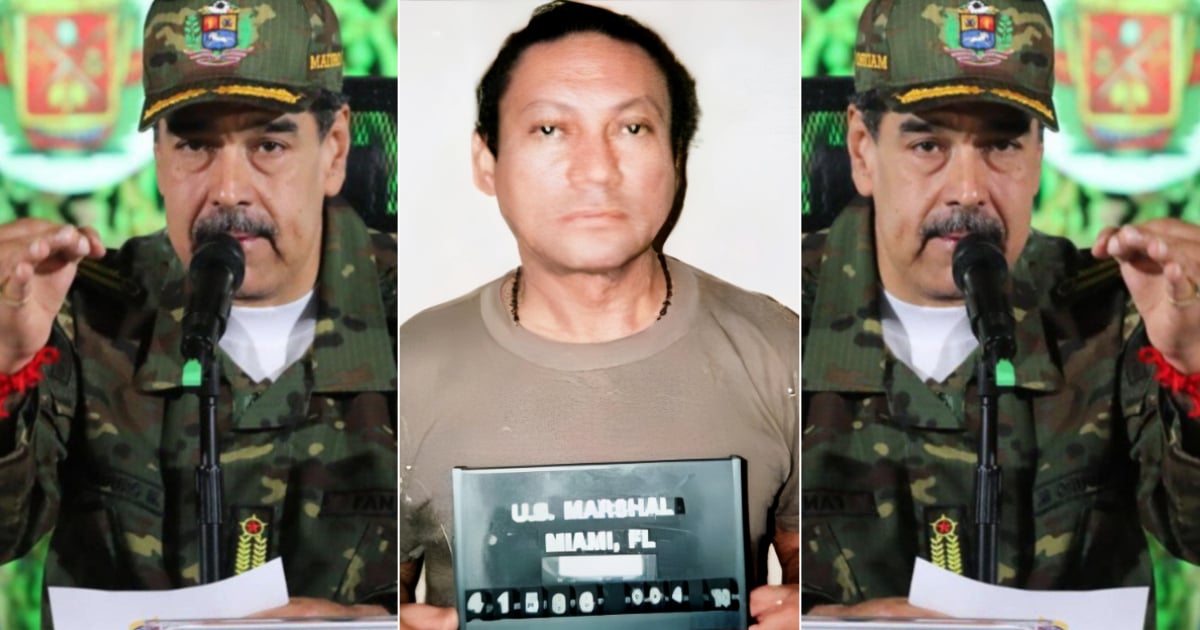
Under the headline “Maduro under pressure: The ghost of Noriega returns with the U.S. deployment in the Caribbean”, dozens of Cubans and Venezuelans exchanged views, often irreconcilable, on the similarities and differences between Manuel Antonio Noriega and Nicolás Maduro, and the potential outcome of the new offensive by Washington.
The Shadow of Panama
For some commentators, historical parallelism is inevitable. “I hope Maduro ends up like Noriega”, wrote a user, convinced that chavismo could have its days numbered just as the Panamanian regime did over three decades ago.
Others agreed: "Thus they will all fall, the end of socialism has arrived in America and the world", noted a participant in the debate.
But not everyone shares that view. Several users recalled that the current circumstances are very different from those of 1989. "Venezuela is not Panama, nor is Maduro Noriega", emphasized another commentator.
For this sector, the country's size, the international backing from powers like Russia, China, and Iran, and the existence of a significantly larger armed force make a similar military operation practically unfeasible.
"A direct invasion of Venezuela risks a third world war", warned one of the most widely circulated messages. Others echoed that the United States doesn't need a massive invasion: "Maduro can be taken out like Bin Laden", stated a Cuban.
Fatherland or life versus Fatherland or death
Ideological passions also shaped the debate. A user expressed solidarity with Caracas: “Go Venezuela, Cuba and other friendly countries are with you, without fear. Homeland or Death, we will overcome!”. Her message sparked a wave of responses filled with sarcasm and criticism.
“Stop the gossip and go take your pill, we Cubans do not support another dictatorship like the one we have here”, replied another participant. “Communism will be eradicated forever. Homeland and Life. Freedom for oppressed peoples”, insisted another intervention, alluding to the opposition slogan that has gained strength in Cuba.
The fear that young Cubans could be sent as "cannon fodder" to a potential conflict also surfaced in the comments. "Those mothers don't want their children to go to a foreign war; whoever goes won't return alive," warned a user.
The weight of sanctions and corruption
Among those who defended Maduro, several pointed to the impact of economic sanctions. "If the sanctions are lifted, you will see what a humble and hardworking country can do," expressed a commentator.
However, others responded harshly: “What sanctions? The Chavistas have been pillaging oil, gold, and all resources for 26 years, while the people suffer from hunger.”
Corruption within the Venezuelan elite was repeatedly mentioned: "Today, Chávez's daughter is a multimillionaire in France, where did she get so many millions? That is the true blockade for the Venezuelan people."
A geopolitical theater?
A critical current downplayed the military deployment. "It's all a theater and drama, no one here is going to fire a bullet," remarked a user. "It's pure Trump spectacle to distract from his internal problems," added another.
However, others warned about the symbolic dimension of a withdrawal without results. “If the U.S. moves troops and then withdraws, Maduro will say the same thing as Fidel did in 1961: we defeated imperialism. The problem is not just military; it’s the historical narrative”, stated an analysis shared on several occasions.
Noriega's wound
Some comments evoked personal memories from the time of Noriega. "Here in Cuba, they said he was innocent, and I believed it, until the opposite was proven. Look at how we were deceived!", wrote a user.
Others recalled the official propaganda of those years and how the fall of the Panamanian general was used as a warning and example in the region.
There were also historical parallels: "Noriega was a CIA agent, Maduro is not. That is the big difference.", argued one user, while another replied that "in the end, both ended up mired in drug trafficking."
The regional domino effect
The discussion also extended to the role of Cuba and Nicaragua. "If Venezuela falls, Cuba and Nicaragua will also fall," remarked a commentator, who recalled Havana's economic dependence on Venezuelan oil. "The domino effect is real; these dictatorships support one another," he added.
Others were more radical: “If they are in the Caribbean, they should first go to Cuba, remove the PCC members, and then continue to Venezuela”.
Between fear and mockery
Reactions varied between alarm and humor. "They say toilet paper has run out in Miraflores, there's a tremendous diarrhea situation", quipped a user. Another was more blunt: "Noriega hid in a church, Maduro will hide underground".
But there were also warnings about the human cost of a conflict: "It's not the same to lose in elections as it is to die at the foot of the cannon. If Venezuela surrenders, the empire will continue to intervene everywhere", wrote a supporter of chavismo.
An open conclusion
The debate concluded with a clear takeaway: Noriega's figure remains an uncomfortable ghost in Latin America, and his memory divides opinions. For some, he is the reflection in which Maduro will ultimately be seen; for others, he is proof that Venezuela will not become a new Panama.
Amid the hope for change and the fear of military escalation, social media once again became an ideological battlefield, where the ghosts of the past intertwined with the uncertainties of the present.
Filed under: