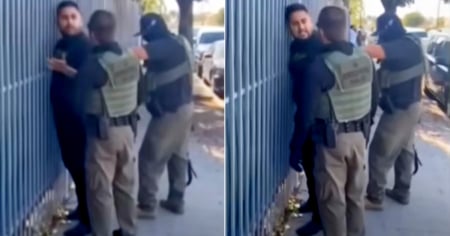
Can I be deported if I am I-220A? This is the question being asked by the hundreds of thousands of Cubans who find themselves in a state of limbo bordering on legality in the United States because they were allowed to enter the country under this immigration status, which is now under the scrutiny of the Department of Homeland Security (DHS).
Until last February, it was assumed that no immigrant with an I-220A would be deported. In the event of arrest, there was confidence that they could fight their case while in detention. However, last week marked the first deportations of Cubans with I-220A. This has led attorney Willy Allen, an expert in immigration, to categorically express his fears for all detained I-220A individuals. Furthermore, he reiterates what he stated in CiberCuba last May: he is convinced that all I-220A cases will be regularized, but there will be victims along the way.
"The last week of the month is when the flight (for deportations) to Cuba takes place. Last week, two people, I-220A without final orders of deportation, were sent back to Cuba. One was awaiting his credible fear interview while in detention. The other was waiting for his final asylum hearing. Both were put on a plane and forcefully returned to Cuba. I believe this is an injustice. At this moment, I am reviewing one of the cases and sending it to someone who works with the Government to see if I can find a way for him to return to the United States for his process, but I see it as very difficult," said Allen.
The lawyer acknowledged in the weekly program he hosts on Mondays at 11:00 AM on CiberCuba that right now, "all I-220A individuals in detention are in great danger." According to Willy Allen, this is because the current government is not following its own rules and is focused on deportation. They did this with nearly 200 Venezuelans who were deported, and half of them either had TPS or were awaiting court. Very few had criminal records. "At this moment, the need to appear strong, the need to show they are deporting and fostering hatred against migrants is leading to these types of injustices," he added.
The worst part is that Willy Allen believes there will be more deportations of Cubans with I-220A. "I think we will see more injustices. I fear for the Cubans with I-220A who are detained. I worry that, just like those I have in detention, many of them will be deported."
The lawyer stated in an interview with CiberCuba that a colleague of hers in Houston mentioned that an Immigration officer said they were looking for Cubans to deport. The explanation may lie in the fact that even the Government expects by December of this year arguments in favor of considering the I-220A as a parole and, therefore, its beneficiaries can benefit from the Cuban Adjustment Act after a year and a day in the United States. This could result in nearly 400,000 Cubans being able to obtain residency through that pathway. However, nothing is confirmed. These are all speculations. Furthermore, Willy Allen believes that the officer made that comment to instill fear.
"I don't know if that was a lie. I suspect it was an exaggeration by the official, something they said to instill fear and panic. Once again, high concern, but I am not afraid, I am not panicking," he insisted.
However, he acknowledged that he is very concerned at the moment because he is seeing "many irregularities in the way DHS and ICE (Immigration and Customs Enforcement) are operating." Still, Allen recognizes that the American judicial system is very protective of rights. "I believe in the American system and I believe in the American judicial system," he stated.
At the moment, it is estimated that there are 400,000 Cubans with I-220A, awaiting a court ruling expected in January, but whose arguments will likely be revealed in December. That decision could change the fate of many families if it is ultimately determined that the I-220A status is a parole because they were inspected and admitted at the border. If that is the case, the day after the court's decision is made public, those who have been in the U.S. for over a year and a day will be able to apply for the Cuban Adjustment Act.
Filed under: