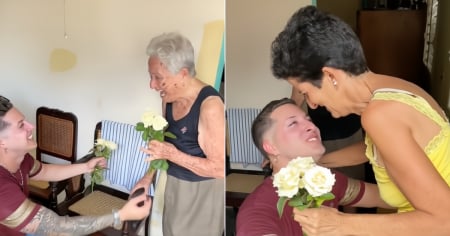
A Cuban has generated an intense reaction on TikTok after posting a video on her profile @naranjosleya, where she shows her arrival in Cuba with her son. The clip begins with a provocative phrase: “I’m not going back to Cuba. It’s on fire,” which quickly caught the attention of thousands of users. But what seems like a direct criticism turns out to be a message aimed at those who question emigrants who decide to return, even if just for a short time.
Throughout the video, the author addresses the criticisms often directed at those who return to the island. "If you don't miss the people from your neighborhood, the place where you were born and grew up, you shouldn't return to Cuba," she asserts. Her discourse, rich in personal references, highlights the emotional conflict experienced by many emigrants between dislocation and the family ties that still bind them to the island.
In the images, he is seen descending from the plane with his son in his arms, reuniting with family in an emotional embrace. Later, he continues: “If you haven't spent the last two years crying or watching your children grow through a phone, you should not go to Cuba.” The post has been interpreted by many as a defense of those who, despite the country's conditions, return to see their loved ones.
The phrase that has resonated most in the comments is also the one that gives meaning to the entire message: “If you are willing to live for 15 days with the people you love what they experience in an entire year, just to hug them, then yes, you should go to Cuba.” Rather than passing judgment, the author presents a personal stance on what it means to return, while acknowledging the weight of that decision.
The video has sparked dozens of reactions, both supportive and critical. Some users applaud her bravery for addressing a sensitive topic; others accuse her of inconsistency for returning after emigrating. "I do go back, even if it's just for a few days, because my mother is there," commented one user. Another was more emphatic: "I returned after 25 years, and the misery is overwhelming, but family is worth it."
The author has responded to several comments, clarifying that it is not a political message or a stance, but an emotional experience. "He met his brothers; we must continue going. There is his family," she explained about her son. Her testimony has reignited an ongoing conversation among Cubans: when —and why— to return?
The video does not seek to impose a truth, but it does reveal a sentiment shared by many Cubans: the desire to embrace their loved ones again, even if only for a few days, and the weight of having to justify that desire. Whether to return or not remains a personal decision, filled with emotions, memories, and also contradictions.
Frequently asked questions about the travels of Cubans emigrated to Cuba
Why do some emigrated Cubans decide to return to Cuba, even if only for a short time?
Many Cuban emigrants return to Cuba to reunite with their loved ones and maintain the family ties that still bind them to the island. These returns are seen as a way to nourish the soul and reconnect with their roots, despite the challenging conditions in the country.
How do Cuban families react to the return of an emigrant member?
Reactions vary significantly. Some families display overflowing joy and deep emotion at the reunion, while others may react in a more restrained manner or even with surprise. These reunions are moments filled with emotions and expectations, reflecting the complex emotional dimension of separation and reunion.
What criticisms do Cubans face when returning to the island after emigrating?
Cuban returnees often face criticism from some who consider their return inconsistent after having emigrated. However, many defend their decision as an emotional necessity to see their families and friends, emphasizing that it is not a political message, but a personal experience.
What is the emotional impact of family separation for Cuban emigrants?
Family separation has a significant emotional impact on emigrated Cubans, who experience a mix of nostalgia, love, and longing to reunite with their loved ones. These feelings are intensified by the distance and the difficulties in returning to the island, turning each reunion into a deeply meaningful event.
Filed under: