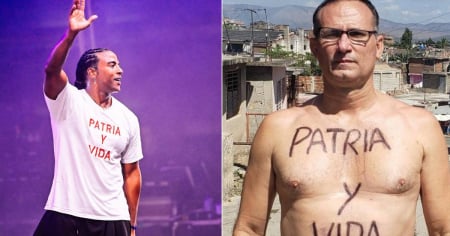
The Cuban regime confirmed this Monday that the opposition leader José Daniel Ferrer García was exiled from the country to the United States, accompanied by members of his family.
The departure occurs, according to Havana, as a result of a formal request from the U.S. government and with the explicit consent of Ferrer himself.
The information was disclosed through an official statement from the Ministry of Foreign Affairs of Cuba (MINREX), which tries to present the event as a lawful act and the result of an ordinary legal procedure, when in reality the opposition leader was exiled from the country and has earned the admiration of the people for displaying an indomitable courage over the years.
Ferrer’s departure comes after years of reports of human rights violations, systematic repression, and extreme prison conditions, which for many observers and international advocates represents a form of covert exile.
The MINREX stated that the procedure was evaluated by the Cuban Prosecutor's Office taking into account "the legal situation" of Ferrer, "the observance of due process," and "specific circumstances of the case."
It was also mentioned that institutions applied "legal powers," without providing specific details about the legal framework used to authorize the departure from the country of a Cuban citizen under precautionary measures.
José Daniel Ferrer had received an early release in January 2025 while serving a sentence of 4 years and 6 months in prison.
The benefit was revoked just three months later, in April, on the grounds that he had violated the conditions imposed by the court, as stipulated in the Cuban Penal Execution Law.
Since then, he had been in provisional detention, charged with an alleged new offense, details of which were not provided in the statement.
Although the regime does not explicitly acknowledge it, Ferrer's exile occurs after intense diplomatic pressures and international outcry regarding the treatment he received during his imprisonment.
The MINREX statement attempts to frame the departure in an institutional tone, asserting that the Cuban state maintains its "unwavering commitment to the rule of law, the protection of the rights of all individuals, and the defense of national sovereignty against discrediting campaigns."
However, various voices both inside and outside of Cuba believe that this is a new case of forced exile, a common practice of the regime to rid itself of troublesome opponents without officially acknowledging an expulsion.
José Daniel Ferrer, founder and leader of the Cuban Patriotic Union (UNPACU), has been one of the most active and persecuted figures in the Cuban dissidence over the past two decades.
He was one of the political prisoners from the Group of 75 imprisoned during the so-called Black Spring of 2003, and since then, he has endured multiple arrests, beatings, and arbitrary detentions.
His departure from Cuba does not put an end to the systematic harassment against his family and surroundings, which have been subjected to constant surveillance, brief detentions, and acts of repudiation.
Although he is currently outside the country, Ferrer has reiterated on multiple occasions that his commitment to the fight for democracy in Cuba is "non-negotiable."
The people of Cuba feel, and will continue to feel, great respect and admiration for someone who is undoubtedly one of the bravest men in the country’s contemporary history, a heroism that is in no way tarnished by this forced exit.
Frequently Asked Questions about the Exile of José Daniel Ferrer
Why did José Daniel Ferrer leave Cuba?
José Daniel Ferrer decided to leave Cuba under extreme pressure from the regime, motivated by the need to protect his family. In a letter from prison, he denounced a pattern of systematic abuses and reaffirmed his commitment to the fight for Cuba's freedom, stating that his departure is not a surrender but a strategy to continue his activism from exile.
How does the Cuban regime present José Daniel Ferrer's departure?
The Cuban regime tries to present Ferrer's departure as an act in accordance with the law and part of a regular legal procedure. However, various voices believe that it is a forced exile, a common practice of the regime to rid itself of inconvenient opponents.
What conditions was José Daniel Ferrer facing in prison?
José Daniel Ferrer faced extreme conditions in prison, including beatings, torture, humiliation, and death threats. He was subjected to cruel and inhuman treatment, and his family also suffered relentless persecution. These conditions were reported by his family and international activists.
What has been the international reaction to the case of José Daniel Ferrer?
The international community has expressed growing concern over Ferrer's case. The United States has condemned his imprisonment and the repression by the Cuban regime, while various human rights organizations have called for his immediate release. Ferrer's case has been highlighted as an example of political repression in Cuba.
Filed under: