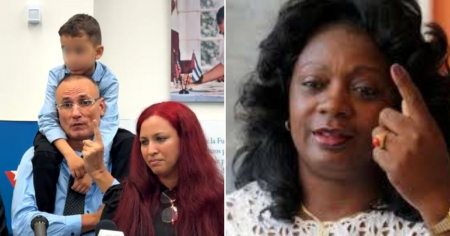
Dr. Nelva Ismarays Ortega Tamayo, wife of opposition leader José Daniel Ferrer García, who arrived in Miami this Monday exiled by the Cuban regime, expressed her sadness for having to leave behind many needy people in Cuba to whom she provided food and offered medical assistance in her own home.
Ortega, a physician by profession, along with Ferrer and three of his children, arrived at Miami airport on a direct flight from Santiago de Cuba, after the opposition leader was released from prison, as a result of a lengthy negotiation process that culminated in his forced exile.
During the press conference held by the founder of the Cuban Patriotic Union (UNPACU) at the headquarters of the Cuban American National Foundation (FNCA), Ortega also answered questions from journalists from various media outlets.
The doctor was unable to hold back her tears as she expressed what it means for her and her family to have been forced to leave the country as a condition for Ferrer's release from his arbitrary imprisonment.
It is "an extremely difficult situation", he admitted. "One might think about going out to explore at some point, but not like this."
Ortega revealed that they were "happy to be free," but his voice broke while confessing the sadness of "leaving family, leaving friends, leaving so many social cases that exist there."
According to her testimony, shortly before leaving for the airport, people who have received her help approached her with concern. “This morning, while it was raining, they said to me: ‘Doctor, what are we going to do now? There’s no José Daniel, there won’t be a doctor, what will we do?’”.
He explained that they always tried to help the poor population in the face of the terrible food crisis in the country, and held the government responsible for the hardships that Cubans are experiencing, especially those who are most vulnerable.
"It hurts greatly to see that, how a regime enjoys having its people in such a state. It hurts immensely the struggle that so many mothers face having their children without electricity, without anything to provide them for food, because the government doesn't even supply that; it's not just about food, it's medical care, it's everything, it's zero, it's nothing. They take pleasure in it," she affirmed.
"It's very hard to leave family, to leave friends, to leave everything, but as my husband says, we will return, we will return, and very soon, very soon," she assured emphatically.
Fears Before Exile
In response to another journalist's question, Ortega stated that they experienced “very tough” moments in recent days due to the fear that State Security agents would burst into their home in the early morning to take them to the airport, because “they didn’t want anyone to know what was happening.”
But, despite the worry and fear of harassment and being followed, it gave her “some encouragement” when the children -Danielito and Anita- told her that “the best thing about being in a country with freedom was that they could be with dad, and above all, they would be able to enjoy their dad”.
Ortega spoke about the impact that Ferrer's incarceration has had on his younger children. “It’s not just about the fact that the child was little; we were able to experience – I can say ‘experience,’ even though it was in prison – the first birthday that Anita could have, turning 11, and for the first time she was able to be with her dad. And all those things one suffers through,” he emphasized.
"It hurts to see, as a mother, when children have to suffer simply because of a dictatorship, because of such a criminal and murderous regime; the ones most affected are the children when they cannot be with their parents. That situation is extremely painful," she acknowledged, very affected.
He also recounted the tense moments they experienced at the Santiago de Cuba airport before boarding the flight. The wait was nearly two hours until they were able to meet Ferrer right at the airplane door. "We didn't breathe until we got there, and he met us," he stated.
Regarding this situation, Ferrer clarified: “The fear that they would put me on the plane and leave them in Cuba as hostages was primarily based on the fact that they tried for two months to force me to go to Guyana or Nicaragua, alone.”
"I told them: kill me if you want, but I am not going to leave my family behind," he recounted to the journalists.
Ferrer, 55, accepted the exile imposed by the regime of the island as a condition for his release from prison. His release occurred after more than four years of detention and harassment by the Cuban regime.
Shortly before noon on October 13, the opposition leader traveled to Miami accompanied by his wife and other family members, as well as a consular team from the United States Embassy in Cuba.
Frequently Asked Questions about the Exile of José Daniel Ferrer and His Family
Why was José Daniel Ferrer exiled from Cuba?
José Daniel Ferrer was exiled from Cuba as a condition for his release from prison, following a lengthy negotiation process. The Cuban regime forced him to accept forced exile, a demand he accepted to protect his family and escape the inhumane conditions of the prison where he was held. This measure is part of the political repression of the Cuban government against its opponents.
What is the situation of the needy people that Ferrer's family supported in Cuba?
The family of José Daniel Ferrer, especially his wife, Dr. Nelva Ismarays Ortega, provided medical assistance and food to those in need in Cuba. With his departure, these individuals have been left without the support they were receiving, as the Cuban regime does not adequately meet the basic needs of its citizens, worsening the food and healthcare crisis in the country.
What measures has the international community taken regarding the case of José Daniel Ferrer?
The international community has condemned the imprisonment and exile of José Daniel Ferrer, demanding his release and that of other political prisoners in Cuba. Human rights organizations and governments, such as that of the United States, have expressed their support and have denounced the human rights violations committed by the Cuban regime against Ferrer and his family.
Filed under: