
Related videos:
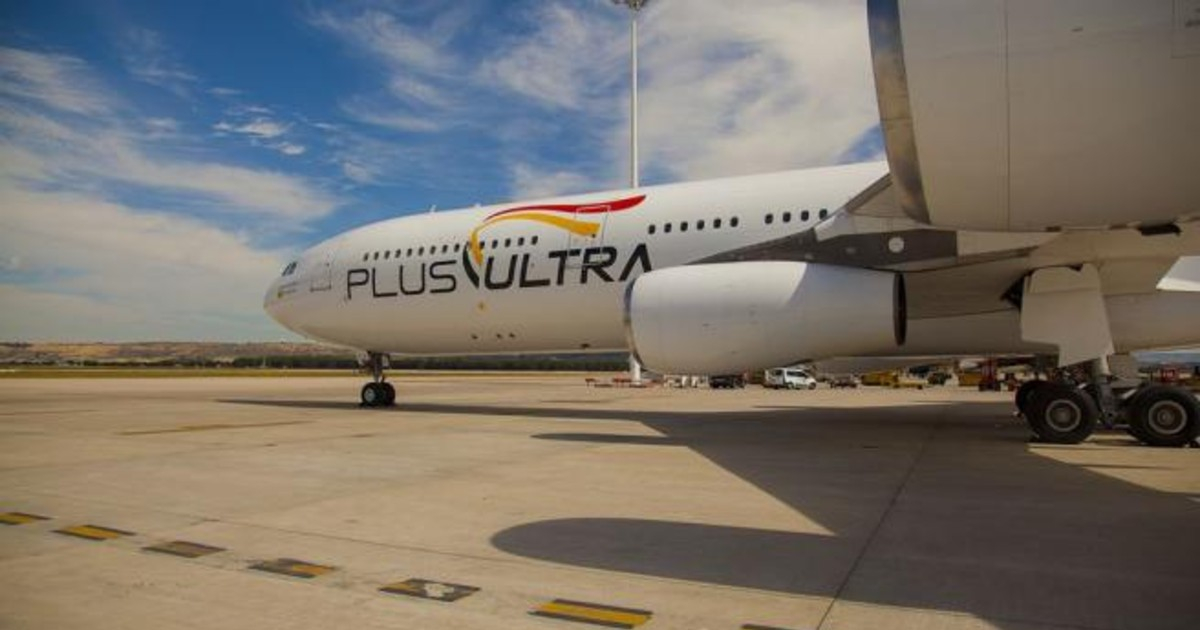
The Spanish National Police has just arrested in Madrid the president and owner of Plus Ultra, Julio Martínez, and the CEO, Roberto Roselli, in an operation related to alleged money laundering that raises doubts about the million-euro bailout received by the airline and its connections to Venezuela, as well as contracts that directly affect Cuba. From the island, this case is significant because Plus Ultra has been a key player in flights, medical missions, and connections between Havana, Madrid, and Caracas.
Who are the National Police and UDEF?
To clarify, the UDEF is the specialized unit for economic and tax crimes. It handles cases of corruption, illegal commissions, money laundering, and dirty money schemes. If the UDEF is raiding a company and arresting its executives, it is because the issue at hand is not just a simple administrative irregularity, but a case of potential corruption or large-scale money laundering.
What is SEPI and why is it important to Plus Ultra?
The SEPI is the major public holding of the Spanish state: a group that manages the government’s stakes in companies (energy, industry, media, etc.). During the pandemic, it was tasked with managing a Support Fund for the Solvency of Strategic Companies, funded with billions to rescue “key” companies for the economy.
Through this fund, SEPI approved a bailout of 53 million euros for Plus Ultra in 2021: 19 million in a regular loan and 34 million in a participative loan (a type of credit that resembles an equity investment). This decision is the political and judicial origin of everything that is happening now, as economic media have detailed while discussing the controversial bailout of 53 million euros.
Why was the rescue so controversial?
Viewed from Cuba, it helps to understand why the rescue of Plus Ultra became a scandal in Spain: Plus Ultra was a tiny airline, with only a couple of operational aircraft and less than 0.1% of the Spanish market. No bank wanted to lend it money, even with a public guarantee, but the State directly provided 53 million.
A significant portion of its business was focused on Venezuela and Cuba, not in the Spanish domestic market, and its shareholders included Venezuelan businessmen linked to the chavismo environment, who have been identified by other countries for alleged corruption and money laundering. The opposition in Spain criticized that a strategic company was not being rescued but rather a marginal airline closely tied to the regimes of Maduro and Díaz‑Canel was being favored with Spanish taxpayers' money.
Connection with Venezuela: chavismo and "boliburgueses"
Plus Ultra ended up largely controlled by Venezuelan capital close to the political power in Caracas. In Venezuelan slang, the term “boliburgueses” is used: businesspeople who became wealthy in the wake of chavismo, through contracts with the government, deals involving the Central Bank's gold, imports, food programs, and other opaque operations.
Those Venezuelan partners provided Plus Ultra with something more valuable than money: political access. Thanks to this support, the airline gained routes and preferential treatment on the Madrid–Caracas route at a time when Venezuela was increasingly isolated due to sanctions and economic issues, as documented by investigations into the “undeclared baggage” of Plus Ultra. The current suspicion is that Plus Ultra not only served to transport passengers but also to move and launder capital derived from Venezuelan corruption, utilizing internal loans, shell companies, and accounts in tax havens.
Connection with Cuba: flights, Cubana, and missions
For Cuba, Plus Ultra has been more than just "another foreign airline": Cubana de Aviación has restrictions on using many aircraft in Europe due to safety and environmental issues, and it is going through a chronic crisis of fleet and parts. Plus Ultra filled part of that void: it operated flights to Havana and signed cooperation agreements and aircraft lease agreements (wet lease) that, in practice, turned it into a partner of Cubana to maintain connections with Europe.
A symbolic case: a Plus Ultra Airbus A340 operated a flight from Madrid to Havana to Gabon with over 150 Cuban doctors, as part of the medical missions that are one of the main sources of income for the Cuban state, as revealed by specialized press when uncovering that the rescued Plus Ultra also conducted business in Havana. In other words, the airline was part of the logistical machinery of one of the most sensitive and profitable enterprises for the island's government.
How the UDEF got involved in the case
After the rescue in 2021, a court in Madrid opened a preliminary investigation to determine whether public aid regulations had been violated and if the reports that justified the rescue were "manipulated," in line with the concerns expressed in headlines such as “Plus Ultra will not be able to repay the rescue”. That case was closed for technical reasons, but it did not dispel the doubts.
Over time, prosecutors and investigators began to cross-reference data with other European countries: suspicious financial operations emerged between Plus Ultra and companies associated with Venezuelan corruption networks. Loans between companies in the same environment were detected, difficult to justify for commercial reasons, along with payments to companies in Panama, the Emirates, and other opaque financial centers, as well as movements exceeding one million euros linked to individuals already under investigation in Switzerland for Venezuelan money laundering, as has been reported in chronicles about the detained executives of Plus Ultra.
What is being researched now exactly?
What is at stake is not only whether the bailout was "timely" or "ethical," but something far more serious: whether Plus Ultra was used as a vehicle to launder money originating from Venezuelan corruption and if part of the 53 million euros provided by the Spanish state ended up being used to regularize or repay alleged loans from those networks, instead of saving jobs and real economic activity, as suggested by the tracking of the rescue funds.
It is also being investigated how the routes and contracts of the airline with Venezuela and Cuba fit into this network, including flights and services that directly impact the Cuban state economy. That is why the unit in charge is the UDEF (Economic and Fiscal Crime) and not a mere administrative unit: this is a case of potential international corruption, with high-level political and financial connections.
How does this look "from Cuba"?
From the perspective of Havana, the Plus Ultra case reveals three uncomfortable truths: that a key airline for travel, missions, and connections between Cuba and Europe may be deeply involved in a money laundering legal process in Spain; that the same networks of entrepreneurs and officials supporting chavismo and the Cuban elite have likely used front companies in Europe to move and launder money; and that part of the European public bailout system during the pandemic ended up benefiting an economic and political mechanism that links Caracas and Havana.
What can happen in the short term?
If the investigation forces Plus Ultra to reduce operations, cancel routes, or enter into insolvency proceedings, Cuba may temporarily lose seats and frequencies on certain routes (especially those where the Spanish airline provides aircraft and operations). The impact will be greater because Cubana has only two operational aircraft and relies precisely on leases like that of Plus Ultra to maintain part of its European connectivity.
If Iberia, Air Europa, German charters, and other operators maintain or increase their frequencies, the effect will be felt more in prices, layovers, and schedule stability than in a complete breakdown of the Cuba–Europe air bridge.
Filed under: