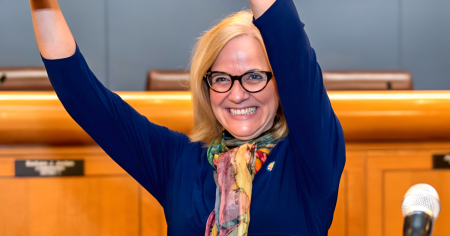
Eileen Higgins was sworn in on Thursday as the mayor of the city of Miami, becoming the first woman to hold the position and the first Democrat elected to lead the city in over two decades.
The ceremony took place in the auditorium of the downtown Miami Dade College campus, before a packed room of supporters, elected officials, and local political leaders.
The oath was taken by the Secretary of the Miami-Dade County Court, Juan Fernández-Barquín. Higgins was accompanied by her parents and received a lengthy ovation from the audience present.
In the front rows were the mayor of Miami-Dade County, Daniella Levine Cava, the outgoing mayor of Miami, Francis Suárez, the five city commissioners, and several of Higgins' former colleagues on the County Commission.
In her first speech as mayor, Higgins emphasized the message that marked her electoral campaign.
"They chose competition over corruption, leadership over distraction, and public service over political stagnation," he stated.
He added that his commitment will be to turn that vision into concrete and measurable actions.
"My job now is to carry out their decisions and to bring the vision to fruition with determination: a city defined not by what we say, but by what we do," he emphasized.
The new mayor made an explicit call for unity and directly addressed those who did not support her at the polls. "I am here to serve everyone," she said.
He emphasized that Miami must serve all its residents, regardless of their origin, language, beliefs, political preferences, or place of residence.
"The diversity of our community is our strength," she stated.
Higgins, 61 years old, took office after winning the elections on December 9 with approximately 60% of the votes against the Republican Emilio González, a candidate supported by President Donald Trump and the Governor of Florida, Ron DeSantis.
Although the municipal elections in Miami are officially nonpartisan, the outcome ended a 24-year streak without a Democrat winning the Mayor's office, since Manny Díaz took office in 2001.
In addition to being the first woman, she is the first non-Hispanic person to hold the position of head of the municipal government of Miami, a city with a Latino majority.
His victory was seen as a significant political shift in South Florida and as an indication that the electoral map of the region continues to evolve.
During the ceremony and in previous statements, Higgins reiterated that one of her priorities will be to bring order to a City Council that, according to her, has been characterized by chaos and internal conflicts in recent years.
Among the key topics that will be central to his agenda, he mentioned the creation of more affordable housing and the reform of the city's problematic permitting system, which has been a source of complaints from both residents and business owners.
"We must act like the government of one of the most famous cities in the world," she declared last week, referring to the need to improve the efficiency and credibility of the municipal administration.
Higgins will govern alongside a mostly new Municipal Commission with little experience.
Following the recent elections, Christine King is the longest-serving commissioner, starting her second term. Rolando Escalona unexpectedly won District 3 against former commissioner Frank Carollo; Ralph Rosado, an urban planner with no prior public office experience, joined after a special election in June; and Miguel Ángel Gabela and Damián Pardo are halfway through their first term.
In the political arena, Higgins' arrival at the City Hall coincides with the democratic leadership of Daniella Levine Cava in Miami-Dade County, an unprecedented occurrence that solidifies a moment of female prominence in key positions of local government in South Florida.
Before her tenure as county commissioner, Higgins worked in the United States Foreign Service from 2009 to 2012. During that time, she served as a staff assistant to the U.S. ambassador in Mexico and later as the Economic and Energy Affairs Officer for South Africa and Namibia.
In her campaign and now as the elected mayor, Higgins has also expressed her opposition to the 287(g) agreement signed by the Miami Commission with the Immigration and Customs Enforcement (ICE), which allows local police to collaborate in federal immigration enforcement tasks. The issue remains one of the sensitive points in the political debate in the city.
"When we come together, when we share this city and respect one another, our opportunity is limitless," stated Higgins during his speech at Miami-Dade College.
With his oath, a new chapter begins in the politics of Miami, marked by expectations of change in one of the most emblematic cities in the United States.
Filed under: