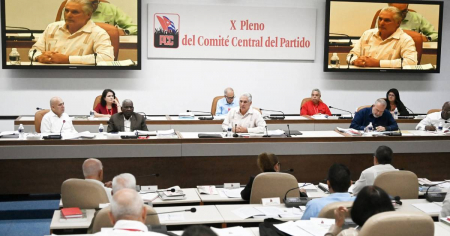
As a result of the proposals from the country's top leadership within the framework of the VIII Congress of the Communist Party of Cuba (PCC), economist Ángel Marcelo Rodríguez Pita emphasized the resistance of the government to stimulate economic processes.
This Monday, in a new episode of Las mañanas de CiberCuba, the member of the political initiative Cuba Humanista emphasized that the Cuban state is resistant to recognizing the private sector on equal terms, in its intention to establish itself as the main economic manager in Cuba.
“It does not recognize the private sector as an ally, nor does it want to acknowledge it as a competitor,” said Rodríguez Pita.
The economist mentioned the existence of "a legal framework that undermines rights" in this sector, through regulations and standards that are implemented inadequately, leaving “many gaps” to exercise “control mechanisms” aimed at hindering the development of private management. It is a way to disqualify this sector, he stated.
In this regard, the Minister of Economy Alejandro Gil Fernández emphasized during a plenary session of Congress the need to strengthen state-owned enterprises and to subordinate other forms of production to this, appealing to legal and tax instruments that limit capital and profits for small and medium-sized entrepreneurs to hinder their development. In practice, self-employment is viewed by the authorities as a necessary evil whose role is essentially complementary.
However, the economist stated that private entrepreneurs cannot be excluded from the economic life of the country, as they are part of the strategy to invigorate economic processes under the current circumstances: “The reforms involved in the economic ordering task cannot be halted because their survival depends on it”, he specified, referring to the power structure in Cuba.
Rodríguez Pita stated that "the Cuban government is a large tank that cannot move" , and added that one of its major problems is the "non-social public spending" generated by the government's leadership, with a deficit that the state has not been able to control. "If that structure does not change, the economy will be in total decline," he concluded.
This Monday, the structure of the PCC was announced, with Miguel Díaz-Canel appointed as its First Secretary. So far, the position of Second Secretary has not been announced.
In this new political context, Rodríguez Pita predicted a clearer path for the promotion of local development, as Díaz-Canel could exert greater influence as the designated president and now as the leader of the party organization following the retirement of Raúl Castro.
Granting more power to state institutions and companies seems to be the goal of the PCC's strategy, which has not been satisfied with six decades of unproductivity and inefficiency. All of this is happening without a strategy that clearly indicates how to pull the country out of the systemic crisis it is facing and without proposals that suggest a concrete update of a failing economic model.
Filed under: