
Related videos:
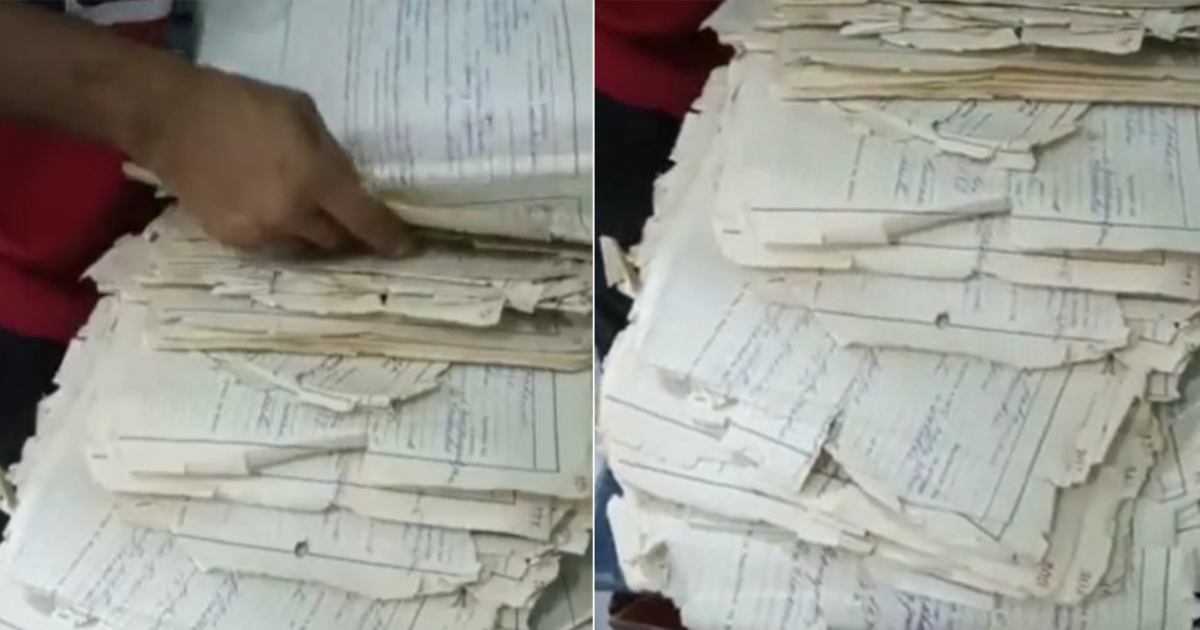
A Cuban has shared a video on social media showing the advanced state of deterioration of the records at the Civil Registry office in Centro Habana.
“Please pay attention. What I am going to show in the video, I'm not sure if it is beneficial or harmful. This is the civil registry book from Centro Habana; don’t be surprised if when you request a birth certificate, they tell you that you have not been born,” reported on Twitter the user known as Letha, a Cuban resident in Florida.
In the video, a man can be seen reviewing a stack of files written in ink that are in a state of significant deterioration, crumpled and disorganized, while he highlights that birth records begin to disappear from a certain date.
Several users have shared their own experiences in the comments to the tweet regarding their dealings with the registration offices.
"I went to get an enrollment, and they had to do one for recovery. Because my book is one of the ones that was destroyed. And it took three months," reported a user.
"I have not been born, nor am I in the system; a mouse has eaten my page from the registry. For all the certifications I’ve obtained in the last 15 years, I pay a colleague and dictate my information to them. He or she always tells me: now we’ll put you in the system, but they never do," comments another.
Another user explains that, while it is a nightmare to carry out a process or find a document in the civil registry offices, in the Food Control and Distribution Offices (OFICODA), on the contrary, the entire system is automated, and “three months after leaving the country, even if you are on vacation, sick, or visiting a family member, bam, you are canceled.”
In addition to the OFICODA, the Ministry of Interior (MININT) processing services, related to the repression of the citizens on the Island, were made available since last February through its virtual application.
The citizen services for voter registration and vessel registration, which were previously offered by processing offices in Cuba and through the citizen service email, are now managed through this new digital service.
The request for services is made through the portal of that ministry, which requires authentication by entering the identity information of the interested party. The portal will display the completed procedures, as well as the details of the driver’s license and the vehicle. It also includes access for locating detained individuals.
While some of these services have been helpful to dozens of people in Cuba, others, such as locating detainees, have been at the center of the debate since the government routinely refuses to provide information about arrested activists and opponents.
At the end of 2021, the Cuban Carmen Raquel Panizo Villares reported the ordeal she faced to obtain her husband's death certificate, who passed away at the Pedro Kourí Institute (IPK) in September in Havana due to coronavirus.
Since the death of her husband Alberto Rojas Ortega, she has been caught in a labyrinthine process of tedious paperwork to obtain the aforementioned official certificate.
Filed under: