
Related videos:
The Cuban regime once again resorted to its strategy of political disqualification to justify the country's economic and social crisis, caricaturing the tumultuous and vibrant republican past of the island once more.
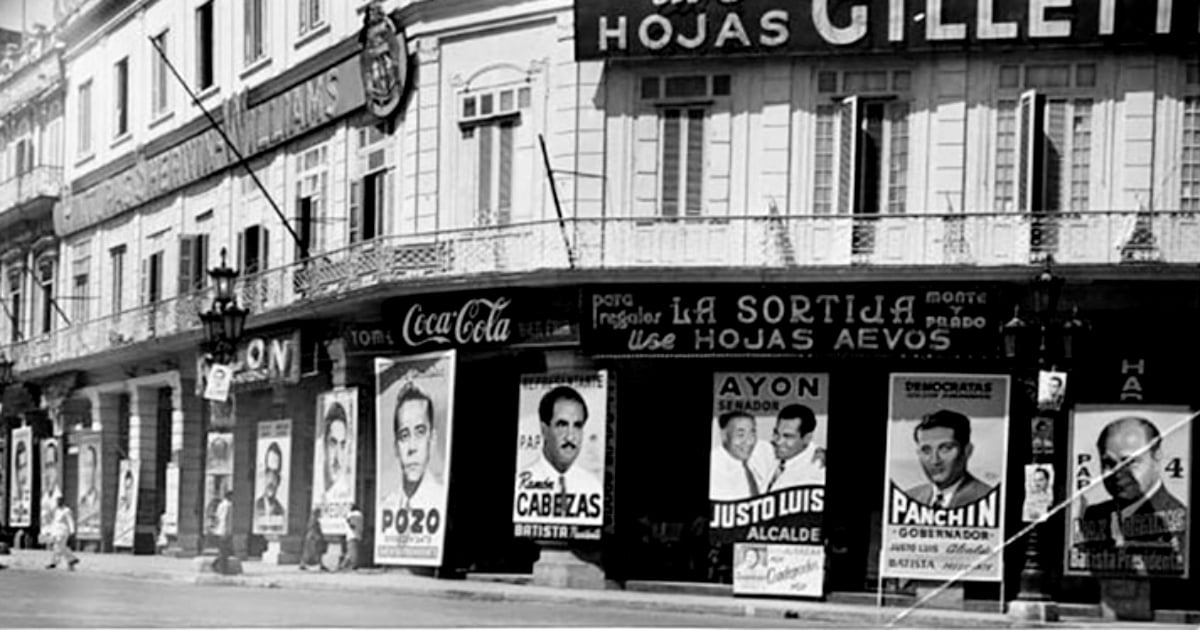
In response to the recent decisions made by the United States government, the Ministry of Foreign Affairs issued a statement in which it described those Cubans advocating for a shift towards democracy after 66 years of absolute Castroism as "political heirs of Fulgencio Batista."
The historical paradox is evident: the very government of the so-called "Revolution" has maintained uninterrupted power since 1959 without allowing democratic, open, and multi-party elections for over 77 years, far exceeding the period of Batista's dictatorship, which lasted just seven years.
The measures announced by the United States include the reactivation of Title III of the Helms-Burton Law, which allows U.S. citizens to file lawsuits against foreign companies operating on properties confiscated after 1959.
Furthermore, the List of Restricted Cuban Entities was expanded, prohibiting transactions with new state-owned companies such as Orbit S.A., the entity responsible for processing remittances in Cuba following the sanctions on Fincimex.
Both have been reported as entities under the umbrella of the Business Management Group S.A. (GAESA), controlled by the military and the leadership of the Cuban regime.
Through these measures, Washington aims to increase pressure on the regime and expose its repressive and antidemocratic nature.
In response, the Cuban regime decided to intensify its rhetoric, pointing to the sanctions as part of an "economic siege" designed to suffocate the country, and applauded by anti-patriotic Cubans, "plattists," and "political heirs of Batista."
In its manipulative zeal and driven by its outdated and crude propaganda machinery, Havana deliberately ignores the devastating impact of its own failed policies, as well as the systemic corruption that pervades its administration.
Under the discourse of "continuity," a term adopted by Miguel Díaz-Canel since his rise to power in 2018, the regime has attempted to provide a false legitimacy to the extension of its totalitarian model and the persistence of its elites in power.
This "continuity" is actually the perpetuation of the Communist Party of Cuba (PCC) as the only legal and decision-making force in the country, ensuring an absolute monopoly on power and institutionalized violence, repressing any expression of political dissent and practicing a "state terrorism" condemned by international organizations as well as non-governmental organizations.
By establishing itself as the only legal party since the 1976 Constitution, the PCC has consolidated a system where decision-making is still monopolized by a closed group of leaders who prevent any political alternatives.
The centralization of power within the Party has resulted in the systematic denial of fundamental rights and the elimination of any form of political pluralism on the island.
This model has led to a deep crisis, characterized by shortages of food and medicine, constant power outages, and a partial dollarization of the economy, while those at the top continue to accumulate wealth and privileges.
Despite the official rhetoric, Cubans continue to demand profound changes. Mass emigration, social protests, and the economic crisis highlight a growing rejection of the "continuity" upheld by the regime.
Cuba remains trapped in a system that resists democratization, perpetuating the lack of freedoms and the suffering of its people. The rhetoric of "continuity" is nothing more than an attempt to disguise the reality of a dictatorship that has survived thanks to repression, the absence of freedoms, and absolute control over the means of production.
While the Cuban people cry out for real change, the regime clings to its empty rhetoric, using the history of the republican era as a mirage to divert attention from its own lack of democratic legitimacy.
In this context, the responsibility for the national crisis lies not in external decisions, but in the perpetuation of a system that has proven to be unviable and detrimental to the Cuban people.
Filed under: