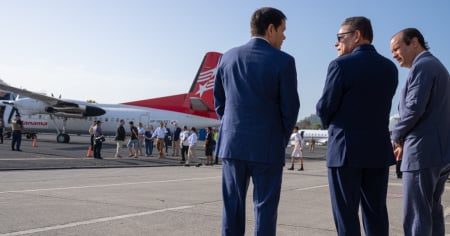
The United States Secretary of State, Marco Rubio, has taken on the role of interim administrator of the United States Agency for International Development (USAID).
Rubio, during a tour of Latin American countries, stated that USAID has failed to promote the national interests of the United States and accused it of acting like a "global charity."
In a tweet posted on X by journalist Reshad Hudson, the Cuban-American emphasized that the government of President Donald Trump does not intend to eliminate the agency entirely, but rather to align it more closely with U.S. foreign policy, which is why it was put under the control of the Department of State.
This decision comes amid a significant restructuring of the agency, which includes a substantial reduction in its staff.
In a video posted by the account Rapid Response 47 (the official account of the White House Rapid Response), Trump himself commented on USAID: "I love the concept, but they turned out to be radical left lunatics. The concept is good, but what matters is the people."
The billionaire Elon Musk, tasked with leading the "government efficiency office" in the Trump administration, has also harshly criticized USAID, describing it as irreparable and advocating for its closure.
These measures have sparked criticism from Democratic lawmakers, who argue that the dissolution or merger of USAID could weaken the United States' influence abroad and benefit rival nations like China.
USAID, founded in 1961, is responsible for administering U.S. civilian foreign aid and development assistance, managing a budget of over $50 billion and operating in more than 100 countries.
"That's ridiculous. It's taxpayer dollars," said Rubio upon his arrival in El Salvador.
The suspension of funds puts the continuity of these initiatives at risk, limiting essential resources for their operation.
But the Trump administration defends the measure, arguing that it seeks to reassess and align foreign aid with the national interests of the United States.
The absorption of USAID by the State Department and the freezing of foreign aid represent a significant shift in the United States' international assistance policy, with potential repercussions for organizations and projects in Cuba and other regions that relied on this support.
Undoubtedly, these types of decisions raise concerns about the impact on Cuban non-governmental organizations and media that depended on U.S. external assistance.
Frequently Asked Questions about Marco Rubio's Control over USAID and Its Impact
Why did Marco Rubio take control of USAID?
Marco Rubio took over the control of USAID as interim administrator to align the agency with the foreign policy of the United States. This decision was made in the context of a significant restructuring under the administration of Donald Trump, with the aim of reevaluating and adjusting foreign aid to national interests.
What criticisms has USAID received under the Trump administration?
USAID has been criticized by figures such as Elon Musk, who called it a "criminal organization" and advocated for its closure. The Trump administration and Musk have pointed out that the agency was operating as a "global charity" instead of serving the interests of the United States. These criticisms have led to a restructuring and the absorption of USAID by the Department of State.
What impact does the restructuring of USAID have in Cuba?
The restructuring of USAID and the freeze on funds have jeopardized the continuity of initiatives that supported independent media and NGOs in Cuba. This change could undermine support for democratization and human rights on the island, raising concerns about the impact on organizations that relied on U.S. assistance.
What objectives does the Trump administration seek with the control of USAID?
The Trump administration seeks to align foreign aid with the national interests of the United States. By integrating USAID into the State Department, the aim is to ensure that foreign aid programs do not operate independently of U.S. foreign policy and that they are effective and consistent with the country's priorities.
Filed under: