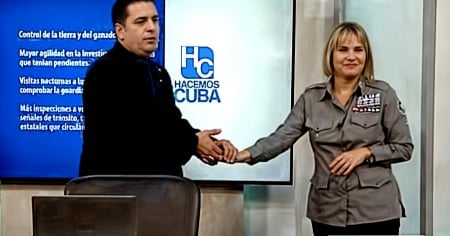
Cuban Television utilized prime time to issue a public warning to the political prisoners released in recent weeks, making it clear that any action deemed as a violation of the imposed conditions could result in their return to prison.
In a report presented by Humberto López on the state-run program Razones de Cuba, it was reaffirmed that these releases do not constitute an amnesty and that those released continue to be under strict supervision of the regime.
"The early release processes announced on January 14 constitute legitimate acts of a sovereign state regulated clearly and in detail by current legislation," López assured in the television segment.
At the same time, he made it clear that these benefits have "requirements that are also very clear and mandatory," and that failure to comply with these will result in the "revocation of the benefit" and "re-admission to the penitentiary facility."
The message from the government also targeted the activists and opponents who have denounced the release process as a manipulation tactic by the regime to enhance its international image.
López accused the activists—whom he referred to as "terrorists of the digital space"—of inciting the released individuals to challenge the imposed conditions and provoke their re-incarceration. "Those who heed these mandates will not be able to have a normal life," the host warned, in a tone that many interpret as a veiled threat.
The report also mentioned that Cuban Penal Execution Law allows for the revocation of probation if the individual "violates any of the established obligations or is sanctioned for a new offense."
In the case of extrapenal freedom, reentry into prison would be justified if the beneficiary "does not display good behavior." The report reaffirmed that the process of releases has been carried out as an act of "humanitarian political will" before the Vatican, within the framework of a "socialist state based on the rule of law and social justice."
This intervention on national television comes at a time of increasing tension, following the Cuban regime's abrupt halt of the political prisoner release process after the initial weeks of releases, a decision condemned by international organizations and Cuban civil society.
The campaign of public threats against the released prisoners reinforces the arguments of these accusations and calls into question the authenticity of the releases, which in many cases have been accompanied by state pressure and surveillance.
Second message broadcast in less than a month: Is there fear in the Palace?
This is the second time in less than a month that Humberto López has broadcast a similar message on Cuban television, reinforcing the regime's position that the releases do not mean total freedom for the freed political prisoners.
In its first broadcast, the host also addressed the released prisoners and their families with warnings about the risk of re-incarceration should they fail to comply with the conditions set by the government.
The hardening of the regime's rhetoric occurs in a context of growing international pressure. The United States has denounced the persecution against opposition leaders such as José Daniel Ferrer and has insisted that the releases are insufficient without a genuine democratic opening in Cuba.
The United States Embassy in Havana recently reiterated its call for the unconditional release of all political prisoners.
The releases announced on January 14 were framed by the regime as an act of "political will," but human rights organizations have reported that this is a strategy to relieve international pressure without truly altering the repressive structure of the government.
The above became evident after Cuba's return to the list of countries supporting terrorism by the Trump administration, which reversed the decision of the previous administration, prompting a reaction from Havana and the immediate halt of the release process negotiated with Joe Biden.
Of the 553 prisoners that the Cuban totalitarian regime promised to release, only a fraction have been freed so far, and the process has been interrupted without official explanations.
In one of its latest reports on the matter, the non-governmental organization Justicia 11J counted a total of 145 political prisoners released, out of more than 1,000 as reported by organizations such as Prisoners Defenders, Cubalex, and the Cuban Observatory of Human Rights (OCDH).
At the same time, independent media and activists have warned about the surveillance and harassment faced by those who have been released from prison. According to testimonies, they have been summoned for interrogations and warned about their public behavior. The #TODOS initiative, a data journalism platform, has documented these cases and closely monitors the situation of the released political prisoners.
Filed under: