The Deputy Minister of Domestic Trade, Aracelys Cardoso Hernández, acknowledged during her speech at the Round Table that the supply in national currency is inadequate due to a contraction in production and a deficit of foreign currency, which hinders the restocking of domestic trade.
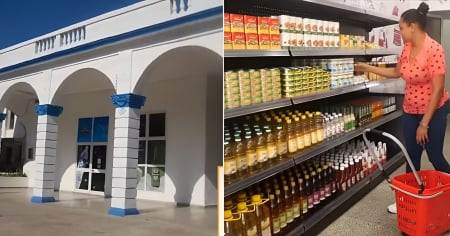
The Cuban government has announced the opening of 50 new dollar stores, thereby strengthening the foreign currency trade within the country.
This movement is part of a broader strategy for foreign currency collection, in a context where the supply in national currency remains insufficient.
On the other hand, dollarization not only fails to resolve the structural issues of the Cuban economy, but it also deepens inequality and limits access to basic goods for those who rely on salaries and pensions in Cuban pesos.
New business models in wholesale and retail trade to capture foreign currency
Cardoso Hernández recalled that since the easing of sectoral policy in 2022, various business models have been implemented in wholesale and retail trade to generate income in foreign currency. The ultimate goal, he said, is to achieve a greater supply in national currency that benefits the population.
As of today, 15 wholesale and retail marketing businesses have been approved, of which eight are linked to the enterprise system of the Ministry of Domestic Trade.
One of these businesses operates under an international economic partnership contract.
In terms of wholesale marketing, three businesses are exclusively dedicated to this activity, while five mixed companies have been authorized to sell both wholesale and retail consumer goods and various products.
Cardoso Hernández emphasized that wholesale marketing must ensure the supply of raw materials and supplies that promote national and local production, in addition to prioritizing the availability of essential products, such as hygiene items, household goods, and food.
Alma Caribe S.A.: Expansion of wholesale and retail trade
Sonia Rivero Batista, a Cuban manager of the mixed company Alma Caribe S.A., explained that this entity is engaged in the marketing of both food and non-food products, sourced from national production as well as imports.
In its first stage, the company will prioritize the supply of food, cleaning, and hygiene products, with the goal of meeting the demand of both wholesale and retail trade.
Alma Caribe also aims to ensure a stable supply of raw materials and inputs necessary for the development of the national industry and non-state management forms. The company will soon open its first store in El Vedado, specifically on 23rd Street.
For its logistical design, it has studied experiences from similar markets, such as the one at 3rd and 70 in Playa.
As part of its expansion strategy, Alma Caribe plans to open 15 stores in Havana during the initial phase, and in a second stage, it will expand its network to 50 stores across the country, of which 48 will be newly constructed. At the same time, it is working on developing an online commerce platform.
Mercalhabana S.A.: A New Venture in Wholesale Trade
The Ministry of Interior Trade has established Mercalhabana S.A., a commercial company aimed at strengthening wholesale and retail trade.
According to its vice president, Yaimara Pérez Barrera, this entity represents a system of 22 wholesale companies and aims to participate as a shareholder in foreign investments, as well as manage imports and exports to supply the country's wholesale channel.
Mercalhabana S.A. has an extensive network of warehouses and is partnered with the National Refrigeration Company, which provides essential refrigeration capabilities.
However, Pérez Barrera acknowledged that the current infrastructure shows significant technological deterioration, which is why the company's strategy focuses on modernizing equipment and renovating its facilities.
Despite its recent establishment, the company has already secured a deal in the form of a joint venture for wholesale and retail marketing and is exploring other similar opportunities.
Additionally, it has implemented alternative marketing methods, such as consignment sales and the customs deposit regime, which has allowed for a partial restocking of wholesale trade.
Deputy Minister Cardoso Hernández concluded her remarks by stating that wholesale marketing will strengthen the Cuban market and enable the renewal of the national industry, ensuring a greater supply for the population.
"Domestic trade in national currency is and will continue to be predominant in our country. The population must have confidence, as despite the current situation of the Cuban market, it is a priority of the State and our ministry to maintain and expand offerings in national currency," he emphasized.
He also explained that currency trading is a necessary temporary measure to acquire resources that will sustain social programs. "The partial dollarization of the economy is a short-term strategy. The Cuban state will define priorities for the use of these currencies based on the needs of the population, the economy, and industrial development," he concluded.
Reaction of economist Pedro Monreal
The economist Pedro Monreal has critically analyzed this strategy, pointing out that wholesale currency trade, presented as a mechanism to strengthen national production, does not effectively guarantee supplies unless structural problems are resolved, such as stability in electricity supply and the existence of real incentives for national producers.
Moreover, Monreal warns that this collection system has not proven in practice that the funds obtained translate into a greater supply of national currency for the population.
Instead, there has been an observed strengthening of the state commercial infrastructure that monopolizes retail trade in foreign currency.
The economist also questions the official narrative that proposes a "virtuous circle" of foreign currency acquisition, supply sales, and production promotion. Previous experiences, such as the case of GELMA, the state-owned enterprise responsible for selling supplies to agricultural producers in foreign currency, have shown that this scheme does not always deliver on its promises.
Another crucial point is that the expansion of internal trade in dollars is not so much a strategy for attracting remittances, but rather a maneuver to channel them from the informal market towards the large state-owned holdings.
This sidelines private players, who remain excluded from the wholesale foreign currency trade, while the dollarized retail trade continues to be monopolized by state-owned companies.
The Cuban government has justified this strategy as part of a series of measures for "flexibilization" and "attracting foreign investment," but these statements contrast with the reality of a highly restricted market dominated by the state monopoly.
The expansion of foreign currency trading imposes an additional barrier to the participation of private actors in the economy and reinforces a model where only a few state sectors have access to the benefits of dollarized trade.
In this context, for Monreal it remains to be seen how the new currency allocation mechanism announced by the government will operate and whether it will lead to a "reshaping" of the foreign exchange market, or if it will simply continue to benefit the same privileged sectors within the state apparatus.
Frequently Asked Questions about Partial Dollarization and Currency Trading in Cuba
What does the opening of new dollar stores in Cuba imply?
The opening of new dollarized stores in Cuba represents an effort by the government to collect foreign currency in a context where the supply in national currency is insufficient. This move aims to strengthen trade in hard currency, although it has also been criticized for increasing inequality and limiting access to basic goods for those who only earn in Cuban pesos.
How does partial dollarization affect the Cuban economy?
Partial dollarization affects the Cuban economy by creating a system where only those with access to foreign currency can purchase goods in dollarized stores. This deepens economic inequality and restricts access to products for the majority of the population, who receive their salary in national currency. Moreover, it does not address the structural problems of the economy and may weaken the country's monetary policy.
What is Alma Caribe S.A. and what is its role in Cuban trade?
Alma Caribe S.A. is a mixed company dedicated to the marketing of food and non-food products, both domestically produced and imported. Its role in Cuban commerce is to prioritize the availability of food, personal care, and hygiene products, as well as to ensure the supply of raw materials and inputs necessary for the development of the national industry. It plans to open 15 stores in Havana and expand to 50 stores nationwide.
What is the objective of Mercalhabana S.A. in the Cuban market?
Mercalhabana S.A. seeks to strengthen wholesale and retail trade in Cuba through a network of 22 wholesale companies. Its goal is to participate as a shareholder in foreign investments and to manage imports and exports to supply the country's wholesale channel. The company is also working on modernizing its infrastructure to enhance the supply of essential products.
What criticisms has the partial dollarization strategy in Cuba received?
The strategy of partial dollarization in Cuba has been criticized for increasing economic inequalities and failing to address the structural problems of the economy. Experts such as economist Pedro Monreal have indicated that this system does not guarantee a greater supply in the national currency and only reinforces the state monopoly over retail trade in foreign currency, leaving out private actors and a large part of the population that relies on the Cuban peso.
Filed under: