
Related videos:
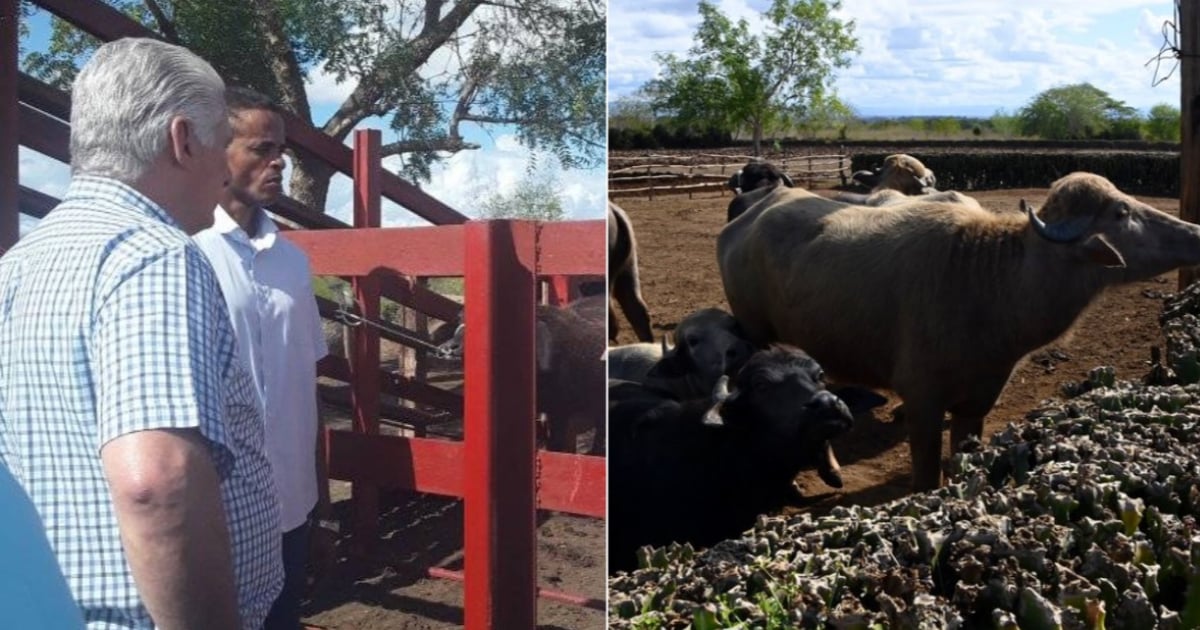
During his first visit to the municipalities of Guantánamo, the Cuban leader Miguel Díaz-Canel highlighted the production of buffalo meat and milk at Collective #1 of the Iván Rodríguez livestock company, presenting it as an example of the potential of this type of livestock in the country.
The leader emphasized the training and adaptation process of buffalo livestock to Cuban conditions for agricultural work, assuring that this initiative can contribute to land preparation, crop cultivation, and the transport of supplies and products, as reported by Presidencia Cuba on the social media platform X.
In this entity, a program for the production of milk, meat, and the provision of breeding stock is being developed to promote this livestock population in six municipalities, despite the challenges faced by the agricultural sector in the country.
According to the newspaper Venceremos on its Facebook profile, Díaz-Canel's tour of the municipality of Niceto Pérez included a visit to the Vaquería Browe, which is part of Farm #2 Buffalo Breeding of the Iván Rodríguez Livestock Company.
There, the leader emphasized the significance of meat and milk production, despite the drought and the challenges faced by workers, presenting yet another triumphalist example of the official narrative that promotes the idea of Cuba as a prosperous country to the world.
In this livestock unit, Díaz-Canel also acknowledged the effort of the cowboys to tame the powerful animals and employ them in tasks such as animal traction, hauling, and other typical activities of livestock farming, according to the text from Venceremos.
The regime has promoted buffalo farming in recent years as an alternative in response to the food crisis and the shortage of cattle.
However, despite official statements, the reality of the country remains marked by shortages of meat and milk, as well as precariousness in the agricultural sector.
Years ago, according to official data, Cuba imported 2,984 buffalo, of which 279 were of the river variety, coming from Panama and Trinidad and Tobago, while 2,705 were swamp buffalo brought from Australia.
Although those initial figures grew significantly in just a few years, the current reality contrasts sharply with that expansion. Today, the scarcity of this resource in the country highlights the regime's inability to sustain and develop agricultural projects over the long term.
While Díaz-Canel praises the production of buffalo meat and milk in Guantánamo, the reality for Cuban families is different: shortages and scarcity continue to define their daily lives.
Food scarcity in Cuba has reached alarming levels, and the government started distributing cola syrup in January as a substitute for milk for children, sparking outrage among affected families.
Since December, the regime had announced difficulties in ensuring powdered milk, initially offering chocolate as an alternative, but the new measure has sparked a wave of criticism.
Frequently Asked Questions about Buffalo Meat and Milk Production in Cuba
What is the objective of buffalo meat and milk production in Guantánamo?
The goal is to promote the potential of buffalo livestock in Cuba, highlighting its adaptation to the local environment to contribute to agriculture and livestock development in various municipalities. This production is viewed by the Cuban government as an alternative in response to the food crisis and the shortage of cattle.
What challenges does the production of buffalo meat and milk face in Cuba?
The production faces challenges such as drought and the precariousness of the agricultural sector, which makes it difficult to sustain long-term agricultural projects in the country. Despite the initiatives, the reality for Cuban families is characterized by supply shortages and a continuous scarcity of food.
How has the adaptation of buffalo livestock been in Cuba?
Buffalo livestock has been trained and adapted to work under Cuban conditions, participating in agricultural tasks such as draft animal work and the transportation of supplies. This adaptation is a key point that the Cuban government highlights as a step toward food sovereignty.
What criticisms have been raised regarding the management of the Cuban government in the agricultural sector?
Despite official speeches, criticisms point to the government's inability to sustain agricultural projects in the long term. The scarcity of food and lack of resources highlight inefficient management that fails to meet the basic needs of the Cuban population while promoting an image of success abroad.
Filed under: