
Related videos:
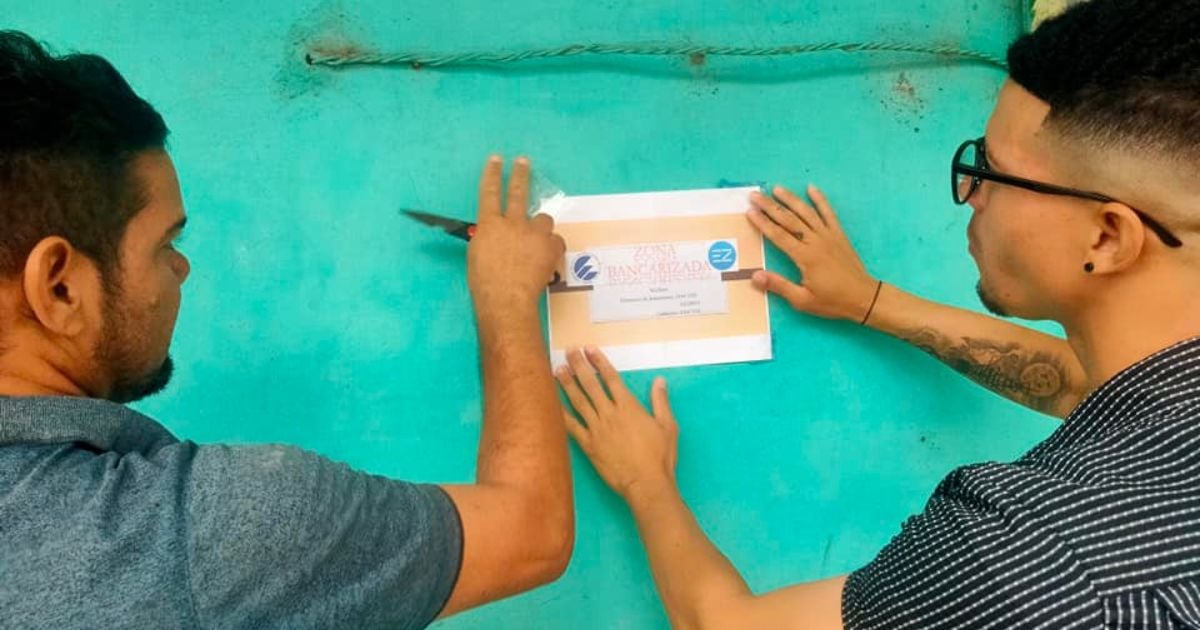
The Cuban regime continues to make useless contributions that do not address the real problems facing citizens: in the Guantanamo city of Baracoa, the government has started to mark a "Banking Zone" in the urban center with stickers, as part of its strategy to promote the use of electronic payments in businesses.
According to Radio Baracoa, the Banking Group of the municipality has begun placing these markers in two blocks of the city, from the Baracoa market (formerly Campón) to the ETECSA office on the pedestrian walkway.
The measure requires that businesses in the area must accept at least one of the electronic payment platforms implemented in Cuba, although the use of cash is not excluded.
However, the text itself points out that this measure "symbolizes the commitment of all the businesses involved," without specifying how mandatory its implementation is or whether its compliance is truly required.
Local authorities justify the initiative as a step towards financial modernization and the streamlining of transactions, but in practice, banking in Cuba has been a forced and deficient process, marked by constant failures in payment platforms and a population that does not always have access to the necessary digital means to operate in this system.
One of the most striking aspects of the sticker is that it includes government phone numbers that customers can contact in case of any issues with the service.
According to the local government, this tool (a sticker with phone numbers to report violations) guarantees "the protection of consumer rights and promotes transparency in business operations, consolidating trust in the banking process in the territory."
The authorities have assured that "the initiative will be extended to other areas of the municipality where coverage allows, with the aim of increasing the use of electronic payments in businesses."
However, for many Cubans, these types of government initiatives seem more like an attempt to cover up the country's economic deficiencies than a genuine solution to the problems of access to goods and services.
The process of banking in Cuba, driven by the government since August 2023, has been a subject of ongoing debate and frustration for the population. On that date, the regime approved a banking program aimed at reducing the use of cash and promoting digital payments. However, the measure faced significant resistance due to the lack of technological infrastructure and a distrust of the state financial system.
By April 2024, the situation had reached a critical point. The government acknowledged the failure of the process and its impact on the informal dollar exchange rate, which skyrocketed due to the shortage of cash in circulation. Cubans reacted with outrage, pointing out that the measure not only limited their access to cash but also complicated trade and basic services. The lack of operational ATMs, long lines at banks, and the imposition of electronic payments in a country with constant connectivity issues were some of the most reported problems.
Despite the challenges, in June 2024, Miguel Díaz-Canel insisted on the banking of agricultural markets, a measure that generated even more backlash, especially among producers who depend on cash for their daily transactions. The proposal aimed to digitalize payments in food marketing, but farmers warned that the Cuban banking system was not prepared to manage transactions in the agricultural sector without affecting product availability in the markets.
By late 2024 and early 2025, banking penetration became a key factor in the liquidity crisis in Cuba. In municipalities like Jovellanos, workers faced restrictions on withdrawing their salaries in cash, leading to long queues and widespread discontent. In Santiago de Cuba, even reports emerged of vandalism against bank branches, reflecting the desperation of a population forced to cope with a collapsed financial system.
Despite the government's attempts to present banking as an economic solution, the reality on the streets revealed a landscape of uncertainty and discontent. The failure of the program not only affected the daily lives of Cubans, but it also had an impact on the exchange rate, making access to foreign currencies more expensive and deepening the economic crisis on the island.
Frequently Asked Questions about Banking and Dollarization in Cuba
What is the "Banking Zone" in Baracoa and what is its purpose?
The "Banking Zone" in Baracoa is an initiative of the Cuban government that involves marking areas where businesses must accept electronic payments. The aim is to promote the use of digital payment gateways to modernize and expedite transactions, although its implementation is perceived as inadequate by the public due to the deficiencies in the system and the lack of access to digital means among the population.
What are the criticisms of banking in Cuba?
Criticism of banking in Cuba focuses on the fact that the process has been forced and inadequate, with frequent failures in payment platforms and limited access for the population to the necessary digital means. Additionally, many view the measure as an attempt to mask the country’s economic shortcomings rather than providing real solutions to the problems of accessing goods and services.
What implications does partial dollarization have for the Cuban economy?
Partial dollarization means that key sectors such as trade and tourism services operate in dollars, which deepens economic inequalities. While the government seeks to attract foreign currency and control the monetary flow, most Cubans, who do not have access to dollars, are excluded from these markets. This strategy increases the social gap and limits the effectiveness of monetary policy.
How do the current economic measures affect the Cuban population?
Economic measures, such as banking and partial dollarization, impact the Cuban population by increasing inequalities and restricting access to basic products for those who rely on Cuban pesos. These policies are viewed as temporary fixes that do not address the structural issues of the economy, generating discontent and a sense of exclusion among the population.
Filed under: