
Related videos:
Carlos Fernández de Cossío, Deputy Minister of Foreign Affairs of Cuba, denied that the Trump administration has addressed the issue of migration or a possible increase in the volume of deportations with the island's government thus far.
"There has been no request of that nature from the U.S. government,” de Cossío said in a statement to the agency Reuters.
"We haven't yet sat down to discuss whether that would be possible."
However, the Trump administration is reportedly planning to revoke the legal status of approximately 530,000 Cubans, Haitians, Nicaraguans, and Venezuelans who were allowed to enter the U.S. legally under the humanitarian parole program, as reported by the Reuters agency last week.
The measure being considered would be part of a broader effort to end the probation programs from the Biden era, which allowed around 1.8 million migrants to enter the United States through various programs.
Additionally, the Trump administration suspended the processing of residency applications for beneficiaries of Humanitarian Parole and other immigration programs implemented under the Biden administration, citing "concerns regarding fraud and security." This pause will remain in effect indefinitely while the procedures are being reviewed.
Deportations of Cubans to the island
According to the current immigration agreements dating back to the 1980s, Cuba has routinely accepted immigrants deported from the United States by air and sea.
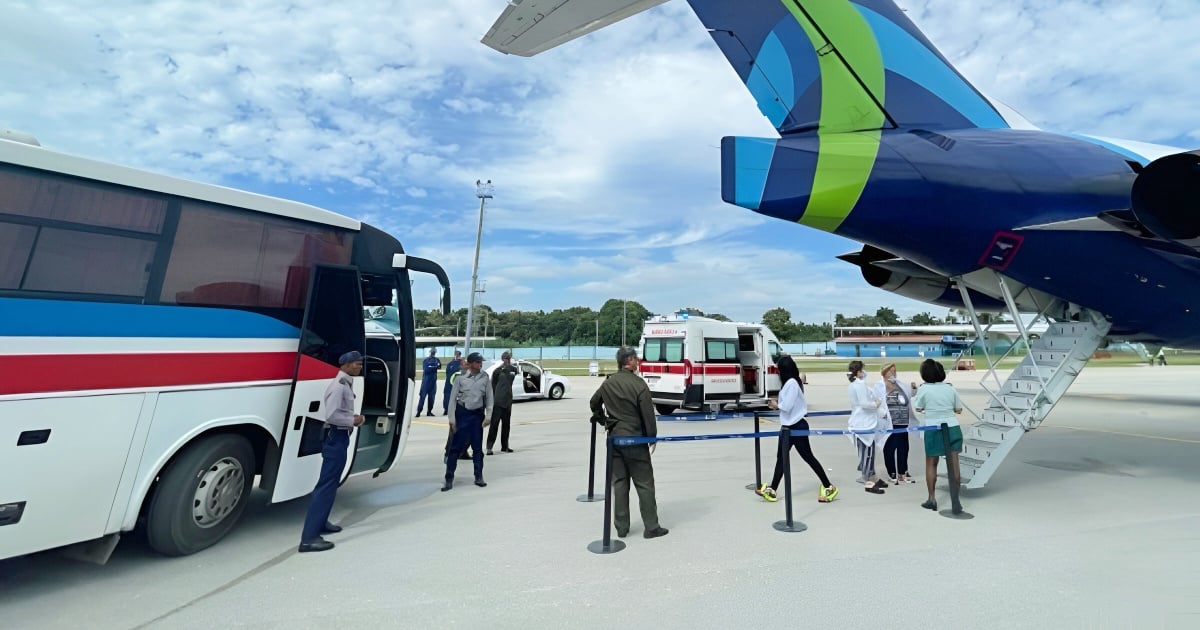
Since Trump took office on January 20, a flight arrived on the island with 104 deported citizens.
However, Fernando de Cossío warns that "large-scale deportations of Cubans who were initially legally admitted to the United States were never contemplated in the immigration agreements between both countries."
Such a statement suggests that the regime would not make it easy for the U.S. government to facilitate the return of Cubans who are beneficiaries of humanitarian parole.
The deputy minister pointed out that when the agreements were signed, the possibility that the United States would admit and then deny entry to individuals was not considered reasonable at that time.
Therefore, "anything similar would have to be discussed."
The diplomat refused to say whether the Cuban government would be willing to cooperate with such an agreement, calling it "unrealistic and unjust."
The White House, the U.S. Department of State, and the Department of Homeland Security did not respond to requests for comments from Reuters regarding the deportation of Cubans.
The migration negotiations between the two countries have seen both progress and setbacks in recent years.
The last bilateral meeting on the issue took place in December, before Donald Trump took office during his first term.
Both nations are expected to resume dialogue in April in Washington, although Fernández de Cossío has stated that, so far, the U.S. administration has not officially confirmed the meeting.
Cuba blames the U.S. for encouraging migration
For decades, the Cuban government has maintained that the United States promotes the massive migration of citizens from the island by implementing a combination of measures that include economic sanctions and favorable immigration policies for Cubans.
According to the authorities in Havana, the sanctions imposed by Washington aim to economically suffocate the country, creating an internal crisis that forces thousands of Cubans to seek better living conditions abroad.
They argue that U.S. laws provide Cubans with a more accessible path to citizenship compared to other nationalities, which serves as an additional incentive for emigration.
The Cuban Deputy Minister of Foreign Affairs, Carlos Fernández de Cossio, has emphasized this point and noted that Cubans arriving in U.S. territory do so under privileged conditions compared to other migrants.
"They did not tear down a wall, they did not have to jump a fence to enter the United States, they were invited," stated the official, emphasizing that Washington's immigration policies favor Cubans over other migrant groups.
However, the U.S. government has a diametrically opposed view.
From Washington, the Cuban communist government is being directly held responsible for the current migration crisis, arguing that the island's administration has poorly managed the economy and systematically violated the human rights of its population.
U.S. officials have pointed out that the lack of political freedoms, repression against opponents, and the internal economic crisis, worsened by poor state management, are the true causes of the Cuban exodus.
The Cuban migration crisis has intensified in recent years, reaching unprecedented numbers.
Since 2020, more than a million Cubans have left the island, representing approximately 10% of the country's total population.
This phenomenon, according to analysts, has few parallels in times of peace and is only comparable to mass migration movements occurring in contexts of war or severe humanitarian crises.
Currently, Cubans are one of the main groups of migrants crossing the border between the United States and Mexico.
Many of them have entered the North American country through the legal admission programs prompted during Joe Biden's administration, while others have resorted to irregular routes to reach U.S. soil.
Frequently Asked Questions about the Deportations of Cubans and Humanitarian Parole in the U.S.
Is it likely that the United States will carry out mass deportations of Cubans?
The Cuban government believes it is unrealistic to expect mass deportations of Cubans from the U.S. due to the existing immigration agreements between the two countries. Deportations must take place within the framework of these agreements, which have historically granted preferential treatment to Cuban migrants.
What impact would Donald Trump's administration have on immigration policy towards Cuba?
A Trump administration is expected to tighten immigration policies towards Cuba. Its plans include mass deportations and could affect Cubans who have not regularized their immigration status. However, beneficiaries of the Cuban Adjustment Act may be less impacted, as this law offers a pathway to legal residency.
What is humanitarian parole and why does it face an uncertain future?
The humanitarian parole is a program that allows the legal entry of migrants into the U.S. under certain conditions. It currently faces an uncertain future due to the drastic decrease in the number of approvals and Donald Trump's promises to eliminate the program when he takes office in January 2025. The approval figures have significantly declined, and the situation is further complicated by the possibility that the new administration may change current immigration policies.
How does the Cuban Adjustment Act affect Cuban migrants in the U.S.?
The Cuban Adjustment Act allows Cubans to regularize their immigration status in the U.S. after one year of residency in the country. This provides them with a significant advantage over other migrant groups and may protect them from mass deportations in the near future.
What alternatives do Cubans in the U.S. have if humanitarian parole is eliminated?
Cubans who are already in the United States may consider alternatives such as applying for permanent residency under the Cuban Adjustment Act. This law allows for residency after one year and one day in the country. They can also explore options such as political asylum or an employment visa, depending on their personal situation.
Filed under: