
Related videos:
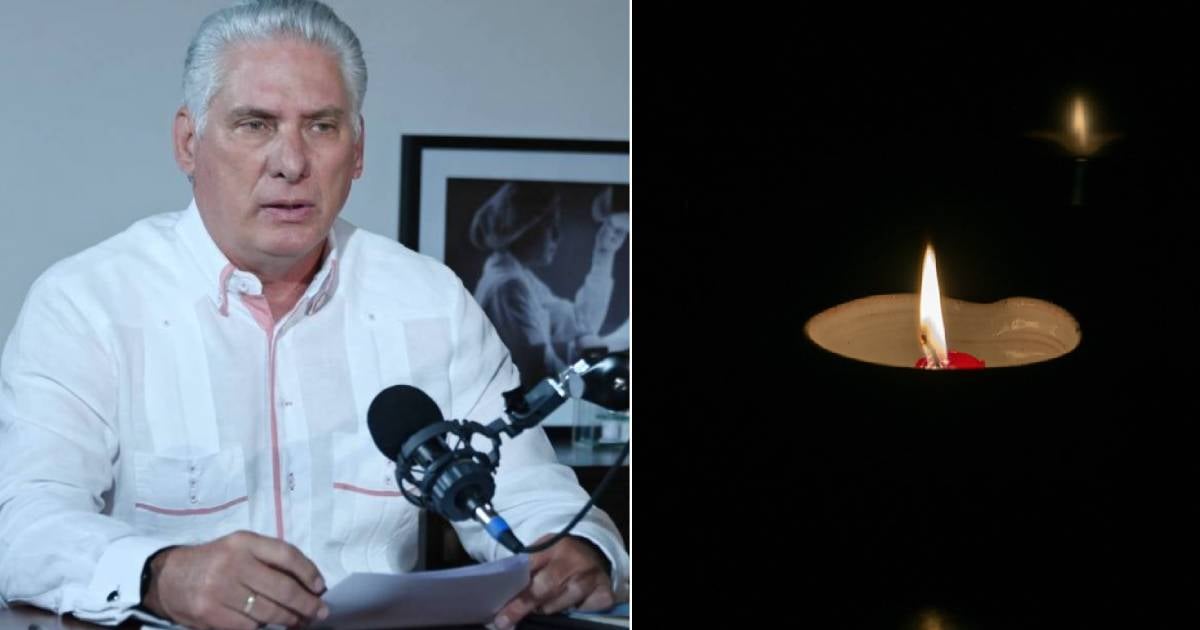
In an effort to express his gratitude for the "understanding" of Cuban families during the hours of uncertainty experienced due to the disconnection of the National Electric System (SEN), the president Miguel Díaz-Canel faced a strong wave of criticism on social media.
Numerous users reacted with outrage, accusing him of insensitivity and downplaying the hardships faced by the people, reporting that his message does not reflect the daily reality of those struggling to survive amid the energy crisis.
Let's go step by step. The communist leader posted on his various platforms: “Thank you, Cuba, for your understanding during the times of uncertainty and discomfort due to the disconnection of the SEN. And thanks to the workers and directors of the Electric Union of Cuba, who faced it without a moment of rest. We continue to have deficits, but we are now connected,” he wrote on his social media.
However, the message ignited the anger of many Cubans, and some did not hesitate to respond and make it clear that he is one of the culprits behind the hardships faced by the island's citizens.
For example, the user Lunita posted on X: "You have to be an idiot to talk so much nonsense from your air conditioning while the people are watching the little they have to eat go to waste."
Others, like the internet user Frank El Makina, mocked the president, calling him a "clown" and recalling the repressive treatment towards citizens.
Additionally, comments in the section of the same post on Facebook also displayed widespread discontent.
Some users pointed out that the "understanding" of the people is not voluntary, but rather a result of fear, while others criticize the prolonged disconnection still suffered by places like Guisa and Pedro Betancourt, where the electricity service has been intermittent. "The only one connected here is you, because in Pedro Betancourt they turned on the lights for 3 to 4 hours, and we haven't seen any light come on since," stated a user.
Others highlighted the cynicism and disconnection of the government, suggesting that the people endure out of fear of reprisals.
This reaction on social media highlights the growing disillusionment and frustration of a citizenry that, in the midst of a crisis in basic services and economic difficulties, feels abandoned and repressed.
Far from providing concrete solutions, the president warned that the country continues to face a serious energy deficit and made it clear that power outages will continue.
While Díaz-Canel attempts to project an image of control and gratitude, many Cubans are calling for an urgent improvement in the living conditions in a country that, according to them, has forgotten its children.
Scheduled blackouts continue in Cuba following the electrical collapse
The Electric Union of Cuba (UNE) continues with the scheduled blackouts following the electrical collapse, despite having confirmed that the National Electricity System (SEN) has been restored across the country.
In their report this Monday, they indicated that on March 16, the service was affected 24 hours a day. The maximum impact was 1,601 MW at 7:30 PM, but it did not coincide with peak hours.
The availability of the National Electric System at 07:00 hours this Monday is 1,900 MW, while the demand is 2,600 MW, resulting in 736 MW affected. During the noon period, an estimated impact of 1,200 MW is expected.
Díaz-Canel says that he is not disconnected from the people
In March 2024, Díaz-Canel stated that he is not out of touch with the people and that the first indicator to understand the public's opinion is his friends and family.
Four days after the protests that shook several towns in Cuba, where hundreds of people took to the streets to demand their rights, he appeared on television attempting to portray himself as a humble person empathetic to the needs of the public.
"None of us lives disconnected from the community. I am in a familiar, friendly, and working environment where people share the same problems as the population because they are part of the community," he said.
"Therefore, my friends and my family, in the best sense, complain that the situation is tough; they share those sentiments with us," he said.
The leader noted that there are mechanisms to study the public opinion that reaches them in real time, but he insisted that his family and close friends are the most direct way for him to learn what people think.
Frequently Asked Questions about the Energy Crisis in Cuba
Why are there frequent power outages in Cuba?
The frequent power outages in Cuba are caused by the collapse of the National Electric System (SEN), which arises due to the lack of maintenance of thermal power plants, such as Antonio Guiteras, and the shortage of fuel. The situation is exacerbated by the lack of investment in electrical infrastructure and poor government management.
How has the Cuban population reacted to Díaz-Canel's comments on the energy crisis?
The Cuban population has reacted with anger and discontent to Díaz-Canel's comments, labeling his words as insensitive and disconnected from reality. Citizens have expressed their frustration on social media, demanding change and criticizing the lack of effective solutions from the government.
What measures is the Cuban government implementing to address the energy crisis?
The Cuban government has announced the creation of "microsystems" and "energy islands" as temporary measures to mitigate power outages, and has promised to work tirelessly to restore the SEN. However, no clear and effective long-term plan has been presented, and electricity cuts continue to affect the population.
How does the energy crisis affect the daily lives of Cubans?
The energy crisis is severely affecting the daily lives of Cubans, interrupting essential services such as drinking water and food refrigeration. Prolonged blackouts complicate cooking and access to healthcare services, exacerbating the already difficult living conditions and increasing social discontent.
Filed under: