
Related videos:
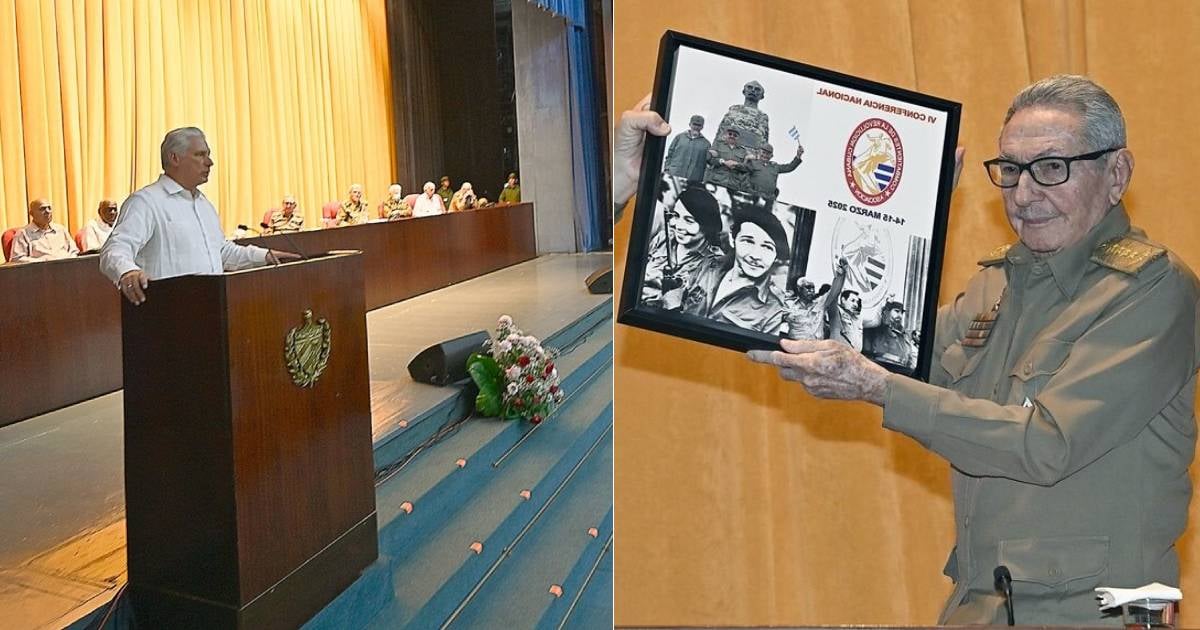
The Cuban leader Miguel Díaz-Canel concluded the National Assembly of Combatants of the Cuban Revolution this Saturday with a speech marked by his well-known call to resistance, amid the economic and social crisis facing the island, recently exacerbated by a general blackout that has been occurring since Friday, March 14.
During his speech, Díaz-Canel reiterated the official narrative about the "heroic resistance" of the Cuban people in the face of difficulties, blaming the U.S. embargo for the country's critical situation.
In a defiant tone, the leader asserted that "Cuba will not surrender" and that the government will continue to support the socialist model despite the obstacles.
"Today, in the face of the threats we face, when there is an attempt to suffocate the people economically to subdue us, humiliate us, and destroy the Cuban Revolution, we defend unity in response to the Army General's call to cherish it as the apple of our eye. With the heroic resistance of the Cuban people, we defend sovereignty and commit to the refinement of the monumental work of social justice that has built socialism in Cuba," affirmed Díaz-Canel in his speech.
Likewise, the leader recalled Cuban history by mentioning the Baraguá Protest led by Antonio Maceo, noting that "Maceo defended principles that we today embrace as revolutionary convictions: unity, sovereignty, and social justice. He protested because the Zanjón Pact was a consequence of the disunity within the mambí ranks and because it did not guarantee either sovereignty or the abolition of slavery."
The event brought together senior officials from the Communist Party, members of the State Council, and veterans of the Revolution, in an occasion where there was a strong call to the new generations to "keep the legacy of the fighters alive", emphasizing the importance of unity and ideological discipline.
However, the reality of many of the fighters of the Cuban Revolution contrasts sharply with the official narrative. Despite the rhetoric about defending revolutionary values, numerous veterans live in conditions of neglect and precariousness.
Recent reports have documented how many of them survive by selling cans on the street to feed themselves, without receiving support from the government they once defended so passionately.
Furthermore, their demands for better living conditions are ignored by the authorities, who only remember them during commemorative events, without providing them with dignified assistance.
“There aren’t even floral tributes for their graves”, some relatives of deceased combatants lament, highlighting the lack of recognition and support.
The situation of the ex-combatants reflects the contradiction between Díaz-Canel’s rhetoric and the reality of a forgotten population, whose "resistance" appears more as a necessity for survival than an act of ideological loyalty.
"From this fighting platform, I want to share, as my own conviction, the idea expressed by the Army General on the 65th Anniversary of the Triumph of the Cuban Revolution: 'For us, the Cuban revolutionaries, difficulties do not make us lose sleep; our only path is to continue the struggle with optimism and unwavering faith in victory'," the leader added amidst applause.
The closure of the assembly took place in a context of growing social discontent, with sporadic protests in various regions of the country and a political crisis that challenges the stability of the government.
Despite this, Díaz-Canel reaffirmed his commitment to resistance and loyalty to the current political model in Cuba, without indicating any intention to implement structural changes in the economy or government management.
Frequently Asked Questions about Díaz-Canel's Speech and the Situation in Cuba
What was the main message conveyed by Díaz-Canel in his closing speech at the assembly of fighters?
Díaz-Canel reiterated his call for the "heroic resistance" of the Cuban people in the face of the economic and social crisis the island is experiencing. He blamed the U.S. embargo as the main culprit for the country's critical situation, while defending the socialist model and unity as the cornerstones for overcoming adversity.
What has been the situation of the former combatants of the Cuban Revolution according to the news?
Despite official speeches, many veterans live in neglect and precarious conditions. Numerous reports indicate that they survive by selling cans on the street without receiving governmental support. Their demands for better living conditions are ignored, and they are only remembered during commemorative events, without being offered dignified assistance.
What criticisms does Díaz-Canel's government face amid the current crisis in Cuba?
The Díaz-Canel government faces criticism for its rhetoric of resistance while the population suffers from a severe economic and social crisis. Many citizens believe that the government's management is ineffective and that the official discourse is disconnected from reality. Promises of improvement lack a clear action plan, which has led to protests and criticism on social media.
What is Díaz-Canel's stance on the socialist model in Cuba?
Díaz-Canel maintains his stance of continuing to support the socialist model, despite the crisis. The leader reaffirms the need to improve this model and defends unity and resilience as key elements for progress, although his words contrast with the lack of deep and effective economic reforms.
Filed under: