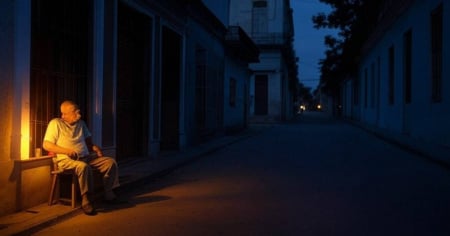
A young Cuban explained on social media the "emergency kit" she uses whenever the power goes out in her home. Her video reflects how the reality of blackouts in Cuba has sadly become a prominent part of daily life for its citizens.
A young resident of Matanzas has gone viral on TikTok after sharing on her account @sheyreyes03 a video in which she shows all the devices she uses when the power goes out, a situation that—according to her own words—is common in her daily life in Cuba.
"These are the things I use when the power goes out here in Cuba," he says at the beginning of the video, which lasts just over a minute. He then casually and naturally shows his "survival kit": a rechargeable fan with up to six speeds and a charging timer, two portable chargers that can recharge a phone up to five times, several long-lasting LED lamps, and a generator that turns on at night when the blackouts extend.
The video has garnered dozens of comments ranging from support, empathy, concern, and surprise. "The best purchase, the plant," wrote one follower, while another user commented, "Strong, but thank God you are equipped." From Venezuela, someone sent warm greetings, and another follower added, "The good thing is that you already have your plant."
There were also questions about the products: “How much did the plant cost you and where did you buy it?” asked one user, while another inquired if she had the link to the fan on Amazon. Sheyla replied: “No, but look it up by the brand and it will come up.”
Some comments reflected disbelief at the possibility of receiving products from abroad: "Do you get Amazon in Cuba?" asked one follower. Others expressed interest in helping directly: "Girl, how can I send you things from here in the USA? Some stuff that might be useful to you," wrote a user.
Critical messages about the country's situation were not lacking: "This is how Venezuela is. Communism destroys everything," commented a user. Another asked to discuss the "economic blockade," and someone quipped, "So there isn't as much poverty as they say in other videos... here in Nicaragua, a power plant like yours is quite expensive."
This type of content, which combines personal experiences with the harsh national reality, has become common on Cuban social media. Just a few days ago, another young woman from Matanzas celebrated being able to sleep through the night with electricity. “Do you know what it’s like to wake up and see the whole house lit up?” she asked, while demonstrating how she was able to cook, wash, and take care of her baby thanks to a few hours of continuous electricity service.
The virality of these videos is no coincidence. Cuba is experiencing one of the longest energy crises in recent years. According to data from the Electric Union, the generation deficit on Monday, March 31, exceeded 1,300 MW, with more than 75 power plants out of service due to a lack of fuel. Even Havana is not spared from the blackouts, which are implemented in rotating blocks.
Despite this reality, the regime attempts to maintain a triumphalist discourse. Last Friday, Miguel Díaz-Canel inaugurated a solar park in Remedios and promised that by summer, 560 MW of photovoltaic energy will be added. However, the population receives these announcements with skepticism. Most of the thermoelectric plants in the country are in poor condition, maintenance has been piling up, and the shortage of fuel worsens the collapse of the national electrical system.
Meanwhile, thousands of Cubans like Sheyla continue to adapt to the blackouts, equipping themselves with flashlights, generators, and a great deal of resignation.
Frequently asked questions about blackouts in Cuba and how to cope with them
How do power outages affect the daily lives of Cubans?
Blackouts in Cuba have a significant impact on the daily lives of its residents, affecting everything from routine tasks to food preservation. Power outages force families to seek alternatives such as cooking with charcoal, using rechargeable flashlights, and relying on portable devices to maintain communication. Furthermore, the lack of electricity prevents the use of essential appliances and can lead to the loss of perishable foods, further complicating the economic and social situation on the island.
What do Cubans think about the government's promises to improve the electricity supply?
Cubans receive the government's promises to improve the electricity supply with skepticism, as everyday reality contradicts these statements. Despite the announcements regarding the incorporation of photovoltaic energy, the population continues to experience prolonged and constant blackouts. Distrust is fueled by the deteriorating state of thermal power plants and a lack of maintenance, which hinders any substantial improvement in the electricity supply.
How do Cubans organize themselves to face the energy crisis?
In the face of the energy crisis, Cubans are turning to creativity and solidarity to cope with power outages. Many families are using traditional methods such as charcoal stoves and sharing resources like generators with their neighbors. Furthermore, there is an increase in the purchase and use of rechargeable and portable devices that allow for certain activities to continue during electricity shortages. Resilience and ingenuity are becoming key tools to face daily challenges.
Filed under: