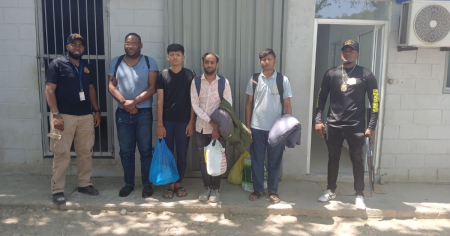
The tightening of immigration policies in the United States under the new administration of Donald Trump has forced thousands of Cubans to reconsider their final destination and choose Mexico as a host country. What was once a passage route to the "American dream" has now transformed into a destination in its own right: the "Mexican dream."
Since January 2025, the new U.S. strategy to address the migration crisis has led to a historic drop in border crossings. In February, only 150 entries of Cubans were recorded, a figure that starkly contrasts with the over 6,300 from the previous month.
The Customs and Border Protection (CBP) recently warned in a statement that: “The border is closed to illegal crossings, and for those who are still willing to test our resolve, know this: You will be processed and deported.”
Mexico as a destination and not just a transit point
While the United States closes its doors, Mexico becomes a point of arrival. In just the first quarter of 2024, more than 17,800 Cubans sought asylum in Mexico, making it one of the largest migrant groups.
In Tapachula, Chiapas, the figures are particularly striking: 5,152 asylum applications were submitted in that municipality, which has become a hotspot for Caribbean migration.
This phenomenon marks a radical change in the migratory strategy of Cubans. Until recently, most aimed to cross the border into the United States through the CBP One application.
However, with the elimination of that program and the resumption of mass deportations, many have given up on their attempt to reach the North.
"Reaching the United States is no longer a priority. The conditions are very harsh, and in Mexico, at least we can establish a life and work," stated a Cuban migrant settled in Tapachula.
Change of dynamics in the region
This migratory redirection has also had logistical and social consequences. In cities like Monterrey, Guadalajara, and Tijuana, there has been an increase in the presence of Cuban migrants seeking employment and better living conditions.
The situation, however, is not without difficulties. The cost of living in Tapachula is high, and wages are low, which complicates the economic stability of newcomers. Despite this, the desire to settle in Mexican territory continues to grow, especially among those who have family in the United States but no longer see an immediate reunification as feasible.
In parallel, Mexican authorities have received more than 8,000 asylum applications just between January and March of this year, with Cubans making up more than half of them, according to the UN Refugee Agency (UNHCR).
The flow of migrants in the Central American region is decreasing
Honduras has also seen a decrease in the flow of Cuban migrants heading north. Of the more than 369,000 travelers who crossed the country in 2024, around 60,000 were Cubans, but that number has drastically fallen in 2025.
From January to March 6, only 3,448 Cubans were registered in Honduran territory, which represents just 10% of the flow recorded the previous year. This decline is explained by the growing fear of being deported from the United States or becoming trapped in precarious conditions during the journey.
This is the new migration reality
The "Mexican dream" is far from idyllic, but it presents itself as a tangible alternative in light of the tightening access to the United States.
The possibility of settling down, receiving government assistance, and eventually being visited by family from the north now seems more viable than crossing an increasingly insurmountable legal and physical barrier.
While Trump’s policies are reshaping the migration landscape of the Americas, thousands of Cubans are beginning to settle in a country that, until recently, was merely a part of the journey.
Frequently Asked Questions about the Migration of Cubans to Mexico in 2025
Why are Cubans opting for the "Mexican dream" instead of the "American dream"?
Cubans are opting for the "Mexican dream" due to the tightening of immigration policies in the United States under the administration of Donald Trump. Mexico has become an attractive destination for these migrants, as it offers the possibility of settling, working, and receiving government assistance, unlike the increasing obstacles to reaching the United States.
How has the closure of programs like CBP One affected Cuban migrants?
The cancellation of the CBP One program has left many Cuban migrants without a clear path to legally enter the United States. This has led many to consider staying in Mexico as a viable alternative, as they face difficulties advancing north and fears of being deported or getting trapped in precarious conditions during the journey.
What are the challenges faced by Cuban migrants in Mexico?
Cuban migrants face economic and social challenges in Mexico, such as the high cost of living and low wages, especially in places like Tapachula. Additionally, the asylum offices are overwhelmed, resulting in long waits and uncertain processes for obtaining refuge. Despite these challenges, many Cubans prefer to settle in Mexico due to the difficulties in reaching the United States.
What impact do Trump's new immigration policies have on Cuban migration?
The immigration policies of Trump have had a significant impact on Cuban migration, drastically reducing border crossings into the United States. The reactivation of mass deportations and the end of programs like CBP One have forced many Cubans to reconsider their plans and seek alternatives in Mexico.
Filed under: