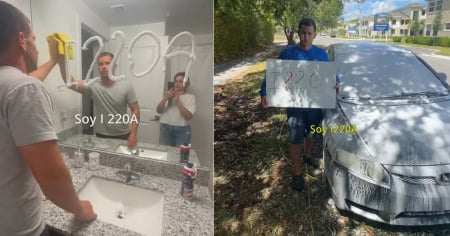
A young Cuban beneficiary of form I-220A, identified as Luis Alberto Naranjo, has recently received his permanent residency in the United States after a long wait.
Her story is a source of hope for the thousands of Cubans in a similar migratory situation, marked by uncertainty and fear of deportation.
A journey of faith and perseverance
Naranjo entered the United States in July 2021 through the southern border, after passing through several countries.
He presented himself at a U.S. port of entry and was released after 16 days in detention, marking the first box. He never had a cut-off date and applied for affirmative asylum.
Since then, he/she applied for his/her residency with the United States Citizenship and Immigration Services (USCIS).
For more than 700 days, he waited for a response that finally came in the form of a phone call: his application under the Cuban Adjustment Act had been approved.
"It's something that can't be described, a lot of joy", Daniel Benítez stated in an interview with a reporter from Univision about that eagerly awaited moment.
A message for other Cubans with I-220A
Naranjo emphasized that his behavior in the United States has been exemplary and that he has not received a single traffic ticket.
Aware that there are many compatriots experiencing the same anxiety he went through, he has wanted to share a message of encouragement.
"For all the I-220A, have patience, have faith in God, and above all, do things right," he noted.
Her case, although characterized by a long and distressing wait, gives hope to many Cubans in a similar situation.
The legal context of the I-220A
According to immigration lawyers, it is estimated that there are approximately half a million Cubans in the United States who were released with the I-220A document.
Many, like Naranjo, were never summoned to court, which has allowed them to seek legal options with USCIS to obtain residency.
Lawyer Jesús Novo points out that, in cases like Naranjo's, "there is an argument that can be made: that he had been inspected and admitted, which is one of the requirements of the Cuban Adjustment Act."
Additionally, it mentions that "there is a federal demand that also stated that Cubans who had I-220A, and at a certain time had entered the country, were allowed to apply for the Adjustment Law."
More complex cases and new arrests
However, not all migrants with an I-220A have a favorable outlook.
There are cases of Cubans who did not present themselves at a port of entry, marked the second box, and do have a cutoff date.
These individuals face additional obstacles.
"These individuals cannot apply with USCIS, because USCIS does not have jurisdiction to adjudicate their petition, and therefore they have a bigger problem," explains Novo. As an alternative, they could try "to request that this court be closed, so that USCIS would then regain jurisdiction," points out Novo.
An example of this complexity is reflected in the recent case of four Cuban women with I-220A who were detained on March 10th.
Of them, Yadira Cantallops and Denise Reyes remain in custody in California, waiting for an immigration judge to decide whether to grant them release on bail.
Frequently Asked Questions about the I-220A Status and the Cuban Adjustment Act for Cuban Migrants in the U.S.
What is the I-220A form?
The I-220A form is a document of parole granted to migrants, allowing them to remain in the U.S. while their immigration status is determined. For many Cubans, it represents a legal limbo, as it does not guarantee permanent residency or a clear resolution to their immigration status.
How long can it take to obtain residency for Cubans with I-220A?
The waiting time to obtain residency can vary significantly. Some cases, like that of Luis Alberto Naranjo, who waited over 700 days, demonstrate that the process can be lengthy and fraught with uncertainty. Patience and compliance with all legal requirements are key during this period.
What message do people like Luis Alberto Naranjo send to other Cubans with I-220A?
Luis Alberto Naranjo, who has finally obtained his residency, sends a message of hope and perseverance. He recommends having patience and faith, as well as behaving exemplary while in the United States, to increase the chances of a favorable outcome in the immigration process.
What role does the Cuban Adjustment Act play in the regularization of Cubans with I-220A?
The Cuban Adjustment Act provides a pathway for Cubans to obtain permanent residency after one year and one day of stay in the U.S. Those with an I-220A may attempt to apply under this law, especially if they have not been summoned to court, which allows them to explore legal options with USCIS.
Filed under: