
Related videos:
The Cuban regime is making progress in implementing a new legal instrument presented as a guarantor of the welfare and rights of children, adolescents, and youth. This is the draft of the Code for Children, Adolescents, and Youth, currently in the school consultation process across the country.
Beyond its hypothetical impact on the well-being of the recipients of the regulation, a detailed review of its provisions by this editorial revealed a carefully structured design to reinforce the official ideology and consolidate state control over childhood, families, and youthful thought.
The initiative, promoted with technical, emotional, and progressive language, appeals to universal notions such as the "best interests of the child," "comprehensive protection," and "harmonious development of personality."
However, beneath that legal rhetoric, there are articles that institutionalize indoctrination, criminalize family dissent, and reinforce surveillance mechanisms with repressive potential, particularly towards parents who are critical of the system.
Legal Mandated Indoctrination
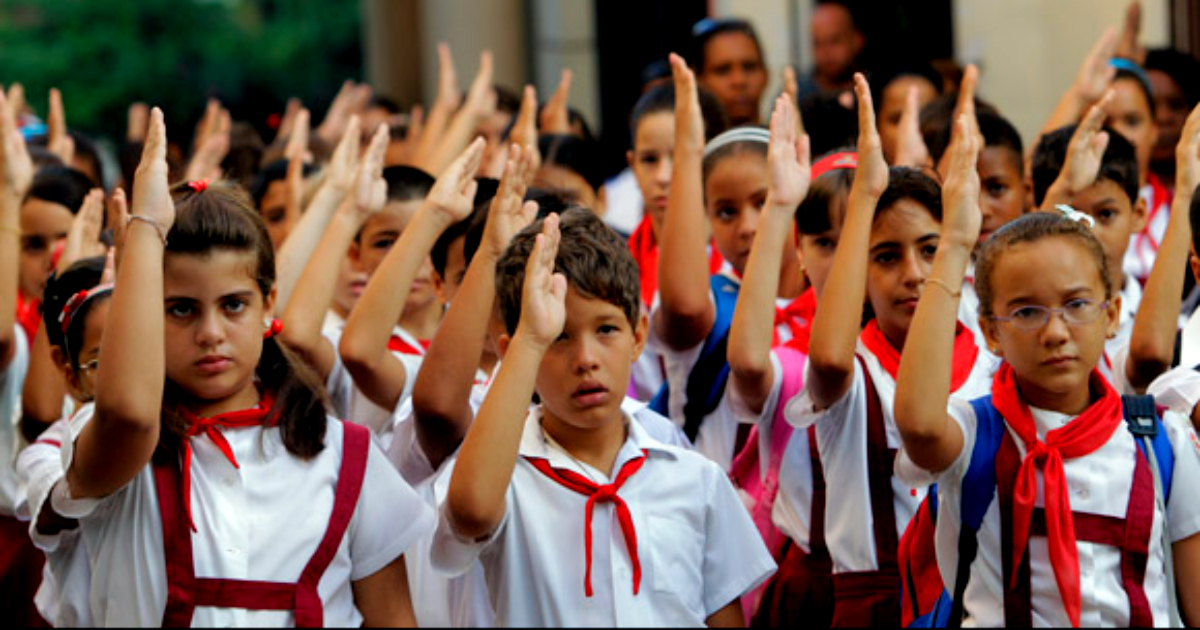
From its preamble, the draft clearly establishes its political intent. The regulation states that girls, boys, and adolescents must be trained as “continuers of the revolutionary work.”
"WHEREAS: The integral development of childhood, adolescence, and youth is a cherished aspiration of the State, families, and Cuban society, which work to instill in girls, boys, adolescents, and young people the values and principles of socialist society, as well as the attributes and qualities that will enable them to fulfill their role as active participants and continuers of the revolutionary work."
It is not, therefore, about ensuring a free, autonomous, or plural development, but rather about guiding childhood towards ideological adherence to the socialist system.
Article 57 reinforces this intention by stating that the educational system will have as its essential purpose the “formation of values in accordance with the principles of socialist society,” effectively nullifying any diversity of thought or the right to an education that is not state-run or ideologically neutral.
“Article 57.3: El Sistema Nacional de Educación tiene como propósitos esenciales la formación y fortalecimiento de valores morales y éticos en correspondencia con los principios de la sociedad socialista, el respeto a los derechos humanos, a la identidad cultural de la nación, el idioma y el medio ambiente en favor del desarrollo sostenible; así como la formación integral de la ciudadanía, el aprendizaje desarrollador de los educandos y su participación activa en el proyecto educativo”.
Control over "problematic" families
One of the most concerning points is Article 91, which imposes on any citizen the obligation to report situations that affect a minor's "morality" or "psychological well-being."
“Article 91.2: Cualquier persona que conozca de alguna situación que ponga en peligro la integridad física, sexual, psíquica y moral de una niña, niño o adolescente; así como de cualquier tipo de violencia u otra conducta que ponga en riesgo o vulnere sus derechos, tiene la obligación de denunciarla a las autoridades competentes a fin de restablecer los derechos quebrantados”.
This deliberately ambiguous clause could be used against opposition families or activist parents, especially if they are accused of "negatively influencing" their children by expressing ideas contrary to the regime.
The duty to honor, defend, and obey: The Code that imposes loyalty from childhood
The content of the draft bill also introduces explicit duties for children and young people, which, although presented as educational, reinforce a logic of ideological submission and civic-political discipline.
The article 117, which defines the duties of girls, boys, and adolescents, includes mandates such as "to honor the Homeland and its symbols," "to protect the cultural and historical heritage of the nation," and "to show due respect to authorities and their agents".
Although these formulations may seem neutral, in the Cuban context—where state authorities, the supposed "historical legitimacy" of the regime, and patriotic symbols are closely linked to the official ideology—these duties can be used to evaluate or sanction children's or families' behavior based on ideological parameters.
In a similar vein, Article 219 imposes upon young people the obligation to "adhere to the Constitution of the Republic of Cuba and its laws," "collaborate with the functioning of institutions and respect the legitimately constituted authorities," and "actively participate in the defense of the socialist Fatherland."
This formulation turns alignment with the totalitarian political system and adherence to its norms into a legal responsibility for adolescents, thus reinforcing the idea that they must not only submit to the laws of the so-called "revolutionary justice" but also actively support a singular ideological model, which constitutes a clear component of indoctrination.
On the other hand, Article 83, which regulates minors' access to cultural life, establishes that it must develop “with a profound decolonizing, anti-consumerist, inclusive, participatory, democratic, educational, and socially conscious spirit.”
While some of these categories may seem progressive, the use of concepts like "social consciousness" within the Cuban framework typically refers to a consciousness shaped by the official narrative, which reinforces a state-directed institutional culture and allows little to no room for alternative or dissenting views.
A code that legalizes indoctrination and surveillance
This legal framework is not limited to protection: it shapes, guides, and supervises. From the imposition of an ideological framework in education to the establishment of surveillance systems over minors, the Code serves as a tool for social control.
Under the guise of “protecting childhood,” the Cuban state seeks to reinforce its political hegemony from the earliest years of life. Childhood is not viewed as a rights-bearing subject in freedom, but rather as ideological material to be shaped for the continuity of the regime.
Furthermore, the possibility that these items could be used to justify interventions in opposition households, or even the removal of custody, is not mere speculation: there are documented instances of similar threats in recent years.
Conclusion
The draft of the Child Code is presented as a legal advance, but its internal structure reflects more of a strategy for state control than a genuine guarantee of rights.
It contains ideological traps and legal ambiguities that could be used for repressive purposes, especially in a country where the judiciary is not independent and political dissent is criminalized.
The risk lies not only in the text itself but also in who applies it, in what context, and for what purposes. In the Cuban case, this risk is more than latent: it is structural and systematic.
Filed under: