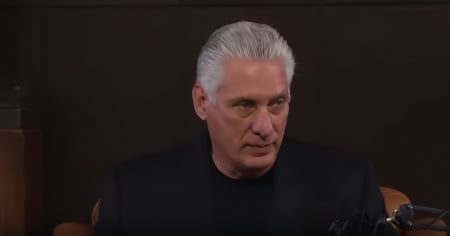
In a recent meeting with Spanish journalists, the Cuban leader Miguel Díaz-Canel launched an attack against independent media and their workers, labeling them as "mercenaries" in the service of foreign interests.
The statements come in a tense context for a free press in Cuba, following the Trump administration's implementation of cuts to the funds allocated for the democratization of the Island, including support programs for media and non-governmental organizations.
"A whole group of media projects against the Cuban revolution, and therefore, we believe that if the people working on those media platforms, serving an enemy government, funded by a government to attack us, were mercenaries," expressed Díaz-Canel.
His words underscore his stance of hostility towards the critical voices of the media, which he views as instruments serving the "media poisoning" aimed at discrediting the Cuban government.
The Cuban leader took the opportunity to celebrate the dismantling of media outlets funded by the United States, noting that the Trump administration's policy had weakened the infrastructure of "subversive" media.
"Now it draws attention, they have revealed themselves," he pointed out, referring to the recent reduction of operations of Radio and TV Martí, channels funded by the U.S. government to disseminate news on the Island.
"They are closing down, they have had mass layoffs. But also, notice how far one can go when there is intent to cause harm. We have had, thanks to the intelligence and creativity of our people, technological conditions that have prevented TeVe Martí and Radio Martí from... I mean, they maintained them out of spite," he emphasized.
For Díaz-Canel, this situation is an example of how foreign-funded media are part of a political strategy to destabilize the Cuban regime.
What Díaz-Canel does not mention is the impact of these policies on the ability of Cuban journalists to report freely and without the pressures of state power.
The closure of media outlets such as Radio and TV Martí, which have been active for over 40 years, along with the cuts to USAID funding, directly impacts the dissenting voices that have managed, despite the restrictions, to document and expose the social, political, and economic realities that the Cuban regime has tried to conceal.
Media outlets such as CubaNet, Diario de Cuba, and CiberCuba - the latter financing itself solely through advertising - have been essential in providing the international community with a perspective on Cuba that transcends the official narrative imposed by the Castro regime.
Despite the regime's efforts to censor independent media, the return of some funds allocated for media projects and organizations promoting democracy in Cuba offers a glimmer of hope for those who advocate for freedom of expression.
In March, the U.S. State Department reinstated certain contracts that had been suspended under the Trump administration, allowing media outlets like CubaNet to receive financial support again. This is despite the pressure from the Cuban government, which does not hesitate to label these funds as "subversive."
The return of these resources was interpreted by many as a sign that the fight for democracy in Cuba has not been defeated.
However, Díaz-Canel continues to seize the opportunity to criticize the United States, stating that the American people should "demand accountability for how their budget contributions were spent on subversion against Cuba."
In his speech, the Cuban leader also highlighted the government's "creativity" in countering attempts at external interference, overlooking that in many instances this "creativity" translates into the control and repression of press freedom on the Island.
The stance of the Cuban regime towards independent journalists reflects a strategy of delegitimization based on discrediting those who dare to challenge the official narrative.
For the Díaz-Canel government, any media that does not follow the line set by the Communist Party is serving foreign interests, a claim that has been widely refuted by journalists and international analysts, who point out that independent media are essential for highlighting the situation of human rights, political repression, and the escalating economic crisis facing Cuba.
The dismantling of aid programs, while it has impacted the operations of some media outlets, has not managed to completely silence dissenting voices.
In this regard, the recent partial reactivation of funds and the growing international solidarity with independent journalists suggest that the future of free journalism in Cuba, although uncertain, remains a worthy struggle for which many will continue to fight.
Frequently Asked Questions about the Situation of Independent Press in Cuba
Why does Miguel Díaz-Canel refer to independent journalists in Cuba as "mercenaries"?
Miguel Díaz-Canel considers independent journalists as "mercenaries" because he believes they serve foreign interests, funded by governments such as that of the United States to destabilize the Cuban regime. This disqualification is part of a broader strategy to delegitimize the media that criticize the Cuban government and provide alternative information to the official narrative.
What has been the impact of the closure of Radio and TV Martí in Cuba?
The closure of Radio and TV Martí, ordered by the administration of Donald Trump, has been celebrated by the Cuban regime as a victory, as it removes a key source of alternative information that countered state propaganda. However, it has raised concerns among opponents and organizations that view these media as vital for the fight for freedom of expression in Cuba.
What measures has the United States taken regarding the funding of independent media in Cuba?
Recently, the U.S. State Department has restored some funding for independent media in Cuba, as part of its commitment to promoting human rights. Media outlets like Cubanet have begun to receive financial support again, which offers hope for independent journalism, although many other grants are still under review or have been eliminated.
Filed under: