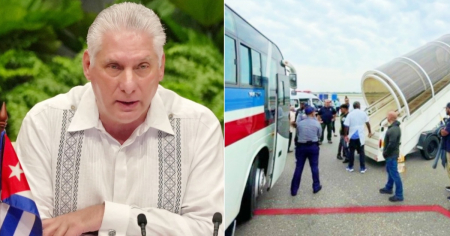
The Cuban leader Miguel Díaz-Canel stated this Tuesday that the government program for the recovery of the National Electric Energy System (SEN) is already showing "discreet results," amid one of the most serious crises in recent years.
His statements were made in an interview published on the YouTube channel Presidencia Cuba and recorded during the "Patria" Colloquium, where he spoke with four Spanish journalists.
Díaz-Canel stated that in February, more than 40 megawatts were added to the National Electric System (SEN), in March more than 170, and that by the end of June, it is expected to reach almost 300 megawatts. By the end of the first half of the year, the figure could exceed 560 megawatts, he said, thanks to the installation of photovoltaic panels.
"That certainly provides a complete assurance. If we have the electro-energy system stable during the day, all production processes can be operational," he stated.
The leader also highlighted investments in water pumping systems and aqueducts powered by solar energy, as well as a project, with the support of a "friendly country," to bring electricity to isolated homes through solar panels.
"Cuba has over 99% electrification, but there remains a group of homes in very remote areas. This year, we will install photovoltaic systems, and those homes will also receive electrification," he stated.
Despite this hopeful speech, Díaz-Canel himself acknowledged just a few days ago that the country continues to face a severe energy deficit.
"We continue to have a deficit, but we are already connected," he wrote on his X account (Twitter), while thanking Cubans for their "understanding" in light of the prolonged blackouts that affected several provinces for over 48 consecutive hours in March.
The statements sparked a flood of criticism on social media. “Thanks Cuba... what a clown you are, husky. That's why you have to walk around with 40 bodyguards and take out the dogs when the electricity goes out because they love and adore you,” replied a user.
In March, the leader distanced himself from responsibility for the electrical crisis, claiming that his administration is “not to blame” because “there is no money” to invest in a definitive solution. Meanwhile, in some regions of Cuba, power outages have exceeded 20 hours daily.
The apparent patience with which many Cubans confront these outages does not necessarily stem from a sense of civic duty, but rather from the fear of reprisals for speaking out against the regime. Desperation, anger, and frustration remain latent, restrained by the fear of repression.
Frequently Asked Questions about the Energy Crisis in Cuba
How is the energy crisis affecting daily life in Cuba?
The energy crisis in Cuba is severely affecting the daily lives of its citizens. Prolonged blackouts, which can last up to 20 hours a day, hinder access to basic services such as food refrigeration, water supply, and the ability to cook. This has exacerbated the already difficult living conditions on the island, increasing social discontent and the frustration of the population.
What is the Cuban government doing to resolve the energy crisis?
The Cuban government has announced the installation of photovoltaic parks as a measure to mitigate the energy crisis. Six new solar parks have been connected to the National Electric System, and it is expected that by the end of 2025, 55 solar parks will have been built. However, even the installation of a total of 1,000 MW of projected solar energy will not completely eliminate power outages, as the deficit includes fuel shortages and deeper structural problems within the island's electrical system.
What has been the reaction of the Cubans to the government's statements regarding the energy crisis?
The reaction of Cubans has been one of discontent and frustration. Many citizens have expressed their outrage on social media, criticizing the statements made by ruler Miguel Díaz-Canel for being insensitive and disconnected from the reality faced by the people. The remarks of gratitude for the "understanding" regarding the blackouts have been perceived as mockery, generating a torrent of criticism and calls for structural changes in the government.
Why is the electrical system in Cuba so unstable?
The instability of the electrical system in Cuba is due to multiple factors, including a lack of investment and maintenance in existing infrastructures, many of which have been in operation for over 40 years. The collapse of national oil production and the lack of modern infrastructure to transport and refine crude oil further exacerbate the situation. Authorities have also pointed to the fuel shortage as a contributing factor to the energy deficit.
What political impact does the energy crisis have in Cuba?
The energy crisis has intensified social discontent towards the Cuban government, leading to an increase in demands for political and structural change from the population. The ineffective management of the crisis has eroded trust in the current leaders, and has fueled criticism of the socialist regime, with many citizens calling for reforms and real solutions to the country's energy problems.
Filed under: