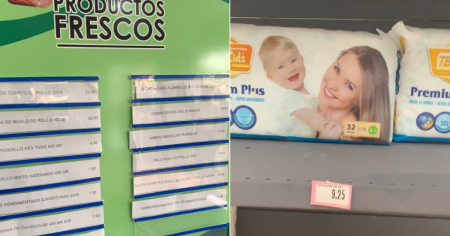
In another step towards the de facto dollarization of the Cuban economy, the network of Tiendas Caribe in Ciego de Ávila announced the reopening of two stores that will operate exclusively in foreign currencies.
According to Televisión Avileña, these are the units Agua y Jabón and La Cruz Verde, which have reopened their doors after a maintenance process, now operating under a payment scheme that accepts only foreign currency.
The news —which no longer surprises many Cubans, but certainly enrages them— is that those who pay in cash will receive their change in gum, candies, or other low-value products, a practice that only occurs in Cuba and represents a direct loss for the consumer, who sees part of their dollars vanish into goods they likely do not want.
A stocked store... for a minority with dollars
Like in other stores, these establishments only accept international cards (Visa, MasterCard, MIR) or cash in foreign currency, which the vast majority of Cubans do not have access to. Meanwhile, stores in Cuban pesos continue to be understocked and with empty shelves, causing frustration and social discontent.
The regime justifies this expansion as a means to "capture foreign currency and improve supply". However, the exclusion of those who only handle Cuban pesos has deepened economic inequality, further segmenting a society already fractured by the crisis.
A strategy that follows the same pattern
The opening of these stores is part of a systematic policy that began with the Supermarket at 3rd and 70th in Havana, which was inaugurated in January 2025 as the first of its kind. It was followed by other similar locations in the central region of the country, all well-stocked but inaccessible to the majority.
Economists like Pedro Monreal have warned that this partial dollarization normalizes a parallel economy where only those receiving remittances or income in foreign currency can access basic products, while the rest of the population remains trapped in a cycle of scarcity, inflation, and frustration.
Between propaganda and reality
Presenting as an achievement the reopening of stores where Cubans cannot buy even a liter of oil with their salary in pesos, while they have to accept chewing gum as change for their dollars, is yet another indication of the disconnection between official rhetoric and the everyday reality of the people.
The strategy of opening more stores that accept foreign currency not only fails to address structural problems but also deepens the divide between those who can buy and those who can only observe.
Frequently Asked Questions about the Dollarization of the Cuban Economy and the New Dollar Stores
Why is the change given in gum and candies at dollar stores in Cuba?
The lack of small change in dollars in Cuba has led to change being given in low-value products like gum and candies. This practice is justified by the absence of fractional coins in dollars, which makes it impossible to provide exact change. Although the government defends this measure as the only viable alternative, it has generated outrage among the population, who perceive this situation as a direct loss of their foreign currency.
How does the opening of dollar stores impact the Cuban economy?
The opening of stores that operate exclusively in dollars deepens economic inequality in Cuba. These stores are well-stocked but are inaccessible to most Cubans who only handle Cuban pesos. This phenomenon has been criticized by economists who point out that the partial dollarization of the Cuban economy normalizes a parallel economic system, benefiting only those who receive remittances or have income in foreign currency.
What justifications does the Cuban government provide for the expansion of stores in foreign currency?
The Cuban government argues that the expansion of stores in foreign currency is a strategy to attract foreign currency and improve the supply of products. However, this justification has been criticized since only a minority of the population can access these establishments, which exacerbates economic and social inequalities on the island.
What payment options are available in Cuban stores that operate in dollars?
The dollar stores in Cuba accept cash payments in foreign currency as well as international cards such as Visa, MasterCard, and MIR. Additionally, some local cards issued by BANDEC and the AIS, Viajero, and Clásica cards are also accepted, often with discounts on purchases. This system limits access for most Cubans who receive their salaries in Cuban pesos.
Filed under: