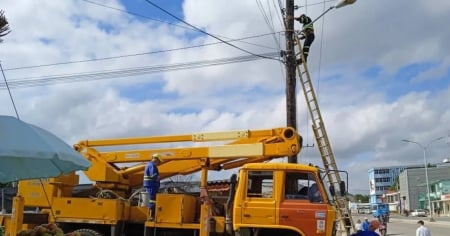
The National Electric System (SEN) of Cuba continues to face a severe electricity generation crisis, leading to new power outages across the country.
According to the latest report from the Electric Union, the generation capacity deficit exceeds 1,400 MW this Friday, which will lead to extended power outages both in the capital and in the other provinces.
On Thursday, April 10, the situation was particularly critical, with a deficit reaching 1,438 MW at 8:40 PM, right when the highest energy demand of the day was recorded.
Although the service was restored at 3:30 AM on Friday, the supply was interrupted again at 5:04 AM. By 7:00 AM, the available capacity in the system was only 1,845 MW, while the demand reached 2,310 MW.
This resulted in 507 MW being affected. For the half-hour period, an impact of 800 MW is estimated, and during peak hours, the deficit could reach 1,475 MW.
The deficit in electricity generation capacity is due to a combination of factors, including generation units out of service for maintenance and breakdowns.
Among the main causes of the generation deficit are the limitations in thermal plants, which currently account for 391 MW of inactive capacity due to failures.
Two units of the CTE Santa Cruz and Felton are experiencing breakdowns, and another four blocks from the CTE Santa Cruz, Cienfuegos, and Renté are under maintenance.
In addition, 74 distributed generation plants, with a capacity of 526 MW, are out of service due to lack of fuel, while 86 MW are non-operational due to a shortage of lubricants.
The situation in the Cuban capital is also concerning. The Electric Company of Havana reported that, due to a generation deficit, scheduled outages will be implemented in the city's blocks.
Block 4 is expected to experience outages from 10:00 AM to 2:00 PM, followed by Block 3, from 11:00 AM to 3:00 PM. After that time, the disruptions will rotate, starting with Block 1, which will be without service until 7:00 PM. Finally, from 7:00 PM to 10:00 PM, Block 2 will be affected.
The situation has generated constant concern, uncertainty, and discomfort among the population, which is facing recurring power outages that affect both households and productive sectors.
The lack of a constant and reliable energy supply impacts the quality of life of citizens and creates challenges for economic activity in various sectors.
With the expectation that the deficit will persist during the peak demand period, the electrical authorities are facing the challenge of stabilizing the system, which continues to rely heavily on thermal generation and the capacity of distributed generation plants.
Despite generating 797 MWh of solar photovoltaic energy the day before, the energy crisis remains one of the country's primary concerns, leaving millions of Cubans facing long periods without electricity.
Frequently Asked Questions about the Energy Crisis in Cuba
What is the main cause of power outages in Cuba?
The main cause of blackouts in Cuba is a significant deficit in electricity generation capacity, due to failures in thermal power plants and a lack of fuel for distributed generation. Additionally, the maintenance of units and damage to the electrical networks contribute to this critical situation.
What measures is the Cuban government taking to address the energy crisis?
The Cuban government has attempted to partially incorporate some thermoelectric units and restore areas affected by breakdowns. However, these measures have not been sufficient to resolve the energy crisis, and the lack of fuel remains a critical barrier to a short-term solution.
How is the energy crisis affecting the Cuban population?
The energy crisis in Cuba is severely affecting the daily lives of Cubans, leading to frustration and annoyance due to the ongoing blackouts. The lack of electricity impacts quality of life, causing wasted food and a growing sense of hopelessness, as reflected in protests and demonstrations against the regime in various regions of the country.
How does the lack of fuel impact electricity generation in Cuba?
The lack of fuel in Cuba has rendered numerous distributed generation plants out of service, significantly affecting the response capacity of the National Electric Power System (SEN). This fuel shortage contributes to the generation deficit and the widespread blackouts experienced by the country.
Filed under: