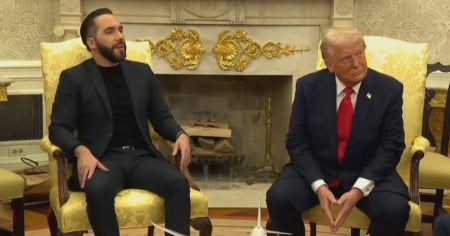
In a surprising turn within his protectionist discourse, the President of the United States, Donald Trump, stated this Monday that he is “very flexible” regarding the imposition of new tariffs, which could pave the way for specific exemptions for certain industries and technological products.
During a press exchange at the White House, where he met with the President of El Salvador, Nayib Bukele, Trump was asked about his recent proposal to impose universal tariffs of 10% on all imports, a measure that has raised significant concerns in the business sector and among the U.S. trade allies. “I am very flexible... I don’t change my mind, but I am flexible.”
When asked about products that could be exempt due to their "short" or limited lifespan, Trump responded, "I'm looking at something to help some automakers (...) They are switching to parts made in Canada, Mexico, and other places, but they need time. Because they will make them here, but they need time," he explained in a video published by the government on X.
Regarding technological products like Apple's iPhones, Trump adopted a conciliatory tone and emphasized his relationship with the company's CEO: “I talk to Tim Cook, I recently helped him. I don't want to hurt anyone (...) But the bottom line is that we are going to make it. To the position of greatness for our country,” he emphasized.
Trade tension, but room for negotiation
Despite insisting that he does not change his mind, Trump clarified his position: “You can't just have a wall and leave it alone. Sometimes you have to go around it, go underneath or go over it.”
This message seems to indicate a greater willingness to negotiate specific exemptions in its tariff policy, particularly in sectors where American companies still rely on foreign components.
Universal tariffs on the horizon
Trump has proposed a baseline tariff of 10% on all imported goods as part of his strategy for "reindustrialization" and "smart economic warfare," which he claims aims to protect domestic industry and reduce dependence on countries like China.
At the same time, Trump increased tariffs on imports from China to 145%, but then temporarily exempted electronics from some of those tariffs by setting a rate of 20% on those goods. The Asian nation responded with an increase to 125%.
However, these tariff exemptions granted could expire in the coming months, as warned by the Secretary of Commerce under the Trump administration, Howard Lutnick.
"They are exempt from reciprocal tariffs, but they are included in the semiconductor tariffs, which will likely come in one or two months," said Lutnick on "This Week" from .
However, analysts warn that this policy could provoke trade retaliation, increase the cost of products, and create friction with historical partners of the U.S., in addition to generating tensions with major tech companies like Apple.
Frequently asked questions about Donald Trump's tariff policy
What changes has Trump announced in his tariff policy?
Trump has announced the possibility of being "very flexible" regarding the imposition of new tariffs, which could allow for specific exemptions for certain industries and technological products. Despite his protectionist rhetoric, he seems open to negotiations to ease some trade tensions.
How could the new tariffs affect American consumers?
The new tariffs from Trump could increase the annual spending of American households by more than $2,100, according to a report by Tax Foundation. These tariffs result in additional costs for importers, which are typically passed on to end consumers, particularly affecting households with lower incomes.
What measures has Trump taken regarding technology and automotive products?
Trump has stated that he could consider exemptions for certain automotive companies and technology products, such as Apple's iPhones, due to his relationship with the company's CEO. However, any exemption is temporary and subject to changes in his tariff policy.
What has been the international response to Trump's tariffs?
Trump's tariffs have generated international trade tensions, provoking retaliatory responses from countries like China and the European Union. These measures could affect trade relations and the global economy, increasing uncertainty in financial markets.
Filed under: