In a meeting held this Monday at the White House, the president of El Salvador, Nayib Bukele, rejected the request to
Ábrego García, 29 years old and a legal resident in Maryland, was deported on March 15, 2025, by the Immigration and Customs Enforcement (ICE), despite having a court order that prevented his expulsion due to the risk of persecution in El Salvador.
During the meeting with U.S. President Donald Trump, Bukele asserted that he has the authority to repatriate Ábrego García and refused to facilitate his return, arguing that he would not smuggle a "terrorist" into the U.S.
“Of course I'm not going to do that. How am I supposed to smuggle a terrorist into the United States?”, Bukele stated to the media cited in the Oval Office.
According to information from the agency Efe, the Salvadoran president acknowledged that he could indeed order their release, but made it clear that he will not. “We are not fond of releasing terrorists in our country”, he expressed in an ironic tone.
Furthermore, he emphasized that El Salvador has become the “safest” country on the continent and that he does not want it to revert to being “the murder capital of the world.”
Before her intervention, the Attorney General of the United States, Pam Bondi, made it clear that the decision regarding the return of Ábrego García is no longer in the hands of the U.S. government, but rather in those of the Salvadoran government, since the young man is now in the custody of the authorities of that country.
The advisor to President Trump, Stephen Miller, regarded as the chief architect of the immigration policy implemented by the White House in recent months, emphasized that Ábrego is a Salvadoran citizen and that it would be very "arrogant" to tell El Salvador what it should do with its nationals.
The case has generated criticism from human rights organizations and U.S. lawmakers, who are demanding the release of Ábrego García.
The U.S. Supreme Court ruled that his deportation was illegal and ordered to facilitate his return, but the Trump administration contends that it is not obligated to repatriate him if El Salvador does not cooperate.
The wife of Ábrego García, Jennifer Vásquez, has publicly requested Bukele's intervention to reunite her family.
Meanwhile, the Salvadoran government has received six million dollars from the U.S. as compensation for accepting deportees under the Foreign Enemies Act, revived by Trump.
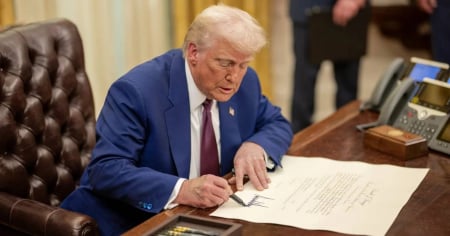
Nayib Bukele was welcomed by Donald Trump at the White House this Monday, in a meeting that solidified a close bilateral alliance on immigration and security matters.
The meeting was accompanied by a series of public statements that highlighted the political and rhetorical affinity between both leaders.
In this way, Bukele becomes the first Latin American president officially received by Trump during his second term.
Frequently Asked Questions about the deportation of Kilmar Ábrego García and the immigration policies of Trump and Bukele
Why was Kilmar Ábrego García deported from the U.S. to El Salvador?
Kilmar Ábrego García was mistakenly deported due to an administrative "oversight" by the U.S. Immigration and Customs Enforcement (ICE). Despite having a court order that prevented his deportation, he was sent to El Salvador due to an erroneous change in his immigration status.
What position has Salvadoran President Nayib Bukele taken regarding the case of Ábrego García?
The president Nayib Bukele has rejected the release of Kilmar Ábrego García, arguing that he does not wish to introduce a "terrorist" into the United States. Bukele has the authority to order his release, but he has made it clear that he will not do so, ironically labeling his comments about releasing "terrorists" in El Salvador.
How has the Donald Trump administration reacted to the U.S. Supreme Court's order regarding Ábrego García?
The Donald Trump administration has appealed the Supreme Court's decision ordering Ábrego García's return to the U.S. Trump argues that he is not obliged to repatriate him if El Salvador does not cooperate, asserting that the responsibility for foreign policy and protection against threats falls on the president.
What agreements exist between the U.S. and El Salvador regarding immigration and security?
The United States and El Salvador have reached agreements to deport suspected gang members and other immigrants to El Salvador, where they are imprisoned. El Salvador receives financial compensation for accepting these deportees, and Trump has praised Bukele for his cooperation in security and immigration control.
Filed under: