
Related videos:
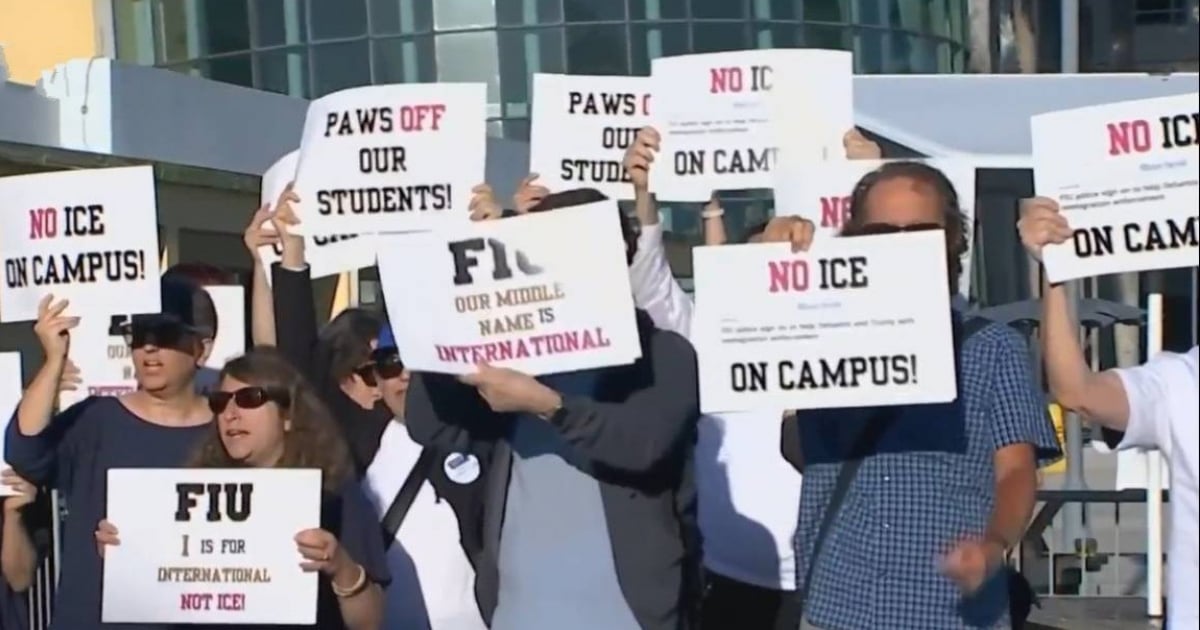
A group of students and professors from Florida International University (FIU) protested against an agreement signed between the institution and the Immigration and Customs Enforcement (ICE) that would allow university police to receive training to enforce immigration laws on campus.
Conflicts began when the Trump administration revoked the F-1 visas of 18 students from Florida International University (FIU) between March 25 and April 10, 2025, as part of the agreement with ICE that is part of the 287(g) Program.
This agreement allows campus police to act as immigration agents, including conducting interrogations and making arrests. The measure has raised concerns within the academic community, fearing that campuses may turn into spaces for immigration enforcement.
The president of FIU justified the change by citing the need to prioritize resources for legal residents of the state.
However, the measure has generated strong opposition among members of the academic community, as they believe it jeopardizes the safety and well-being of students, especially those with vulnerable immigration status.
It is especially highlighted that, under this program, campus police officers would not only be able to interrogate but also detain and deport students if they suspect that their immigration status is irregular.
The protests took place in front of the building where the FIU board of directors was meeting to discuss a change in institutional regulation. If approved, it would allow federal agents to access students' academic records.
This agreement comes in the context of increasingly strict immigration policies in the state of Florida, in compliance with the guidelines set by Governor Ron DeSantis and the Trump Administration.
For many, the collaboration between public universities and ICE represents a new assault on higher education and a factor that could deter the presence of international and migrant students in state educational institutions.
The concern extends to students who benefit from programs like DACA, who have already begun to face tangible consequences such as the loss of academic scholarships and uncertainty about the continuation of their studies in an environment they perceive as hostile.
The university community hopes that the authorities at FIU will reconsider the implementation of this collaboration, in defense of a safe, inclusive, and learning-focused academic environment.
Frequently Asked Questions about FIU's Collaboration with ICE and University Protests
Why are students and professors at FIU protesting against collaboration with ICE?
Students and professors protest because the agreement with ICE allows campus police to act as immigration agents, which they believe puts the safety and well-being of students at risk, especially those with vulnerable immigration status.
What does the agreement between FIU and ICE entail?
The agreement allows campus police to receive training to implement immigration laws, which includes the ability to interrogate, detain, and deport students if they suspect that their immigration status is irregular. This is part of the 287(g) program, which grants local law enforcement the authority to act as immigration agents.
How does this agreement affect international students and DACA beneficiaries at FIU?
The agreement creates uncertainty and fear among international students and DACA beneficiaries, who are already facing consequences such as the loss of academic scholarships and doubts about the continuation of their studies in an environment they now perceive as hostile.
What measures is the state of Florida taking regarding immigration?
The state of Florida, under the administration of Ron DeSantis, has implemented stricter immigration policies, including agreements with ICE for local law enforcement to act as immigration agents. Several agreements have been signed in different cities across Florida to facilitate the detention and deportation of undocumented immigrants.
Filed under: