
Related videos:
Authorities in the province of Guantánamo have confirmed the detection of more than a dozen children and adolescents who consume drugs, including within educational centers, or have been involved in the possession and sale of such substances.
The chief Alexander Millet Suárez, head of the Group of prioritized sectors in the National Anti-Drug Directorate in the eastern territory, revealed that there has been monitoring of young people and minors involved with drugs, including eight minors and two adolescents aged 16 and 17 who were admitted to the Pedro A. Pérez Pediatric Hospital and tested positive for narcotic intoxication.
Additionally, four other minors were "controlled": two for drug use, one for possession, and another for trafficking, the officer specified in statements reported by the provincial newspaper Venceremos.
According to Millet, the adults who provided the substances to these minors "are already serving penalties as established by law." He explained that police operations "led to actions" against 64 individuals, of which 48 were charged and were subjected to the precautionary measure of provisional imprisonment.
The chief prosecutor in the province, Moraima Velázquez Romero, indicated that drug trafficking can result in up to 30 years of imprisonment or life imprisonment.
He warned that "preventive and confrontational actions against drug consumption and trafficking are a high priority for the country" and defended "the severity in the criminal legal treatment of these behaviors, which affect family stability and the security of the country."
"In the case of traffickers, the precautionary measure of provisional imprisonment is the first step, established to ensure that these individuals do not continue to repeat such actions, but almost all the penalties requested and subsequently imposed by the Court have been deprivation of liberty," Velázquez stated.
The prosecutor told Venceremos that, in addition to the "individual assessment" of the cases, young people of penal age - between 16 and 18 years old - receive "special treatment," to analyze the conditions and circumstances of their involvement in these crimes, which may influence the fact that they do not always go to prison, although mitigating factors do not exempt them from responsibility.
Drugs in schools
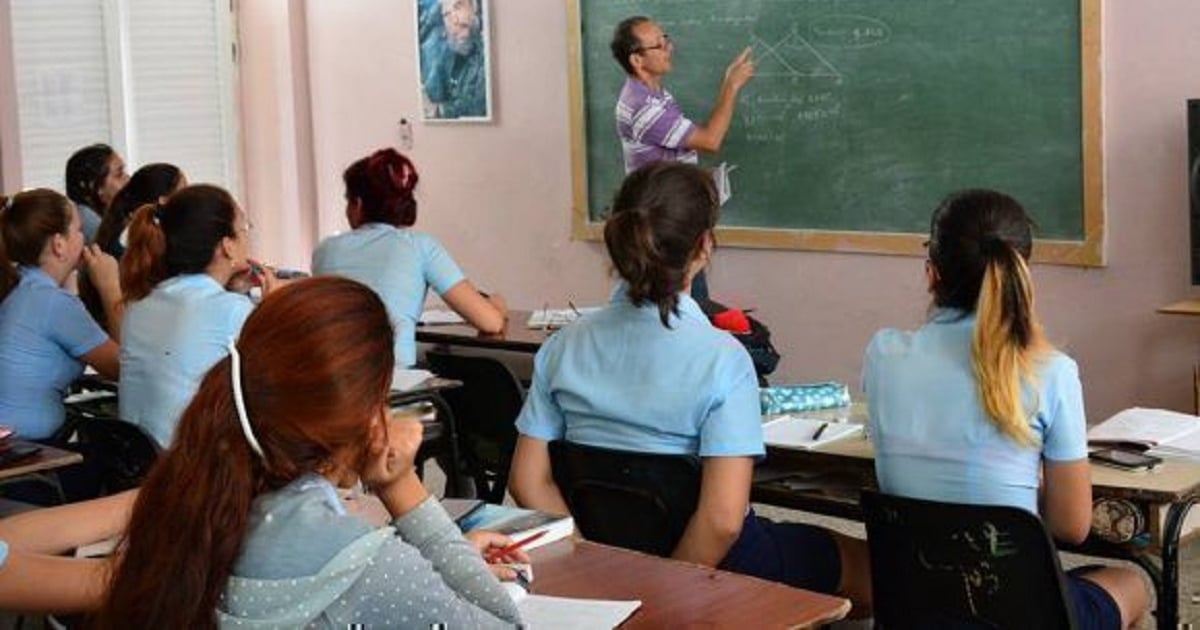
The director of a school in Guantánamo, identified only by the name Andrés, told the newspaper that he had caught two students using drugs in the act, although he did not specify their age or grade level.
During her usual walk through the center at noon, she observed from a distance how "two students emerged from the basement in a suspicious manner."
"One of the girls, upon seeing me, dropped what I thought was a cigarette, so I approached to check and get their attention. As I got closer to the girls, one could barely stand; that's when I realized that what they had in their hands was something far more dangerous than I suspected," Andrés recounted.
"It was a difficult, complicated few hours... even one of the young women's lives was at risk," she stated.
The director pointed out that, although "the use of drugs in a Cuban school is not common, in fact, it is an alarming occurrence because it shows that our country is not free from this scourge."
According to Antonio Tamayo Romero, Deputy Director of Education in Guantánamo, the Ministerial Resolution 15/2019 is implemented in all schools to promote rejection of drugs among children, adolescents, and young people.
However, he acknowledged that cases of drug use or possession in schools in the area highlight the need to "improve prevention efforts and timely alerts to prevent unfortunate incidents from occurring."
Anti-drug operations
Through operations at maritime and air borders, mountainous areas, and land checkpoints, in 2024 the authorities of Guantánamo , according to figures reported by Venceremos.
During the same period, 904 marijuana plants were seized in four illegal growing locations; the municipalities of Guantánamo and Manuel Tames are the ones with the highest incidence, Millet indicated.
By the end of 2024, a total of 13 incidents associated with international drug trafficking were recorded in coastal areas such as Baracoa and Caimanera: eight drug landings were intercepted and five accidental discoveries were made. As a result, the authorities seized 48 packages of drugs and two damaged fragments - apparently due to the action of the sea or the reef - totaling 171.15 kilograms of marijuana and 1.10 kg of cocaine, said the official.
The Cuban government has acknowledged a worrying rise in drug use within educational institutions, an increase that is directly attributed to the greater availability of narcotics on the island.
As part of their "zero tolerance" policy towards drug trafficking, the authorities are conducting exemplary trials to deter this type of activity.
Despite the government's "crusade" against drugs, specialists and citizens believe that institutional responses remain more reactive than preventive, and are also quite ineffective in addressing a rapidly growing issue, especially among young people.
The increasing consumption of the synthetic cannabinoid known as "the chemical", a highly addictive substance, is concerning, particularly due to its presence in vulnerable communities, where clandestine sales points proliferate despite police measures.
In this regard, Millet emphasized that "the chemical" is sold at prices ranging from 150 to 200 pesos on the black market, and "that is why it is more accessible to young people." This drug causes severe poisoning, making it particularly dangerous.
The Cuban government launched this week a Drug Prevention and Response Exercise, which includes discussions in neighborhoods, communities, and workplaces. According to the official newspaper Granma, the debates, which will extend until June 30, will be guided by a document from the Communist Party of Cuba (PCC), which calls to "mobilize awareness and responsibility."
The regime announced this year the creation of a National Drug Observatory, under the responsibility of the Ministry of Justice, which will feature an Early Warning System, maintain oversight of new substances, and monitor the phenomenon of so-called emerging drugs. Additionally, it will seek to establish partnerships with international experts to conduct research in this area.
Frequently Asked Questions about Drug Use in Schools in Guantánamo
What measures are the authorities in Guantánamo taking to address drug use in schools?
The authorities in Guantánamo have confirmed that they are closely monitoring cases of minors involved in drug use and trafficking. Police operations have been carried out, resulting in the arrest of adults who were providing these substances to minors, who are already facing legal sanctions. Additionally, prevention programs have been implemented in schools, based on Ministerial Resolution 15/2019, to promote a rejection of drugs among children and adolescents.
What are the legal consequences for adults who provide drugs to minors in Cuba?
In Cuba, adults who provide drugs to minors face severe penalties, including up to 30 years in prison or even life imprisonment. Authorities have emphasized the importance of exemplary sanctions to deter this type of crime, reflecting a zero-tolerance policy towards drug trafficking.
What drugs are being consumed the most by young people in Guantánamo?
Among the most commonly used drugs by young people in Guantánamo is the "químico," a highly addictive and dangerous synthetic cannabinoid. This substance is particularly accessible among young people, with a black market price ranging from 150 to 200 pesos, which has contributed to its growing popularity and presence in vulnerable communities.
How does the "zero tolerance" policy affect drug trafficking in Cuba?
The "zero tolerance" policy towards drug trafficking in Cuba entails exemplary trials and severe penalties for those involved in drug trafficking and consumption. However, despite these efforts, the problem persists, with an increase in drug use and trafficking, especially among young people. Critics point out that these actions are more reactive than preventive and emphasize the need to address the underlying causes of the issue, such as a lack of opportunities and social decay.
Filed under: