
Related videos:
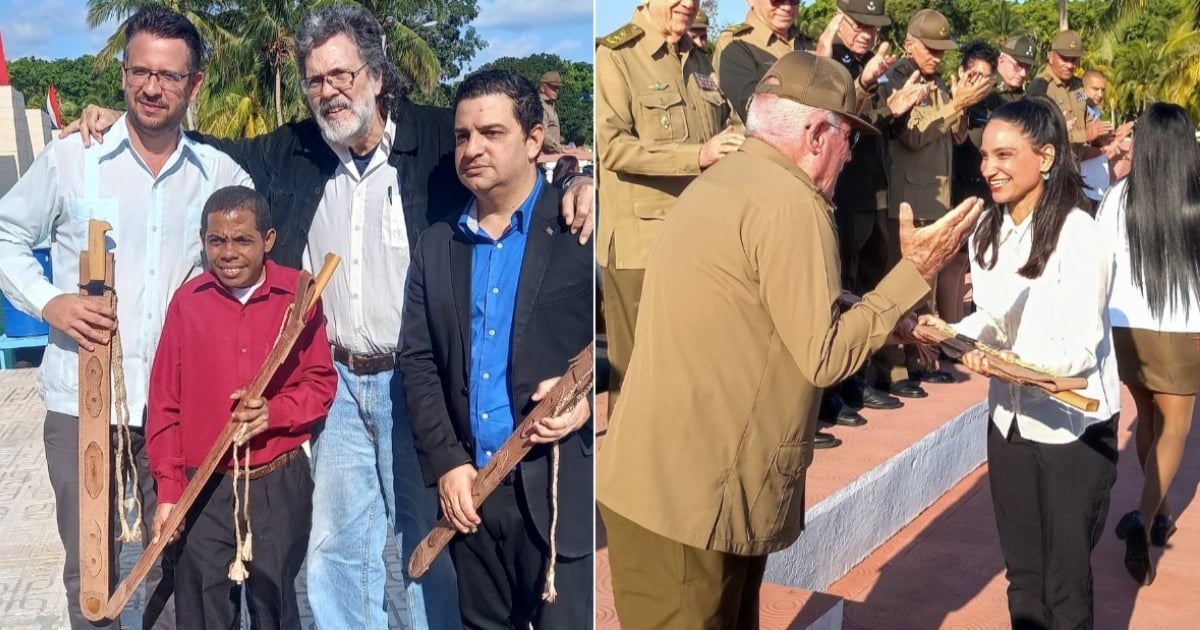
While thousands of Cubans suffer from blackouts, shortages of food and medicine, and political repression, the regime once again displayed its complete disconnection from the reality of the country by celebrating, with pomp and grand speeches, the presentation of a replica of Generalissimo Máximo Gómez's machete, a symbol that once represented the struggle for independence but today serves as a grotesque medal of loyalty to power.
Among this year's awardees are Humberto López, a government spokesperson known for his television campaigns discrediting activists and independent journalists, and Annie Garcés, the young singer famous for her phrase "the 62 thousand millennia" in defense of Castroism.
Others close to the government are joining them, such as Yusuam Palacios; Elier Ramírez, deputy director of the Fidel Castro Center; the Tele Turquino channel; and even La Colmenita from the PNR, a children's group under the auspices of the police.
Humberto López, upon receiving his symbolic machete, thanked the Ministry of the Revolutionary Armed Forces (MINFAR) with a speech filled with military rhetoric: "In times of unconventional warfare (…) let us make every day a new battle."
In a peak of cynicism, he lashed out at what he called "propaganda" and "cheap, simple, crude lies that seek to infiltrate, fragment, seduce, and divide," asserting that his work as a communicator is part of an alleged defense of the homeland. "We are at your service," he concluded.
Annie Garcés, for her part, celebrated on Facebook her inclusion among the awardees as "one of the youngest artists" to receive the machete of Gómez.
The singer, who performed at the event for the 64th anniversary of the declaration of the socialist character of the revolution, wrote about "the beauty of being consistent until the last breath," without dedicating a single word to the blackouts, political prisoners, or the widespread precariousness experienced in her country.
This type of award is not new. Since 1986, the MINFAR has been bestowing this distinction on those who, under the pretext of cultural commitment, act as spokespeople for the official ideology.
In 2021, the duo Buena Fe was also awarded, amid a national context marked by the social upheaval of July 11 and the mass imprisonment of young protesters.
"We try to continue being people of our time," Israel Rojas said then.
Reward obedience while punishing dissent
In a country where artists like Luis Manuel Otero Alcántara are imprisoned, independent journalists are harassed, and dissenting thought is criminalized, it is profoundly outrageous that the highest authorities reward those who have dedicated themselves to justifying repression, censorship, and the cult of personality with patriotic symbols.
The contrast couldn't be more brutal: while some receive a machete at a ceremony with flowers, uniforms, and flags, hundreds of Cubans are behind bars for exercising their right to free expression.
While the regime praises "unity" and "the infinite work of the Homeland in Revolution," thousands await a visa to escape the country that promised them glory but delivered misery.
An empty act for a ruined republic
These types of decorations illustrate the level of cynicism of a government more concerned with rewarding obedience than with addressing the urgent problems of the country.
The true heroes of the present do not have microphones or golden machetes. They are in the bread lines, in the resource-limited hospitals, in the neighborhoods without electricity, and in the families shattered by exile.
Celebrating the tracatanes of the year with a replica of Máximo Gómez's machete is, at best, a painful irony. At worst, it is a blatant provocation to a people who have already lost too much.
Frequently asked questions about the awards of the Cuban regime and the current situation in Cuba
What does the delivery of Generalissimo Máximo Gómez's Machete represent in Cuba?
The delivery of the Machete of Generalissimo Máximo Gómez symbolizes a recognition of loyalty to the Cuban regime, although it was originally a symbol of the independence struggle. Currently, it is awarded to figures who act as spokespersons for the official ideology, reflecting the government's disconnection from the real needs of the Cuban people.
Who are the recent recipients of the Machete of Generalissimo Máximo Gómez?
Among the awardees are Humberto López and Annie Garcés. Humberto López is known for his discrediting campaigns against opponents, while Annie Garcés is a singer who has publicly defended Castroism. Other recipients include figures such as Elier Ramírez and Yusuam Palacio, highlighting the support for those who uphold the official narrative.
What is the main criticism of this type of awards in Cuba?
The main criticism is that these awards showcase the government's cynicism by rewarding obedience while punishing dissent. In a country where artists are imprisoned and dissenting thoughts are criminalized, these honors represent an affront to Cuba's historical memory and highlight the regime's disconnection from the urgent needs of the people.
How does the situation of the award recipients contrast with the reality of ordinary Cubans?
While some receive awards in official ceremonies, many Cubans face blackouts, food shortages, and repression. The recognition of figures loyal to the regime contrasts sharply with the reality of thousands of Cubans who are suffering hardships and seeking to emigrate due to a lack of opportunities and freedoms in the country.
Filed under: