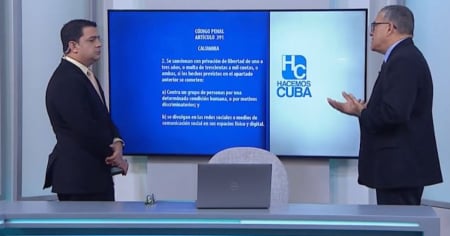
The official Cuban spokesperson Humberto López recently asserted that a "colero" offered to move him ahead in line to buy gasoline in exchange for 1,500 Cuban pesos, revealing a common practice that affects thousands of citizens on the island.
According to López's account on the television program "Buenos días" on Cuban TV, while he was waiting in a long line at a gas station, a person discreetly approached him proposing to expedite his wait if he paid that amount.
“I did a fieldwork project. We spent several days meeting to organize this presentation today, and on Sunday I said, 'Well, let's visit a few Cupets.' In some, I didn't see any situations, but when I arrived at the Cupet located at 33 and 42 here in the Playa municipality, there were around four or five people in the area. They weren't far, Vice President, they were in the Cupet vicinity," López explained to his guests in the studio.
"There was one who was in charge of the line and quickly said to me: 'A truck is coming, don't wait in line, 1500 pesos and you'll go first.' Generally, when you arrive at a place, people recognize you; fortunately, he didn't recognize me and was able to make me the offer so I could understand what was happening," he added.
The event was described by the state spokesperson as a clear manifestation of everyday corruption.
“I told him 'no, I'm not interested,' but that wasn't enough for him. He came back a second time and said 'this is a Cupet in dollars. The tanker is coming, this will stop for an hour. Pay me 500 pesos in national currency per liter and continue down 42, and at 39 and 42 there's another Cupet. You'll fill up with the fuel you pay me for. In other words, pay me in cash in national currency the equivalent of what you would pay in dollars and you can fill up over there. You don't have to pay anything over there, I just tell you who to go to and they'll fill it up for you,'" López continued.
The complaint made by the spokesperson sparked a debate on the platform YouTube, where the program was shared, and some users criticized the complaint for being seen as late and superficial.
Some of the prominent reactions were criticisms of the Cuban government's management: "The problem is how miserable this government has made this country. They are so shameless that they tell you that gasoline is in dollars."
Another internet user questioned the feasibility of standing in long lines: "Gentlemen, there are people who work with vehicles and if I have to wait in line for the fuel to arrive at Cupet and for my turn, I will starve. I believe that Telegram is the best option."
There were also specific criticisms of how the authorities handled these situations: "In my municipality, a list was created with all the vehicles belonging to that area, and it worked very well until the head of Cupet in Granma was annoyed and released the gasoline for sale in line. The result: only the line waiters and resellers purchased it."
From another perspective, many Cubans have pointed out that this type of corruption is a direct consequence of the economic and social crisis generated by government management and have questioned the sincerity and depth of López's denunciation, given his well-known defense of the political system that precisely promotes these illegal practices.
The long lines to obtain fuel in Cuba have become a constant due to the chronic shortage plaguing the country, creating a favorable environment for illicit activities such as reselling or paying to jump the line.
Frequently Asked Questions about Corruption and the Fuel Crisis in Cuba
What is a "colero" in the Cuban context?
A "colero" is a person who sells slots in lines to obtain scarce products or services, such as gasoline. This practice has become common in Cuba due to the shortage of basic supplies, creating a lucrative informal market for those who take advantage of citizens' desperation.
How much does gasoline cost on the black market in Cuba?
The price of gasoline on the black market in Cuba has reached up to 900 pesos per liter. This increase reflects the serious energy supply crisis facing the country, exacerbated by issues of government management and international economic restrictions.
What measures has the Cuban government taken to control the sale of gasoline?
The Cuban government has implemented measures such as restrictions on the amount of fuel that can be purchased and the limitation of sales points. However, these measures have been criticized for not addressing the underlying causes of the crisis, such as poor economic management and corruption within the state apparatus.
What is the impact of the fuel crisis on daily life in Cuba?
The fuel crisis in Cuba severely impacts daily life, making transportation and access to essential services difficult. Citizens are facing long lines and high prices in the black market, exacerbating the already challenging economic situation in the country.
Filed under: