
Related videos:
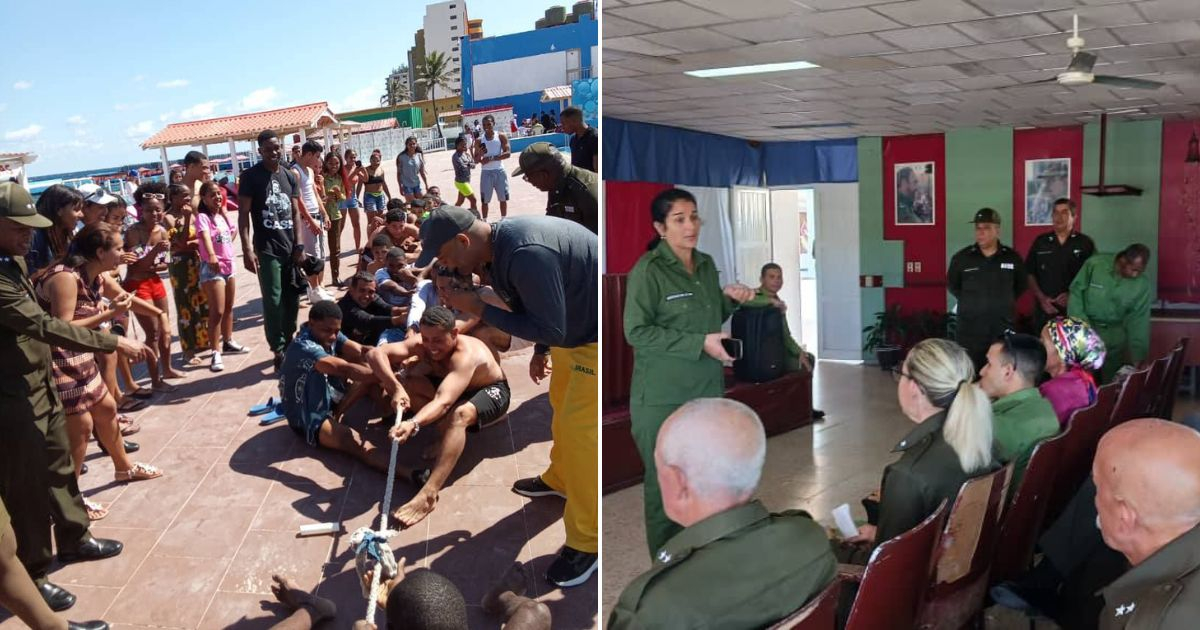
In an attempt to "humanize" the future repressors of the regime, the Ministry of the Interior (MININT) of Cuba organized a "fraternal" festival this week among cadets, in honor of the 63rd anniversary of the Union of Young Communists (UJC) and the 64th anniversary of the failed invasion attempt at Playa Girón, one of the symbolic cornerstones of the government.
According to a publication from MININT on Facebook, the activities took place at the Higher Institute of the Ministry of the Interior in Havana, as well as at its regional faculties in Villa Clara, Camagüey, and Santiago de Cuba.
Under the slogan "Everything for victory," the activities included exchanges with high-ranking officials and sessions of political indoctrination.
The future agents of the state's repressive apparatus were "trained" by the same bodies where they will perform their duties once they graduate.
The events also served to strengthen the narrative of unity and continuity that the regime promotes, amid a growing social disaffection characterized by the economic crisis, youth exodus, and a lack of freedoms.
In settings such as the Memorial of Denunciation and units of the Guardafronteras Troops and the Fire Department, the organizers symbolically promoted "the embrace for the future and the defense of the present," referring to the role these young people will play in upholding the system.
As part of the program, the cadets participated this Wednesday in recreational, cultural, and sports activities at the "Cristino Naranjo" venue in Havana, during a day that combined physical training with ideological propaganda.
The official profile of MININT presented the event as a space to "deepen the sense of belonging" among the cadets to the system, in a context where younger sectors are increasingly distancing themselves from the official discourse.
In recent months, the Cuban regime has intensified its propaganda campaign to humanize the image of the future oppressors of the system, through activities that appear to be civic, educational, and sports-related, organized by MININT.
A clear example of this image operation was the celebration of a soccer tournament among repressive structures of MININT, such as Counterintelligence, the Revolutionary National Police, and the Fire Department.
While they suppress peaceful protests and monitor dissenters, these same agents were photographed on official social media enjoying games and camaraderie at a commemorative event, highlighting the contrast between their repressive role and the image the regime tries to promote.
Simultaneously, the MININT organized a vocational festival at a school in Havana, presented as an educational and recreational day for children and teenagers.
In reality, the activity was part of an ideological recruitment operation disguised as professional orientation, during which police techniques were showcased, security talks were offered, and propaganda materials were distributed.
The intention was clear: to foster, from an early age, a connection with the state control devices.
In the same vein, the act of two cadets who returned a lost backpack containing thousands of euros and dollars was widely publicized.
The story was used as an example of civic and ethical education within the military system, concealing the numerous reports of abuse and violence that weigh on those same institutions.
Frequently Asked Questions about Youth Indoctrination in Cuba
What was the objective of the festival organized by MININT in Cuba?
The goal of the festival organized by the Ministry of the Interior (MININT) was to "humanize" and indoctrinate the future repressors of the Cuban regime through activities focused on camaraderie and political training. The event was held in honor of significant anniversaries of the government, aiming to strengthen the narrative of unity and continuity of the system amid the economic and social crisis facing the country.
How is youth indoctrination carried out in Cuba?
Youth indoctrination in Cuba is carried out through events and activities organized by the regime, such as festivals, military drills, and educational programs, aimed at instilling loyalty to the system and ideological control from an early age. These activities are present in schools, universities, and even in religious spaces, using political propaganda to ensure the regime's continuity.
What role do recreational activities play in the indoctrination of young Cubans?
Recreational activities in Cuba are used as tools for propaganda and indoctrination. Events such as festivals, carnivals, and sports competitions are presented as spaces for enjoyment, but in reality, they serve to reinforce the regime's ideology, promoting a sense of belonging to the system and the continuity of its political narrative among the youth.
What is the impact of indoctrination on the new generations of Cubans?
The indoctrination of new generations of Cubans aims to ensure loyalty to the regime and perpetuate its control over the country. This process limits the development of critical thinking and freedom of expression, affecting young people's ability to question and change the system. Additionally, it contributes to social disaffection and youth exodus, as many seek to escape an oppressive environment with no real opportunities for advancement.
Filed under: