
Related videos:
The Cuban government abstained again this week in a vote at the UN General Assembly that included references to Russia's aggression against Ukraine, thereby maintaining its usual diplomatic line of implicit support for Moscow in international forums.
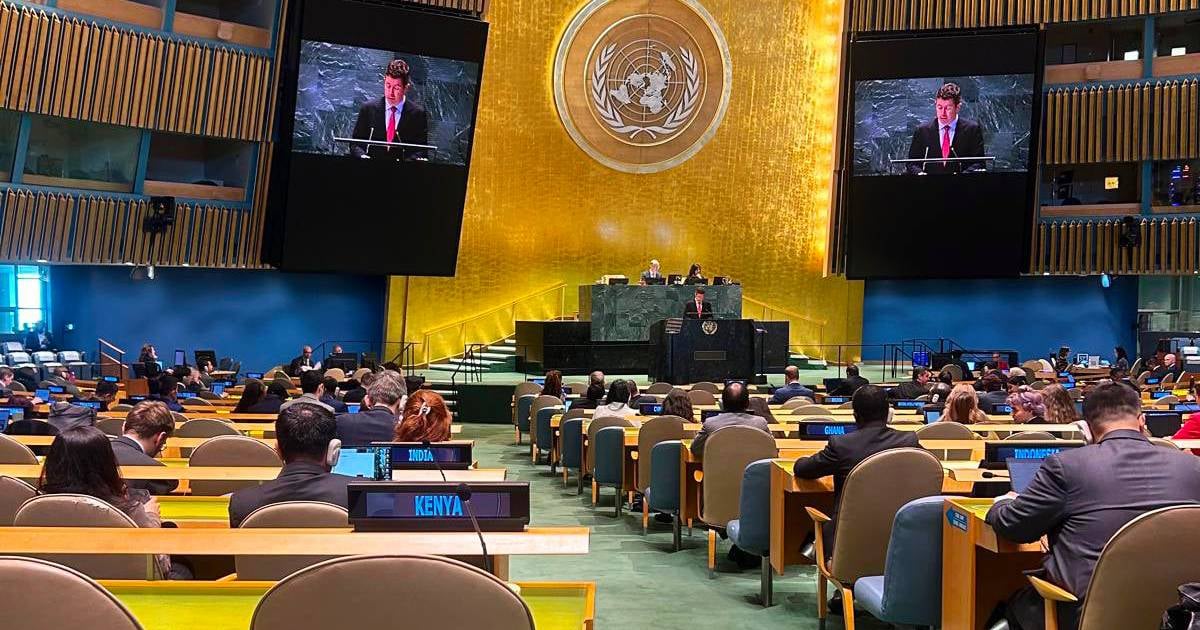
The resolution, identified as A/79/L.75, was presented by Luxembourg and Lithuania, and was approved on Wednesday, April 16, by 105 member countries.
The document reaffirms cooperation between the United Nations and the Council of Europe and highlights the "unprecedented challenges" facing the European continent due to Russia's military actions, both in Ukraine and previously in Georgia.
The text underscores the importance of restoring peace and security "based on respect for the sovereignty, territorial integrity, and political independence of any state."
The resolution makes clear references to Russia's actions and caused divisions in the voting. Cuba, along with 33 other delegations, chose to abstain, while 46 countries did not participate in the vote.
In contrast, the United States, Russia, Belarus, North Korea, Nicaragua, and Mali, among others, voted against it, marking an unusual alignment between Washington and Moscow that has been observed in recent months in the context of the new Administration of Donald Trump.
This is the second recent time that both countries have aligned in their negative vote regarding a UN resolution on the conflict in Ukraine.
While last March the regime reaffirmed its "intention to strengthen bilateral ties on the 33rd anniversary of establishing relations" with Ukraine, Havana continues to refrain from explicitly condemning Russia.
Since the onset of the invasion in 2022, it has chosen diplomatic silence, abstention, or a negative vote when it comes to resolutions that point to the Kremlin for violations of international law.
The resolution also reaffirms the role of the Council of Europe in defending democracy, human rights, and the rule of law, and expresses the willingness of this organization to collaborate with the UN in areas such as the fight against human trafficking, racism, gender-based violence, and sustainable development.
One of the highlights of the document is the support for the creation of the "Registry of Damages Caused by the Aggression of the Russian Federation against Ukraine," as well as the ongoing efforts to establish a special tribunal to judge the crimes of aggression committed in the conflict.
During the debate at the Assembly, U.S. Ambassador Jonathan Shrier expressed his rejection of the text, describing it as "useless for advancing towards peace," although he reiterated his country's support for a lasting solution to the conflict.
For its part, the Russian delegation condemned the "unacceptable politicized language" of the document, while the European bloc defended its content as part of efforts to uphold a rules-based international order.
Frequently Asked Questions about Cuba's Position at the UN Regarding the Russian Invasion of Ukraine
Why did Cuba abstain from the UN vote on Russia's aggression against Ukraine?
Cuba abstained from the UN vote as part of its diplomatic strategy to not explicitly condemn Russia. Since the beginning of the Russian invasion in 2022, Cuba has chosen diplomatic silence, abstentions, or votes against resolutions that call out the Kremlin for violations of international law. This reflects a strategic alignment with Russia, from which Cuba depends for energy supplies and political support, especially in the context of the U.S. embargo.
How does Cuba's relationship with Russia affect its foreign policy?
The relationship between Cuba and Russia impacts its foreign policy by creating a significant dependency in energy and strategic terms. Havana has maintained a stance of implicit support for Moscow, which translates into a foreign policy that refrains from condemning Russian actions, even in scenarios where international law principles are violated. This also allows Cuba to receive support in international forums, such as the UN, particularly on issues related to the U.S. embargo.
What does Cuba's abstention in the UN imply for its relationship with the United States?
Cuba's abstention in the UN reinforces its stance of distancing itself from the United States. Although there are instances when their votes align, such as in a recent case where both Cuba and the U.S. voted against a resolution, this does not imply diplomatic alignment. The relationship between the two countries continues to be marked by historical tensions, such as the embargo, and Cuba's policy of abstaining or voting against resolutions that criticize its strategic allies like Russia remains a constant in its foreign policy.
Filed under: