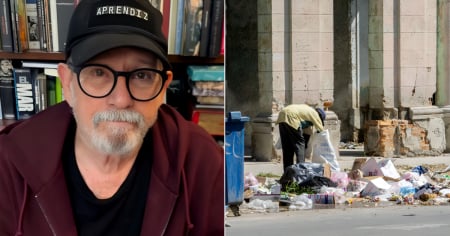
The former Minister of Labor and current presidential pre-candidate of the Communist Party of Chile, Jeannette Jara, clarified after having denied that there is a dictatorship in Cuba.
In an interview on the podcast Why I Had to Say It, hosted by José Antonio Neme and Julio César Rodríguez, the candidate explained that her intention was not to assert that Cuba is not a dictatorship, but to suggest that it is a "different" system.
"When I said that this is a different political system, I did not think it would have the consequences it did, because my intention was not to say it was not a dictatorship. Of course, but you know I also learned that it's already happened, I've already said it, and it's done," he shared in the program.
In his speech, he asserted that he wants to govern Chile with a Chilean model and not one from another country: "Not from Argentina, not from Nicaragua, not from Cuba, not from Peru, not from Ecuador, not from Venezuela. In Chile, we must protect our democracy."
Later on, he questioned the existence of candidates who justify and normalize the dictatorship in Chile: "I swear that this situation gives me a sense of dread. I'm concerned about this situation."
The activist from the Communist Party of that country (PCCh) had stated in an interview with CNN that "each people defines its government," referring to the Cuban dictatorship.
In his words, Jara stated that "the case of Cuba is quite different" from that of other countries questioned for human rights violations, and attributed the current situation on the island to the consequences of the U.S. embargo.
"The main difficulty has been the blockade that has lasted for decades and has them suffocated," he stated.
The candidate from the CPC contrasted her views on Venezuela with those from Cuba, where she acknowledged the existence of an “authoritarian regime” under the leadership of the dictator Nicolás Maduro.
The lawyer and public administrator served as the Minister of Labor and Social Welfare from March 2022 until April 7, 2025, when she resigned from her position two days after being announced as the presidential candidate of the PCCh.
Jara's statements quickly sparked reactions. The presidential candidate Carolina Tohá, former Minister of the Interior and representative of the Party for Democracy (PPD), distanced herself from these comments from the city of Copiapó during an interview on Radio ADN.
Tohá emphasized that the Cuban regime has brought the country to a situation of extreme poverty that she described as “painful and inconceivable.” She also stated that these types of differences within Chilean progressivism must be openly discussed during the campaign.
Frequently asked questions about Jeannette Jara's statements and the Cuban regime
What did Jeannette Jara declare about the Cuban regime?
Jeannette Jara, presidential candidate of the Communist Party of Chile, initially stated that she did not consider Cuba a dictatorship. Instead, she described the Cuban system as "democratic but different from ours." However, she later revised her statements, clarifying that her intention was not to deny the dictatorship in Cuba, but to emphasize that it is a different political system.
What is Jeannette Jara's position on the U.S. embargo against Cuba?
Jeannette Jara attributes Cuba's difficulties primarily to the embargo imposed by the United States. According to her, this blockade has suffocated the island for decades, being the main cause of its economic problems, more so than the Cuban regime itself.
How did Carolina Tohá react to Jeannette Jara's statements about Cuba?
Carolina Tohá, also a presidential candidate in Chile, strongly criticized the Cuban regime, describing it as "painful and inconceivable" due to the extreme poverty it has caused. Tohá emphasized that the Cuban system does not meet the criteria for a democracy, as there are no real alternatives for choice or alternation of power.
What is the international context regarding the perception of the Cuban regime?
The Cuban regime is a divisive topic internationally, especially among leftist sectors in Latin America. While some defend Cuba as a "democratic alternative," others, such as former Uruguayan president José Mujica, criticize its lack of democracy and repression. Reports of repression and a lack of freedoms in Cuba are commonly heard on the international stage.
Filed under: