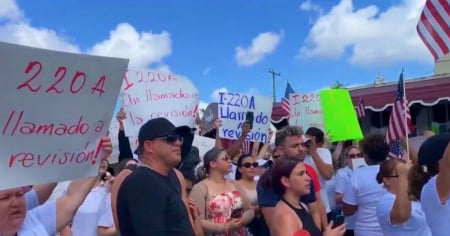
The Cuban Yadira Cantallops, who had been arrested by agents of the U.S. Immigration and Customs Enforcement (ICE) in March, in Miramar, Broward County, was released after a month and 11 days of detention.
The journalist Daniel Benítez confirmed that Cantallops, originally from Holguín, was able to reunite with her family, embrace her young son, and will now continue her asylum case in the United States.
This woman was transferred by ICE to a detention center in California after her arrest. The Cuban was able to present her case before the immigration court, and the judge imposed a bail of $1,500.
Cantallops entered United States territory with her husband Ernesto in January 2022 through the southern border. Both of them were under the immigration status of form I-220A. The couple's son is a U.S. citizen, a fact that could positively influence the progression of their immigration case.
Benítez reported on the case of another Cuban, Denisa Reyes, who was arrested on the same day as Yadira at the ICE center in Miramar. She also received a bond, this time for an amount of $6,000, but it has not yet been possible to confirm her release.
Both cases are framed within events from March, which resulted in the arrest of Cuban migrants with I-220A documents while attending their regular appointments with immigration authorities in the United States.
When were the arrests of Cuban women with I-220A made?
On March 13, 2025, reports began to emerge of young Cuban women residing in the United States who were detained by ICE, despite having the immigration form I-220A, which had previously been considered a form of supervised release.
The first reported case was that of Mailén González, arrested during a routine appointment. This sparked a protest in Miami by activists and members of the Cuban community, who demanded her release.
The next day, news was reported about the arrest of a third Cuban with an I-220A, which confirmed a troubling trend in the actions of immigration authorities in Florida.
In less than a week, it was reported that the list of detained Cuban women with the same document continued to grow, with at least six women arrested during their appointments with ICE. This situation created fear among Cuban immigrants with similar status.
Among them is the case of a 33-year-old Cuban mother who was detained and transferred from San Antonio (Texas) to a facility in Louisiana, reporting inadequate conditions and humiliating treatment during the process.
Several of the detainees provided testimonies from the ICE centers, stating that they were not informed of the reasons for their arrests and that many had no criminal records.
Finally, on March 29, it was reported that one of the Cuban women was released after receiving public and media support. It was seen as an achievement, but the situation of some Cuban women with I-220A detained by ICE remains unresolved.
Frequently Asked Questions about the Detention of Cubans with I-220A by ICE
Who is Yadira Cantallops and why was she detained by ICE?
Yadira Cantallops is a Cuban with I-220A who was detained by ICE in Florida. She was arrested during a routine appointment with immigration authorities and later released after paying a bond of $1,500. Her detention raised concerns due to her immigration status and her history of political persecution in Cuba.
What is the I-220A form and why is it important for Cubans in the U.S.?
The I-220A form is a "Notice of Release on Recognizance". It allows migrants to be released from federal custody under certain conditions, such as attending immigration hearings. However, it is not considered an official legal admission to the U.S., which leaves beneficiaries in a legally uncertain situation, especially for many Cubans who are waiting to regularize their status.
Why has there been an increase in the detention of Cubans with I-220A?
The increase in detentions is due to a tightening of supervision by ICE. Since March 2025, ICE has intensified its oversight of immigrants with I-220A, raising concerns within the Cuban community in the U.S. These actions have been part of a pattern of detentions during routine appointments, causing uncertainty about the future for many migrants.
What impact does Yadira's history of political persecution have on her asylum case?
The history of political persecution faced by Yadira could have a positive impact on her asylum case. Her family has been subjected to repression in Cuba due to their activism for human rights, which strengthens her application for political asylum in the United States. Her case has garnered public and media support, which may improve her chances of obtaining protection in the U.S.
What measures are Cuban-American lawmakers taking regarding the situation of Cubans with I-220A?
Cuban-American congress members have been criticized for their lack of decisive action. Although they have voiced concerns and proposed bills, they are expected to leverage their influence to pressure the Department of Homeland Security to clarify and improve the status of Cubans with I-220A, a situation that affects thousands of migrants in the U.S.
Filed under: