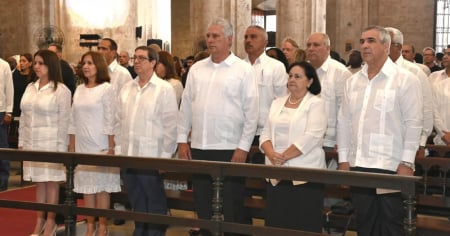
The Army General, Raúl Castro Ruz, made a public appearance this Saturday to sign the condolence book opened at the Apostolic Nunciature in Havana, following the passing of Pope Francis.
The Presidency of Cuba shared images from the official event and confirmed the participation of the ruling Miguel Díaz-Canel and other senior officials of the regime who attended on behalf of the State, the Government, and the Cuban people.
Cuban authorities paid tribute to the Argentine pontiff, highlighting his tireless work in favor of peace, fraternity among peoples, and the search for sustainable solutions to the great challenges facing humanity.
During the meeting, Raúl Castro expressed to the Apostolic Nuncio, the diplomatic representative of the Holy See in Cuba, that the Caribbean nation is deeply saddened by the passing of His Holiness.
Additionally, the Cuban authorities highlighted the affection that Pope Francis demonstrated towards the Cuban people, as well as his contribution to strengthening the relations between the Holy See and the regime in Havana during his papacy.
The passing of Pope Francis has sparked expressions of mourning around the world, where his role as an unwavering advocate for dialogue, social justice, and the rights of the underprivileged is acknowledged.
This Saturday, more than 200,000 people gave their final farewell to the Pope in St. Peter's Square. The funeral was presided over by Cardinal Giovanni Battista Re.
During the mass, his commitment to peace and the poor was highlighted. Delegations from 148 countries attended. Cuba was represented by Salvador Valdés Mesa.
After the ceremony, the casket traveled through Rome to the Basilica of Santa Maria Maggiore, where Francisco was buried in a private ceremony.
Frequently Asked Questions about the Impact of Pope Francis's Death in Cuba
What actions did the Cuban government take following the death of Pope Francis?
The Cuban government declared an official mourning from April 22 to April 24, 2025, lowering the flags to half-mast as a sign of respect. Additionally, tribute events were held, such as the signing of the book of condolences by Raúl Castro and Miguel Díaz-Canel, and a mass celebrated in the Cathedral of Havana in honor of the Pope.
Why did Raúl Castro and Miguel Díaz-Canel not attend the funeral of Pope Francis in Rome?
Raúl Castro did not attend the funeral of Pope Francis in Rome, and instead, Salvador Valdés Mesa, Vice President of Cuba, led the Cuban delegation. No official reasons were given for the absence of both leaders at the event.
What was the relationship between Pope Francis and the Cuban government like?
The relationship between Pope Francis and the Cuban government was close, marked by gestures of affection and cooperation on international issues. During his pontificate, the Pope visited Cuba and acted as a mediator in the restoration of diplomatic relations between Cuba and the United States. However, he faced criticism for not speaking out openly about the repression on the island.
What opinion did Raúl Castro express about Pope Francis after his passing?
Raúl Castro expressed his deep sorrow over the death of Pope Francis, referring to him as a "dear friend" and highlighting his tireless efforts in defense of peace and brotherhood among communities. Castro emphasized the personal and affectionate relationship he established with the pontiff.
Filed under: