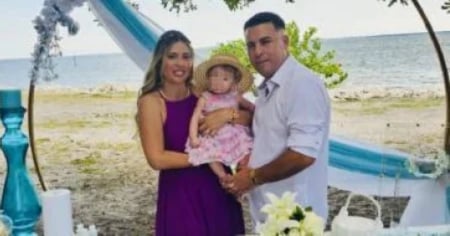
Heydi Sánchez Tejeda, a young Cuban mother recently deported from Tampa, tearfully shared the drama of being separated from her one-year-old daughter.
In an interview with Telemundo, Sánchez shared how painful it has been to face the forced separation from her baby after arriving in Cuba on a deportation flight alongside 82 migrants.
"I was just talking to my baby and my baby was asking for my breasts. My breasts hurt because she’s still breastfeeding from me. I have to express it so that my breasts don't hurt. I need to pump and discard the milk," she said, sobbing.
"How do you think I feel when I throw away my daughter's food? My God, she is only one year old," added the distressed mother.
The case has deeply touched the Cuban community in South Florida, where her husband and young daughter reside.
Sánchez was detained when she attended a routine immigration appointment in Tampa on April 22, and without prior warning, immigration officials informed her that she would be arrested and deported, despite having an active family petition.
The young mother is married to an American citizen, and her residency application was in process.
However, his immigration status was particularly vulnerable: upon entering the United States, he had received an I-220B form, which allowed him to remain in the country while his deportation proceedings were resolved.
The lawyer Claudia Cañizares, who represents Sánchez, explained to Telemundo that the young mother initially entered under the "Remain in Mexico" (MPP) program.
During that period, she was kidnapped in Mexican territory and could not attend her second immigration court hearing, which resulted in an order of deportation in absentia.
“She requested to re-enter the United States and, although she already had that deportation order, she was not deported immediately due to the COVID-19 pandemic,” he emphasized.
"During that time, she got married, had her daughter, and has been reporting regularly. However, when trying to reopen her case, the legal efforts were unsuccessful," the lawyer explained.
The plight of Sánchez highlights the deep cracks in the U.S. immigration system, where mothers like her become trapped in endless procedures, bureaucratic decisions, and immigration policies that, instead of safeguarding families, end up tearing them apart.
The immigration attorney Rosalí Chaviano explained to América TeVé the legal reasons that led to the deportation of the Cuban mother Heydi Sánchez Tejeda, who was under immigration supervision with an I-220B form in the United States.
According to the attorney, the I-220B form does not guarantee protection against deportation, as it is merely a supervision order granted to individuals who already have a deportation order issued by an immigration judge or through an expedited removal process.
"The I-220B form means that it is a supervision order when a person has a deportation order," Chaviano explained. "This order can be issued by a judge or expedited. When a person cannot be deported immediately, this conditional supervision is granted."
The lawyer emphasized that holders of an I-220B must appear periodically before the Immigration and Customs Enforcement (ICE) at appointments that allow for the assessment of whether conditions have changed to permit their deportation.
In the case of Heydi Sánchez, despite her strictly adhering to her appointments and having initiated a regularization process over two years ago through a family petition, her process had not been completed, and the risk of deportation remained.
"If you are going to take any action, it must be months before the appointments. Bringing a lawyer on the same day changes absolutely nothing," warned Chaviano.
Chaviano also warned that the current deportation priorities explicitly include individuals with active orders, which exposes them not only during ICE appointments but also in USCIS processes such as biometrics or residency interviews.
Under the recently implemented stricter policies, even migrants with ongoing legal processes, such as Heydi Sánchez, are subject to swift detentions and deportations.
The lawyer also explained that Cuban authorities have shown a preference for accepting young migrants, professionals, and those without criminal records.
"Unfortunately, what we've seen with Cuba is really a pattern of accepting younger individuals who can work and are professionals; these are the ones that interest them the most. It's not so much about those who have a criminal record or who have been here for many years. Rather, they prefer good people, individuals who can return to the island to work and serve their country," she indicated.
Heydi's husband promises not to give up: "They separated a child from her mother, they killed a family while they were still alive."
Carlos Yuniel Valle, husband of Heydi Sánchez Tejeda, recently expressed his gratitude through tears for the support he has received and stated that he will continue fighting to reunite his family, following the painful deportation of his wife.
"I'm going to make this video without spirit, without desire, without breath," he said at the start of a broadcast in which he recounted the distressing uncertainty he experienced until he learned that his wife had been deported. According to him, it was a friend who confirmed that Heydi was already in Havana, even before the authorities had communicated anything officially.
"Everything we did was in vain. In the end, ICE and Trump got their way," he lamented, visibly affected. "They separated a girl from her mother. They killed a mother, a father, and the future of a little girl," he added.
Valle took the opportunity to publicly thank the journalists and media outlets that got involved in the case, mentioning CiberCuba, Telemundo, Univision, Mario Pentón, and a congresswoman from Tampa. "They treated me wonderfully, fighting for me; there were millions of people wanting to help," he expressed, although with regret he acknowledged that "they were stronger."
The family father also reported that, according to information from Heydi's lawyer, they had even managed to sign the "Stop," a procedure that could halt the deportation. Despite this, the authorities proceeded and put Heydi on the plane bound for Cuba.
The confusion continued even after her departure. “Even at around 12:15 in the afternoon, when she had already been in Havana for over an hour, we knew nothing,” Valle explained. “The computer stated that she was being held at CBP, which was false. The congresswoman called CBP and they said they had nothing to do with it; they only manage people entering, not those leaving.”
Finally, Carlos Yuniel Valle closed his message reaffirming his determination to move forward: “Thank you very much to everyone who has helped me and continues to help me. I will not give up. I will keep fighting. She has a process underway and we will see what we can do.”
Frequently Asked Questions about the Deportation of Heydi Sánchez Tejeda
Why was Heydi Sánchez Tejeda deported?
Heydi Sánchez Tejeda was deported because she had an active deportation order and was under immigration supervision with an I-220B form, which does not provide protection against deportation. Even though she attended her immigration appointments and had an ongoing regularization process, current stricter policies led to her immediate deportation.
What is the I-220B form and how does it affect migrants?
The I-220B form is a supervision order granted to individuals with an active deportation order. It allows migrants to remain in the United States under certain conditions while their situation is being evaluated, but it does not guarantee protection against deportation. Holders must periodically report to ICE to assess whether conditions have changed that would allow for their deportation.
How did Heydi's deportation affect her family?
The deportation of Heydi Sánchez Tejeda separated a breastfeeding mother from her one-year-old daughter, who remained in the United States under the care of her father, Carlos Yuniel Valle, a U.S. citizen. The sudden separation disrupted the mother-daughter bond, causing deep distress within the family and sparking outrage in the Cuban community in South Florida.
What actions are the family and the community taking to help Heydi Sánchez?
Carlos Yuniel Valle, husband of Heydi, has vowed to continue fighting to reunite his family and has thanked the support received from media outlets and individuals who have shown solidarity with his situation. The Cuban community and migrant rights advocates have expressed their outrage and urged the authorities to reconsider the case, highlighting the need for immigration reform that protects families like Heydi's.
Filed under: