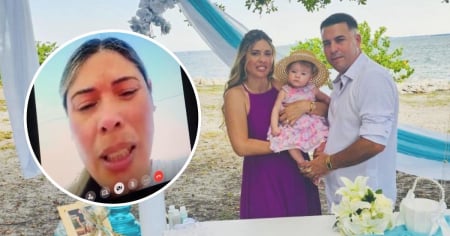
The immigration attorney Rosalí Chaviano explained the legal reasons that led to the deportation of the Cuban mother Heydi Sánchez Tejeda, who was under immigration supervision with a I-220B form in the United States.
Sánchez Tejeda was deported last Thursday, after being detained during a routine appointment at the immigration offices in Tampa, Florida.
The Cuban woman, mother of a breastfeeding baby, was repatriated to Havana on a flight with 81 other migrants, while her daughter remained in the United States under the care of her husband, Carlos Yuniel Valle, a U.S. citizen.
The situation has caused outrage in the migrant community, due to the forced separation of mother and daughter, which has traumatically interrupted the breastfeeding relationship.
According to Chaviano in statements to América TeVé, the I-220B form does not guarantee protection against deportation, as it is merely a supervision order granted to individuals who already have a deportation order, issued by an immigration judge or through an expedited removal process.
"The I-220B form means that it is a supervision order when the person has a deportation order", Chaviano explained. "This order can be issued by a judge or expedited. When the person cannot be deported immediately, this conditional supervision is granted".
The lawyer emphasized that holders of an I-220B must periodically report to the Immigration and Customs Enforcement (ICE, for its acronym in English), at appointments that allow for the assessment of whether conditions have changed to permit their deportation.
In the case of Heydi Sánchez, despite strictly adhering to her appointments and having initiated a regularization process over two years ago through a family petition, her process had not been completed and the risk of deportation persisted.
"If you are going to take any action, it must be months before the appointments. Bringing a lawyer on the same day changes absolutely nothing", warned Chaviano.
Chaviano also warned that current deportation priorities explicitly include individuals with active orders, which exposes them not only during appointments at ICE, but also in USCIS processes such as biometrics or residency interviews.
Under the recently implemented stricter policies, even migrants with ongoing legal proceedings, such as Heydi Sánchez, are subject to swift detentions and deportations.
Likewise, the lawyer explained that Cuban authorities have shown a preference for accepting young migrants, professionals, and those without a criminal record.
"Unfortunately, what we've observed with Cuba is really a pattern of accepting mainly younger individuals who can work—professionals are the ones they are most interested in. They are not as keen on those with a criminal record or those who have been here for many years. Rather, they prefer good individuals, people who can go back to the island to work and serve their country," she indicated.
The deportation of Heydi Sánchez Tejeda adds to other recent cases of Cubans removed after attending routine appointments, even while processing their legal residency. The case has sparked a wave of criticism towards the immigration authorities, questioning the lack of sensitivity in situations involving minors and established family ties.
According to official data, more than 450 Cubans have been deported so far in 2025 on direct flights to Cuba from various countries.
The husband of Sánchez Tejeda, Carlos Yuniel Valle, expressed feeling frustrated in a video shared by journalist Mario Pentón. “Everything we did was for nothing. It was all for nothing, in the end ICE and Trump got their way,” he lamented.
“They separated a girl from her mother. They killed a mother, a father, and the future of a girl while she was still alive”, he added, visibly distressed.
Heydi, w ho arrived in the United States five years ago, was waiting for a response to her claim process, submitted more than two years ago.
The Cuban had no criminal record and had fulfilled all legal requirements: she was employed, paid taxes, and stayed within the law.
In statements later made to CiberCuba, Valle clarified that the meeting was originally scheduled for April 30, but it was unexpectedly moved up to Tuesday the 22nd.
Both arrived accompanied by their daughter and a lawyer, unaware of the traumatic experience they were going to face.
Minutes after arriving, Valle received a distressing call from his wife. “She told me, crying, to come and pick up the little girl because she had to stay.”
He also recounted that the agents handed the little girl to him, who was only screaming and crying. He was not even allowed to say goodbye to his wife.
Frequently Asked Questions About the Deportation of Heydi Sánchez Tejeda
What was the legal reason for the deportation of Heydi Sánchez Tejeda?
Heydi Sánchez Tejeda was deported because she carried an I-220B form, which is a supervision order for individuals with an active or pending deportation order. Despite being in a process of immigration regularization, current stricter policies prioritize the deportation of those with outstanding orders.
What is Form I-220B and what does it imply for Cuban migrants?
The I-220B form is known as a "Supervision Order" and is issued to individuals who already have a deportation order issued. It does not provide protection against deportation and requires holders to report periodically to ICE to assess if conditions have changed for the execution of deportation.
How did the deportation of Heydi Sánchez affect her family?
The deportation of Heydi Sánchez Tejeda left her breastfeeding daughter in the care of her husband in the United States. The forced separation has been traumatic for the family, especially for the baby, who relies on breastfeeding. Heydi's husband has expressed his frustration and pain over the decision made by immigration authorities.
What has been the reaction of the Cuban community to Heydi Sánchez's deportation?
The deportation of Heydi Sánchez has sparked a wave of indignation within the Cuban community in the United States. Many criticize the lack of sensitivity from immigration authorities in separating a mother from her nursing daughter and question the current policies affecting families in vulnerable situations.
Filed under: