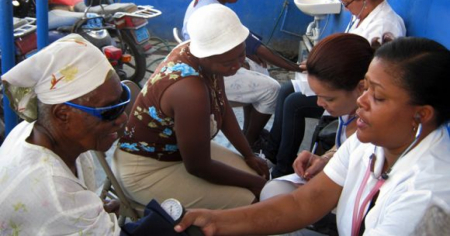
The Cuban doctor Daycee Zamora, a graduate of the University of Medical Sciences of Havana in 2015 and a specialist in Comprehensive General Medicine, publicly denounced the abuses committed by the Cuban regime during her participation in the program Mais Médicos in Brazil, which she described as a system of exploitation disguised as cooperation.
In a video shared on social media, Zamora stated: “My name is Daycee Zamora, I graduated as a doctor from the University of Medical Sciences of Havana in 2015, specializing in Comprehensive General Medicine. In 2017, I went to work in Brazil as part of the well-known Mais Médicos program. I want to clarify and denounce that this program is neither supportive nor altruistic because the truth is that doctors like us who go to work on these missions do so because it is impossible to live as a doctor in Cuba.”
He openly criticized the role of the Communist Party in the organization and control of these brigades: “The Communist Party of Cuba does nothing with these missions but exploit the doctors who go there, abuse us, coerce us, enslave us, rob us, because they take more than 80% of our salary, rob us, exploit us, and put on a mask of solidarity, of altruistic help, of aid to others, which does not truly exist.” He added that what he experienced was “a lot of abuse, a great deal of pretentious indoctrination, chaos of all kinds, coercion, psychological torture; it’s very horrible and highly abusive what is done on these missions, from taking your passport to paying you 20% of what Cuba actually charges for those missions, to blackmailing you.”
Zamora reported that the regime punishes doctors with forced exile if they choose not to return to the island after completing their mission: “As they did to me in my case, with the fact that if the mission ends and you choose to stay in the country where you are working, you cannot enter your island, your country, for 8 years, and we are forced into exile.” He categorically rejected the official narrative that presents these missions as humanitarian: “It’s a lie; there is no such altruism, no such solidarity, and what exists is a lot of interference, a lot of Cuban politics involved in every country to which it 'sells' its altruism, and much abuse by the authorities of the Communist Party of Cuba.”
The video featuring the doctor's statements has been shared across various platforms. On Facebook, the page La Nueva Cuba shared the content, highlighting that Zamora summarizes her experience "as a former slave in the medical mission in Brazil."
On Twitter, user @doclibreuy wrote that "every 'solidarity and selfless aid' offered from #Cuba is armed robbery, abuse, exploitation, and slavery of doctors," adding that the Cuban dictatorship has been "profiting off doctors for decades."
Also on Facebook, the organization Cubanos Libres en Uruguay shared the video stating that Zamora is an activist and a member of the group, and that his testimony highlights "the violations of the Cuban regime and the trafficking of slave doctors."
The experience reported by Daycee Zamora is set against a backdrop of ongoing complaints from international organizations, governments, and other Cuban professionals regarding the operations of the regime's medical missions.
In recent days, the United States government reported that the Cuban regime earns more than $4.9 billion annually from these missions, while subjecting its workers to conditions of labor exploitation. The Department of State and the European Parliament have described these practices as forms of forced labor and modern slavery.
A recent report from the Archivo Cuba project revealed that in countries like Bahamas, the regime retains between 83.9% and 91.6% of the salary paid for each collaborator, leaving the Cuban professional with only between 990 and 1,200 dollars monthly. The contracts include restrictions such as a ban on accepting other jobs or discussing the content of the agreement, and require participation in political events.
The Minister of Public Health of Cuba, José Ángel Portal Miranda, admitted in mid-April that the brigades had retained the passports of doctors for years as a "preventive measure," which he confirmed in an official broadcast.
In the case of Brazil, following the exit of the Mais Médicos program in 2018, numerous Cuban professionals decided to remain in the country, where they have faced difficulties in validating their qualifications and returning to practice as doctors. Doctor Juan Delgado, who participated in the program in 2013, has unsuccessfully attempted to validate his diploma despite his 30 years of experience, and during long periods has been forced to survive with occasional jobs such as selling natural products.
Dr. Mariela Ambruster, who worked in northeastern Brazil from 2013 to 2016, has also been unable to validate her degree after numerous attempts. She currently makes a living caring for the elderly and has lost the original of her diploma, which worsens her legal and professional situation.
Frequently Asked Questions about Cuban Medical Missions
What did Dr. Daycee Zamora report about Cuban medical missions?
Dr. Daycee Zamora reported that Cuban medical missions are a system of exploitation disguised as solidarity cooperation. According to her testimony, Cuban doctors face abuse, indoctrination, and coercion, in addition to having to give more than 80% of their salary to the Cuban regime.
What is the economic impact of medical missions for the Cuban regime?
The Cuban regime receives over 4.9 billion dollars annually through medical missions. This income comes from the payments that recipient countries make for the services of Cuban doctors, of which the regime retains between 75% and 90%, according to various reports and allegations.
How does the retention of their passports in international missions affect Cuban doctors?
The retention of passports prevents Cuban doctors from moving freely and subjects them to control by the authorities of the missions. This practice has been used to prevent doctors from leaving the missions and has been described as coercive by international organizations. Although the Cuban regime acknowledged this practice, it claimed that it is in the process of being eliminated.
What measures have international organizations taken in response to the reports concerning Cuban medical missions?
The European Parliament and the United States government have denounced Cuban medical missions as forms of modern slavery and forced labor. These entities have urged the international community to take action to ensure the labor rights of Cuban doctors and to sanction the countries that benefit from these exploitative conditions.
Filed under: