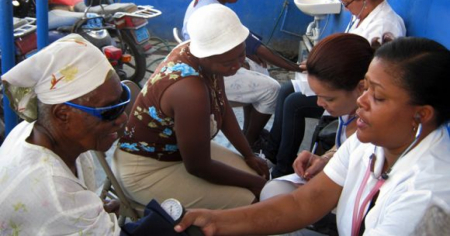
The Minister of Public Health of Cuba, José Ángel Portal Miranda, acknowledged that for years the passports of Cuban doctors on missions abroad were held by the brigade leadership, as a measure to prevent them from “going missing”.
The statements were made during his appearance on the program Desde la Presidencia, hosted by the ruling Miguel Díaz-Canel and broadcast on YouTube, where the minister aimed to refute international allegations concerning the coercive nature of the so-called “medical missions.”
“It is true that at one time, the passports of the collaborators were in the hands of the brigade leaders. This was necessary because it was very widespread, and many young collaborators were leaving and we were losing them. This is an issue we have been addressing over time,” affirmed Portal.
At the same time, he stated that they have already resolved that situation in the few countries where it persisted.
According to the head of the department, the collaborators now have their documentation and move freely in the countries where they are located: "It is easy to truly know that the collaborators have their documentation in the countries," he emphasized.
Portal denied that healthcare workers are being forced to participate in missions or that they face reprisals if they do not accept.
“No one can provide an example of someone who can say that because they were not willing to go out to complete a mission, they faced retaliation,” he insisted.
It was defended that participation in the missions is voluntary, involving a selection process, preparation, and contract signing that specifies the conditions for the country of destination.
"Our collaborators, when selected, come to the central cooperation unit, are informed of the country they will be going to, are explained the characteristics of that country, and are given a contract," he explained.
He assured that if the host country fails to comply with the agreed conditions, the collaborator will be replaced or sent back: “We do have a responsibility for the collaborators who go out,” he stated.
Portal also justified the economic component of the missions, stating that the stipends that doctors receive abroad enable them to meet material needs that they cannot fulfill in Cuba.
“Although they solve a number of problems that, in material terms, salaries may not be able to address in Cuba, they also help families,” he said, while admitting that the salaries received by doctors on the island barely meet the needs for a week.
As a final argument, Portal Miranda attempted to dismiss the criticisms by referring to the numbers: “It cannot be that our collaborators, who have left 605,000 times, could be deceived. There are 165 nations and more than 600,000 people,” he stated.
He added that some have fulfilled their mission between eight and ten times, although he forgot to mention the slave-like regime they belong to, a fact that has been reported by international organizations.
At another point in the program, the minister justified the movement restrictions imposed on doctors in certain contexts, referring to the case of the Cuban doctors kidnapped in Kenya.
"We don’t want to go through what happened in Kenya. It was very unfortunate… for not having all the elements in place. We feel responsible when they are in those places and something happens," she stated, acknowledging the strict surveillance to which the collaborators are subjected.
The so-called "medical missions" have been heavily criticized by international organizations and governments, which view them as a form of forced labor.
Several testimonies have reported the retention of passports, restrictions on movement, and the threat of reprisals for those who abandon missions or refuse to participate.
A doctor consulted by CiberCuba reported that just a few years ago, during the global Covid pandemic, he was on a mission in Venezuela.
"They didn't take my passport away. However, it had a stamp that stated it was valid only for travel between Cuba and Venezuela," he emphasized.
Recently, the United States Secretary of State, Marco Rubio, described international medical missions organized by the Cuban regime as "an atrocious practice" for operating under conditions of labor exploitation.
However, he announced that he will evaluate case by case in the Caribbean, where several countries rely on these services, and acknowledged that there are places where Cuban specialists have "better labor standards."
Days ago, Cuban-American Congressman Carlos A. Giménez, representative of Florida's 28th district, sent a letter to Rubio, in which he supports visa restrictions on foreign leaders linked to the exploitation of health specialists from the island and calls for severe economic sanctions against countries that collaborate with the Havana regime through so-called medical missions.
Frequently Asked Questions about Cuban Medical Missions and Passport Retention
Why was the Cuban government withholding the passports of doctors on missions abroad?
The Minister of Public Health of Cuba, José Ángel Portal Miranda, admitted that the passports of Cuban doctors were being held to prevent them from being lost. However, this argument has been criticized by international organizations that point out that such practices limit the freedom of movement of professionals and are part of a coercive system in the so-called "medical missions."
What impact do medical missions have on the economy of Cuba?
International medical missions represent one of the main sources of income for the Cuban regime. They are estimated to generate around 11 billion dollars annually. This income comes from the salaries that doctors should receive, but which are largely withheld by the Cuban state. The exploitation of these professionals has been denounced as a form of "modern slavery."
What are the working conditions for Cuban doctors abroad?
Cuban doctors on international missions often work under exploitative conditions. In many cases, their passports are withheld, they are paid only a fraction of their salary, and they are under strict surveillance. Furthermore, they face movement restrictions and severe reprisals if they attempt to leave the mission. These practices have been described by international observers as human trafficking.
How has the Cuban regime responded to criticisms regarding medical missions?
The Cuban regime defends medical missions as an act of international solidarity and denies that they are coercive. It claims that doctors participate voluntarily and that working conditions are adequate. However, this narrative has been challenged by reports of labor exploitation and the withholding of salaries and personal documents from the professionals.
Filed under: