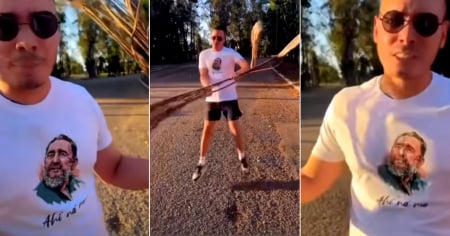
Sandro Castro, grandson of the late dictator Fidel Castro, reappeared on May 1st at the Plaza de la Revolución to encourage the official march for International Workers' Day, in a new demonstration of his desire to combine his privileged life with a self-proclaimed "revolutionary morality."
Accompanied by a group of workers, Sandro made himself heard with extravagant phrases during the march: “Radio Vampiro is broadcasting! Long live May Day! Here’s the vampirach with the Cristach!”, he shouted, referring to his usual nicknames.
On social media, Fidel's grandson maintains an image of a rebellious, party-loving, and eccentric youth. This May Day, he went out to rally the masses during the regime's parade. His presence in the iconic square did not go unnoticed.
This week, Sandro remembered his grandfather on social media. He appeared before his followers saying nonsensical things and wearing a T-shirt featuring the face of Fidel Castro along with the phrase "Right there, nothing more."
The vampire of the Havana nights sought a very personal way to reaffirm his ideological commitment to the revolution, despite the criticism he faces for flaunting luxuries unimaginable for the majority of Cubans.
From his "ranch" in Siboney, he has become a figure that, rather than inspiring, reflects the disconnection of the elite from the reality of the country.
His presence at the May Day event reinforces the narrative of a hereditary "continuity" within Cuban power, where even the most frivolous heirs are called to embody the revolutionary facade before public opinion, while enjoying the benefits of a privileged caste shielded from the crisis.
Frequently asked questions about Sandro Castro and his impact on Cuban public opinion
Who is Sandro Castro and why does he generate so much controversy in Cuba?
Sandro Castro is the grandson of the late Cuban dictator Fidel Castro, known for his ostentatious and provocative lifestyle on social media. His behavior generates controversy as he displays luxury and privileges in a context where most Cubans face severe economic and social hardships. His posts are perceived as a mockery of the struggles the Cuban people endure.
How has the Cuban public reacted to Sandro Castro's actions?
The reaction from the Cuban public has been one of outrage and criticism towards Sandro Castro. Many Cubans see his actions as a demonstration of the disconnection and privileges of the ruling elite, which contrasts with the daily hardships faced by the majority of the population in Cuba. On social media, his posts are subjects of mockery and criticism due to his lack of empathy and sensitivity.
What does the figure of Sandro Castro symbolize for the Cuban youth?
The figure of Sandro Castro symbolizes for many young Cubans the perpetuation of a privileged elite that is disconnected from the realities of the country. His lifestyle and provocations on social media are seen as a reflection of the social and economic inequalities that persist in Cuba, generating feelings of powerlessness and frustration among young people who seek a better future.
What is the impact of Sandro Castro's actions on the perception of the Cuban regime?
Sandro Castro's actions reinforce the perception of a Cuban regime that protects a privileged elite while ignoring the needs of the people. His behavior is seen as an extension of the government's policies of inequality and lack of transparency, which contributes to the growing social discontent and public criticism of the country's management.
Filed under: