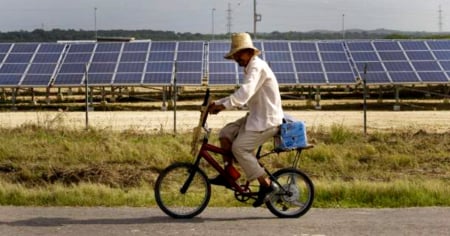
The Juan Pérez II photovoltaic solar park, located in the coastal municipality of Niquero, is the second in the province of Granma that contributes clean energy to the National Electric System (SEN).
The installation "successfully passed the technical and commissioning tests" and currently generates 21.8 megawatts (MW), reported the official newspaper La Demajagua when announcing its inauguration on April 30.
More than 600 workers participated in the final stages of construction, which was celebrated by the leadership of the Communist Party as an example of "collective commitment" and national technical capability.
Nevertheless, the new park only covers a part of the province's energy needs. Currently, Granma generates 15% of its electrical demand during peak hours (120 MW) through solar parks such as Yarey I and II, Jiguaní Desarrollo, Siboney, Payares, and Mártires de Artemisa.
In March, the La Sabana solar photovoltaic park was inaugurated in Bayamo, which also connected to the National Electric System (SEN).
"With the operation of Juan Pérez II and La Sabana, it is expected to cover 30% of the maximum demand (42 MW out of 120 MW)," explained Ariel Ovidio Álvarez Suárez, director of Renewable Sources at the Electric Company of Granma.
This means that the remaining 70% still relies on fossil sources for thermal power generation, in a country plagued by frequent and prolonged blackouts, diesel shortages, and increasing energy vulnerability.
At the inauguration ceremony, the authorities presented awards to more than a dozen companies and individuals, and for the sixth consecutive year, they recognized the Granma Electric Company as a "National Vanguard Collective," despite the ongoing issues with the electrical system.
The authorities also highlighted international cooperation - particularly from China, "through donations" - as a key element in the country's photovoltaic expansion, making it clear that the growth of the sector still relies on external support rather than sustainable internal capabilities.
Granma plans to increase its installed solar capacity to over 115 MW, with new projects underway such as the Camilo Cienfuegos parks in Río Cauto; Las Tapias in Manzanillo (21.8 MW) and Yara (5 MW), as well as a microgrid in the community of El Uno de Santa Rosa in Río Cauto. However, no figures regarding investment, maintenance costs, or specific timelines for the disconnection from diesel were provided.
The Cuban government is betting on the expansion of renewable energy use, which represents less than 5% of the national energy matrix.
In fact, authorities claim that the country will soon be among the top three in the world in making rapid progress towards the transition to clean energy, amid the deep energy crisis currently facing the nation.
In this regard, the investment budget for 2025 reflects a partial change in spending priorities, with a significant increase in renewable energy and debt repayment.
During the past few months, there has been news about the inauguration of several photovoltaic parks. The leader Miguel Díaz-Canel with the installation of these systems, which will generate more than 500 MW of solar energy in the first half of this year.
Furthermore, it was pledged that by the end of 2025, 55 solar parks with a capacity of 1,200 MW will have been built.
However, this measure comes with a significant limitation: the lack of batteries to store the generated electricity, which means that solar energy can only be used in real time, during the day, without the ability to cover nighttime demand, when consumption is at its highest.
Cuban authorities have reiterated their commitment to by 2030.
Frequently Asked Questions about the Energy Crisis and Solar Parks in Cuba
What is the generation capacity of the new Juan Pérez II solar park in Granma?
The Juan Pérez II solar park has a generation capacity of 21.8 megawatts (MW). This park is part of efforts to improve the supply of clean energy in the province of Granma, although its impact is limited due to the reliance on diesel to meet 70% of the provincial energy demand.
How much of Granma's energy demand is met by solar energy?
Currently, about 30% of Granma's energy demand during peak hours is covered by solar energy, according to authorities. However, the remaining 70% still relies on fossil sources, reflecting the significant dependence on diesel in the region and the challenges of achieving a cleaner energy matrix.
What role does China play in the expansion of solar energy in Cuba?
China is a key partner in the expansion of solar energy in Cuba, providing significant donations of equipment for the installation of solar parks. This cooperation is crucial as the growth of the solar sector in Cuba still largely depends on external support due to the lack of sustainable internal capabilities.
What are the limitations of solar energy use in Cuba currently?
One of the main limitations is the lack of batteries to store the electricity generated, which means that solar energy can only be used in real time, during the day. This restriction prevents meeting nighttime demand, which is when the highest energy consumption occurs in the country.
What is the Cuban government's objective regarding solar energy by 2030?
The Cuban government has set out to achieve 2,000 MW of photovoltaic generation by 2030. This goal is part of a broader plan to diversify the country's energy matrix and reduce dependence on fossil fuels, although it faces significant challenges due to the current limitations of the electrical system.
Filed under: